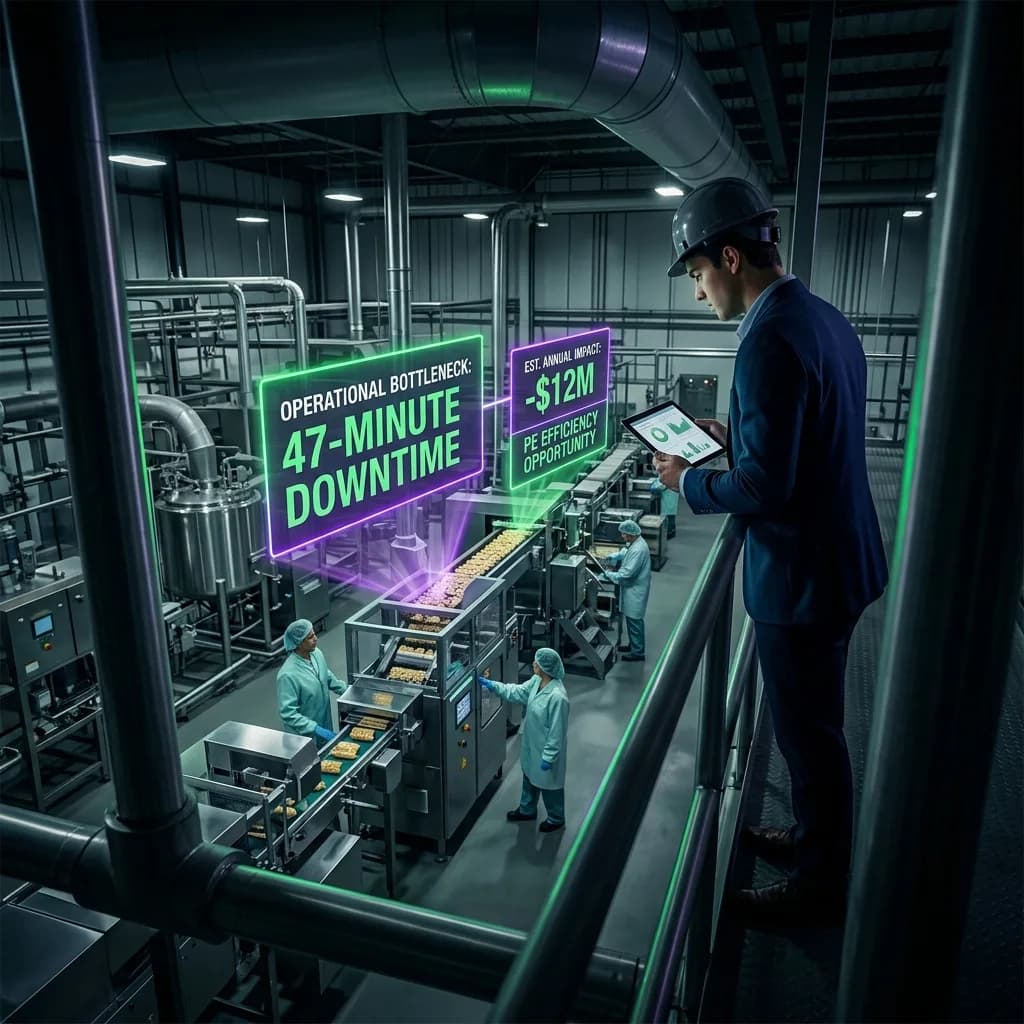

The deal team walked through the 340,000 square foot beverage facility in Ohio, impressed by the gleaming stainless steel tanks and automated packaging lines humming at 1,200 bottles per minute. The seller's presentation showed 18% EBITDA margins and projected 12% annual volume growth. Six months post-close, the new PE owners discovered the reality: a $2.8 million deferred maintenance backlog, energy costs 23% above industry benchmarks, and a quality system that failed FDA inspection, triggering a 45-day production shutdown that cost $6.7 million in lost revenue.
This scenario plays out repeatedly because most analysts focus on the impressive machinery rather than the operational fundamentals that drive sustainable cash flow. A 90-minute plant tour can reveal red flags that save millions in post-acquisition surprises, but only if you know what to look for and which questions expose the real operational health of the business.
The Cost of Missing Critical Details
Poor due diligence on manufacturing operations typically costs PE firms 8-15% of deal value through post-close surprises. A recent analysis of 127 food and beverage acquisitions showed that deals with inadequate operational diligence experienced average EBITDA shortfalls of $2.3 million in year one, with 34% requiring unplanned capital investments exceeding $5 million within 18 months of closing.
The most expensive oversights cluster around four areas:
- Equipment condition and maintenance backlogs — average cost: $3.1 million
- Regulatory compliance gaps — average cost: $2.8 million
- Energy inefficiencies — average annual impact: $1.4 million
- Quality system weaknesses — average cost per incident: $4.2 million
These issues are entirely preventable with proper plant tour preparation and execution.
Pre-Tour Preparation: Setting the Foundation
Before stepping foot in the facility, request specific operational data that will guide your tour focus. Ask for the past 24 months of production reports, maintenance logs, energy bills, and quality metrics. This baseline data reveals patterns that you can validate during the physical tour.
Key pre-tour data requests include monthly production volumes by SKU, overall equipment effectiveness (OEE) by production line, energy consumption per unit produced, and maintenance spending as a percentage of replacement asset value. Industry benchmarks for food and beverage operations show OEE targets of 75-85%, energy costs representing 3-7% of revenue, and maintenance spending of 2-4% of asset replacement value annually.
Schedule your tour during peak production hours, typically Tuesday through Thursday between 10 AM and 2 PM for most food facilities. Avoid Mondays (startup issues) and Fridays (wind-down mode). Request access to the maintenance shop, quality lab, and warehouse areas in addition to production floors. Most sellers limit tours to the cleanest, newest production areas, but the real operational story lives in the support areas.
Equipment Assessment: Beyond the Shiny Surfaces
Modern food processing equipment represents 60-70% of total facility value, making equipment condition assessment critical for accurate valuations. Focus on three key indicators: maintenance practices, upgrade cycles, and capacity utilization patterns.
Start in the maintenance shop. Well-managed facilities maintain detailed equipment histories, predictive maintenance programs, and spare parts inventories worth 2-3% of equipment value. Red flags include handwritten maintenance logs, reactive-only maintenance approaches, and spare parts shortages. Ask to see the computerized maintenance management system (CMMS) and request reports on mean time between failures (MTBF) for critical equipment.
Examine equipment nameplates for manufacturing dates and model numbers. Food processing equipment typically requires major overhauls every 8-12 years and replacement every 15-20 years. Calculate the weighted average age of production equipment and compare to industry replacement cycles. Equipment approaching end-of-life requires capital planning that impacts post-acquisition cash flows.
Critical Equipment Questions
| Equipment Category | Key Questions | Red Flag Indicators |
|---|---|---|
| Processing Equipment | When was the last major overhaul? What's the planned replacement schedule? | No overhaul records, equipment over 15 years old |
| Packaging Lines | What's the current OEE? How often do you change over between products? | OEE below 70%, changeover times exceeding 2 hours |
| Utilities Systems | When were boilers/chillers last serviced? What's your energy cost per unit? | Deferred maintenance, energy costs above industry benchmarks |
Quality Systems: The Foundation of Food Safety
Food safety failures can destroy enterprise value overnight. The 2018 romaine lettuce E. coli outbreak cost the industry over $350 million in lost sales, while individual companies faced recall costs averaging $10 million per incident. Quality system assessment requires examining both documentation and actual practices.
Request to see the Hazard Analysis Critical Control Points (HACCP) plan and recent third-party audit reports. Well-managed facilities undergo annual SQF, BRC, or similar certification audits with scores above 90%. Ask about the last FDA inspection and any resulting observations or warning letters. FDA warning letters trigger customer audits that can result in lost business worth millions in annual revenue.
Walk the production floor with quality personnel and observe actual practices. Look for employees following documented procedures, proper personal protective equipment usage, and functioning monitoring equipment. Temperature monitoring systems should show continuous data logging with automatic alerts for deviations. Manual temperature logs often indicate broken automated systems.
Examine the quality lab capabilities and testing protocols. Modern food facilities test incoming ingredients, in-process samples, and finished products according to documented schedules. Ask about testing frequency, hold-and-release procedures, and pathogen testing protocols. Facilities without adequate testing capabilities face regulatory risks and customer compliance issues.
Energy Systems: The Hidden Profit Drain
Energy represents the second-largest operating expense for most food manufacturers, typically 15-25% of total manufacturing costs. Energy inefficiencies compound over time, making this assessment critical for accurate cash flow projections.
Request utility bills for the past 24 months and calculate energy cost per pound of production. Compare these figures to industry benchmarks, which vary by product category but generally range from $0.02 to $0.08 per pound for processed foods. Facilities exceeding these benchmarks indicate opportunities for operational improvements or risks of higher-than-modeled operating costs.
Examine major energy-consuming equipment including boilers, chillers, compressors, and motors. Ask about energy management systems, demand response programs, and recent efficiency upgrades. Well-managed facilities monitor energy consumption in real-time and have implemented variable frequency drives on major motors, high-efficiency lighting, and optimized HVAC systems.
Energy Efficiency Assessment Framework
| System | Efficiency Indicators | Improvement Potential |
|---|---|---|
| Compressed Air | Pressure settings, leak detection program | 15-30% reduction possible |
| Refrigeration | Temperature differentials, defrost cycles | 10-20% reduction possible |
| Steam Systems | Condensate return rates, insulation condition | 5-15% reduction possible |
| Lighting | LED conversion percentage, occupancy controls | 40-60% reduction possible |
Workforce and Labor Relations
Labor costs represent 20-35% of total manufacturing expenses in food processing, making workforce assessment crucial for operational due diligence. High turnover rates, union relations, and skill gaps can significantly impact post-acquisition performance.
Request turnover data by department for the past 24 months. Industry benchmarks show annual turnover rates of 15-25% for skilled positions and 30-50% for entry-level production roles. Facilities exceeding these benchmarks face higher training costs, quality issues, and productivity losses. Calculate the fully-loaded cost of turnover, including recruitment, training, and productivity ramp-up periods.
Examine the workforce age demographics and succession planning for key positions. Many food manufacturing facilities face skilled worker shortages, particularly for maintenance technicians and quality personnel. Ask about apprenticeship programs, cross-training initiatives, and knowledge transfer procedures for retiring employees.
If the facility is unionized, review the collective bargaining agreement terms, expiration dates, and recent negotiation history. Union contracts impact labor flexibility, wage escalation, and benefit costs. Request details on grievance procedures, work rules, and any pending labor disputes.
Regulatory Compliance: Avoiding the Landmines
Food manufacturing operates under extensive federal, state, and local regulations. Compliance failures can trigger production shutdowns, product recalls, and criminal liability for executives. The FDA Food Safety Modernization Act increased inspection frequency and penalty severity, making compliance assessment more critical than ever.
Review the facility's FDA registration status, process filing requirements, and inspection history. Food facilities must register with FDA and update registrations every two years. Ask about Nutritional Labeling and Education Act compliance, particularly for facilities making health claims or marketing to specific dietary segments.
Examine environmental permits and compliance records. Food processing generates significant wastewater, air emissions, and solid waste requiring permits and monitoring. Request copies of National Pollutant Discharge Elimination System permits, air quality permits, and waste disposal contracts. Environmental violations can trigger costly remediation requirements and operational restrictions.
Ask about product liability insurance coverage and claims history. Food manufacturers face increasing litigation risks from allergen cross-contamination, foodborne illness outbreaks, and labeling errors. Adequate insurance coverage typically ranges from $10-50 million depending on product categories and distribution channels.
Capacity Utilization and Growth Constraints
Understanding true production capacity and growth constraints is essential for validating seller projections and investment thesis assumptions. Many sellers present theoretical capacity based on equipment specifications rather than sustainable production rates considering changeovers, maintenance, and quality requirements.
Calculate effective capacity utilization by examining actual production volumes against sustainable operating rates. Food processing equipment typically operates at 70-85% of theoretical capacity when accounting for changeovers, cleaning, and maintenance requirements. Facilities claiming utilization rates above 90% likely face bottlenecks that will constrain growth without additional capital investment.
Identify the constraining operation or "bottleneck" that limits overall facility throughput. This could be mixing capacity, packaging speed, or warehouse space. Understanding bottleneck constraints helps prioritize capital investments and validates growth projections. Relieving bottlenecks typically requires capital investments of $500,000 to $5 million depending on the constraint type.
Examine warehouse and cold storage capacity relative to production volumes. Many food facilities face storage constraints that limit production scheduling flexibility and increase logistics costs. Calculate inventory turns and storage costs per unit to identify optimization opportunities.
Supply Chain and Logistics Integration
Food manufacturing success depends heavily on supply chain efficiency and logistics optimization. Transportation costs represent 8-12% of total product costs for most food manufacturers, making logistics assessment crucial for operational due diligence.
Examine supplier concentration and geographic distribution. High supplier concentration creates supply disruption risks, while geographically dispersed suppliers increase transportation costs and complexity. Ask about supplier qualification procedures, backup supplier arrangements, and inventory management practices.
Review inbound and outbound logistics arrangements. Many food manufacturers use third-party logistics providers for warehousing and distribution. Examine contract terms, service level agreements, and cost structures. Ask about transportation optimization software, load planning procedures, and delivery performance metrics.
Calculate logistics costs as a percentage of revenue and compare to industry benchmarks. Well-optimized food manufacturing operations achieve logistics costs of 6-10% of revenue. Higher costs indicate opportunities for improvement or risks of above-market operating expenses.
Translating Observations into Investment Impact
The plant tour findings directly impact investment returns through three primary mechanisms: EBITDA accuracy, capital requirement adjustments, and risk premium modifications. Each operational issue identified during the tour translates into specific financial adjustments that affect deal valuation and return projections.
Maintenance backlogs and equipment condition issues typically require immediate capital investments of 1-5% of enterprise value within the first 12 months post-acquisition. Energy inefficiencies represent ongoing EBITDA drags of 50-200 basis points annually until addressed through capital improvements. Quality system deficiencies create both immediate compliance costs and ongoing customer retention risks that can impact revenue projections by 5-15%.
Regulatory compliance gaps often require the most immediate attention, with FDA warning letters triggering customer audits that can result in lost business worth 10-30% of annual revenue. Environmental compliance issues can delay closing or require escrow arrangements for potential remediation costs ranging from $500,000 to $10 million.
The cumulative impact of operational issues discovered during plant tours averages 12-18% of initial EBITDA projections in year one, with well-executed tours identifying 80-90% of these issues before closing. This operational intelligence enables more accurate underwriting, appropriate deal structuring, and focused post-acquisition value creation planning that ultimately drives superior investment returns.
A thorough plant tour checklist transforms a facility walkthrough from a superficial marketing exercise into a critical due diligence tool that protects investment capital and identifies value creation opportunities worth millions in enhanced returns.