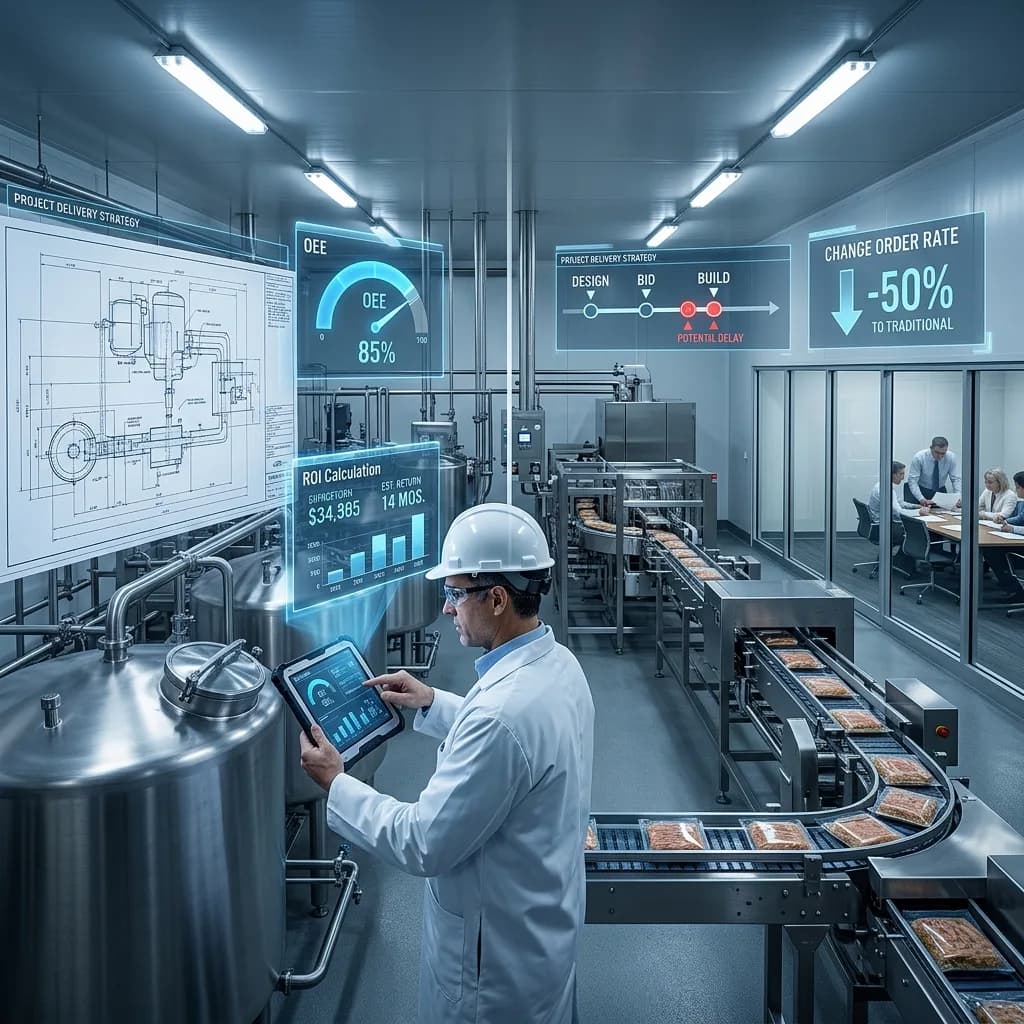
When executing food manufacturing capital projects, how you organize design and construction directly impacts schedule, budget, and quality outcomes.
Traditional approach (Design-Bid-Build): Separate entities. Designer creates plans. General contractor bids and builds. Owner manages both.
Design-Build approach: Single entity designs AND builds. One accountability. One contract.
For food manufacturing, the choice significantly impacts execution success.
Design-Bid-Build: When It Works
Best for: Simple projects with well-understood scope (replacing equipment, minor facility upgrades).
Advantages:
- Competitive bidding lowers initial contractor cost
- Designer works independently without contractor bias
- Owner has clear separation between planning and execution oversight
Disadvantages:
- Designer doesn't know actual construction costs during design
- Contractor starts during design, discovers conflicts late
- Change orders accumulate (site conditions, scope ambiguities)
- Finger-pointing: "Designer didn't account for that" / "Contractor didn't bid carefully"
For a $500K project, traditional delivery commonly experiences 10-20% cost overruns and 10-15% schedule delays.
Design-Build: Why It Works Better for Food Facilities
Best for: Complex projects requiring site-specific solutions (CIP upgrades, facility expansions, utility infrastructure).
Advantages:
- Single point of accountability (designer + builder are same entity)
- Site conditions discovered during design, not mid-construction
- Constructability reviews happen during design, not after bid
- Fewer change orders (both disciplines aligned from start)
- Single contract, single schedule, single budget responsibility
Disadvantages:
- Higher initial cost (designer works during design-build phase)
- Less competitive pressure on pricing
- Less design/construction separation for owner oversight
For a $500K project, design-build typically achieves budget accuracy within 5-10% and schedule predictability within 10%.
Food Manufacturing Complexity Favors Design-Build
Food facilities have unique constraints:
- Sanitation requirements (materials, spacing, drainage)
- Utility demands (electrical capacity, water volume, steam, compressed air)
- Regulatory compliance (FDA, USDA, environmental discharge)
- Production continuity (upgrades happen while facility operates)
These constraints aren't apparent until detailed site assessment. Design-bid-build discovers them late. Design-build addresses them during design.
The Hybrid Approach: Design-Build with Owner's Representation
Many food manufacturers use hybrid delivery:
- Fixed-price design-build contract for construction
- Retained owner's representative on-site
- Owner involvement in design reviews and equipment selections
- Single-entity accountability without losing owner oversight
This approach balances accountability (design-build) with control (owner oversight).
The Financial Impact
Design-bid-build with 15% overrun on $500K = $75K additional cost Design-build with 7% overrun on $500K = $35K additional cost Owner's representative = $25K cost
Net difference: Design-build with representation saves $15K (3%) while improving schedule predictability and quality outcomes.
For food manufacturing companies executing complex capital projects, design-build or design-build-with-owner's-rep delivery provides superior schedule and budget predictability compared to traditional design-bid-build approaches.