A premium juice manufacturer uses thermal pasteurization (72C for 15 seconds). Result: Heat damages fresh flavor, color browns, vitamin C loss 30%. Product inferior to fresh-pressed. Premium positioning challenged.
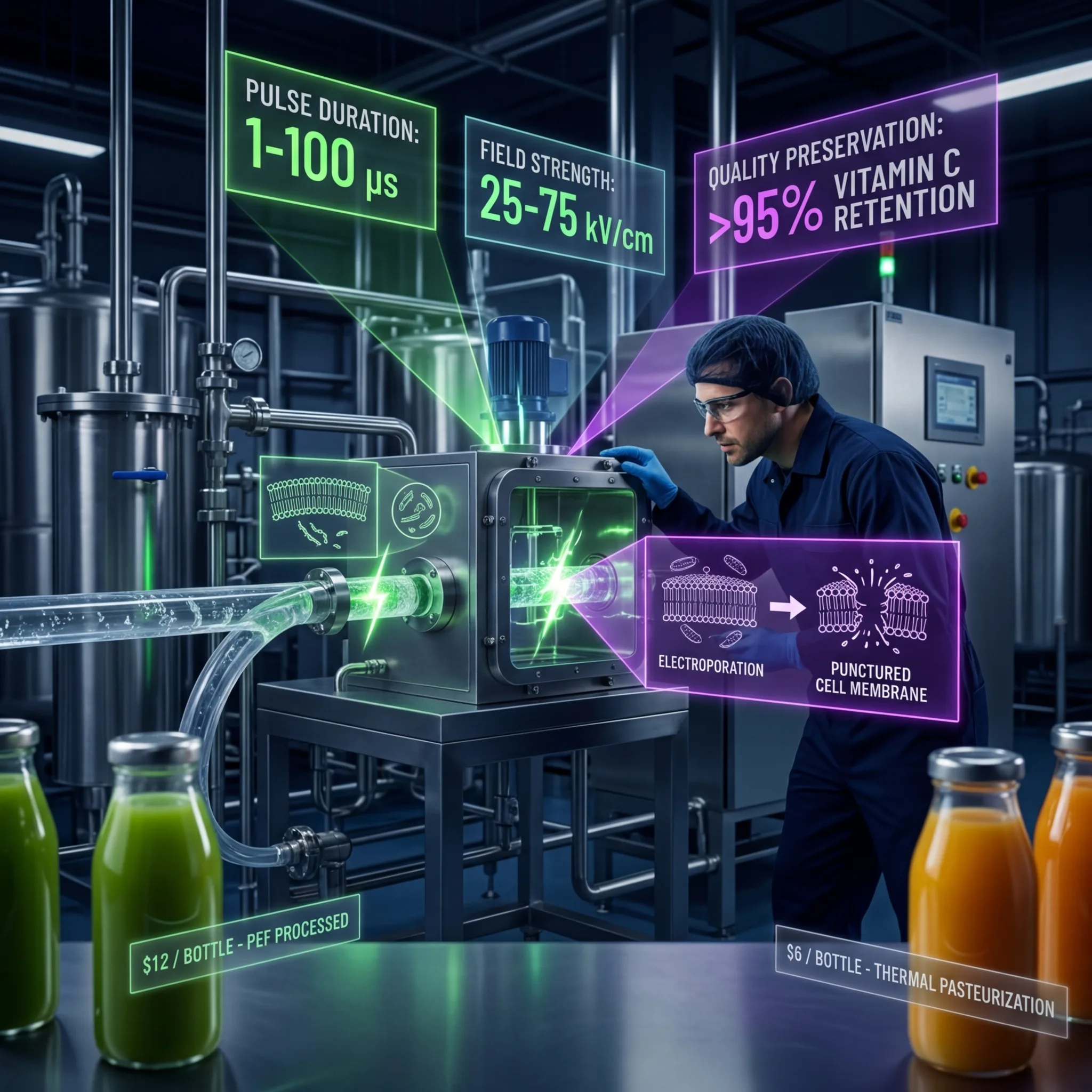
An innovative facility uses PEF processing (short high-voltage pulses, no heating). Microbes inactivated without heating. Fresh taste preserved. Color excellent (bright, fresh). Nutrient retention over 95%. Ultra-premium market positioning achieved at $12/bottle vs. $6 thermal.
PEF technology enables microbial reduction without heat damage.
The PEF Framework
Principle:
High-voltage electric field (25-75 kV/cm) applied in short pulses
- Duration: 1-100 microseconds per pulse
- Creates temporary cell membrane permeabilization in microbes (electroporation)
- Cell membranes punctured, leading to cell death
- Plant cells largely unaffected (larger, more resistant)
Non-thermal Processing:
No heating required for microbial inactivation
- Product temperature: Rises under 5C (minimal)
- Result: Fresh-like quality maintained
Microbial Inactivation
Mechanism: Electroporation
Electric field creates pores in microbial cell membranes
- Pore formation leads to leakage of cell contents
- Cell death (cannot repair fast enough)
- Larger cells (plant, fruit) more resistant (survive)
Effectiveness:
Can achieve 5-6 log reduction (99.999-99.9999% kill)
- Similar to thermal pasteurization (65-72C)
- Without heat damage
Pathogen Reduction:
- E. coli: 5-log reduction typical
- Salmonella: 4-5 log reduction
- Listeria: 4-6 log reduction
- Yeasts/molds: 3-5 log reduction
Equipment Design
Treatment Chamber:
Design: Electrodes apply voltage across narrow gap
- Gap width: 3-5 mm typical
- Electric field strength: 25-75 kV/cm
- Flow rate: 1-10 L/minute (continuous)
Pulse Parameters:
- Pulse width: 1-100 microseconds
- Pulse frequency: 1-10 Hz
- Total pulses: 10-50 pulses per treatment
- Residence time: under 1 second in treatment zone
Power Requirements:
High voltage pulse generator
- Voltage: 20-80 kV
- Current: 10-100 A (peak, pulsed)
- Energy: 10-50 kJ per liter product
Process Flow
- Pre-treatment: Product clarified (remove particles)
- PEF chamber: Continuous flow through electrode gap
- Pulse application: 10-50 pulses in under 1 second
- Exit: Product immediately packaged (no residual treatment)
Temperature Control:
Minimal heating (typically under 5C rise)
- Cooling may be applied between pulses
- Maintains fresh-like quality
Quality Advantages
Compared to Thermal Pasteurization:
| Factor | Thermal (72C) | PEF |
|---|---|---|
| Flavor | Cooked notes | Fresh |
| Color | Browning | Bright, fresh |
| Vitamin C | 70% retained | 95-98% retained |
| Aroma | Some loss | Fully preserved |
| Texture | Slight change | Unchanged |
| Shelf-life | 21-30 days | 21-45 days |
Consumer Appeal:
"Minimally processed" label
- Clean label (no additives)
- Fresh-like quality
- Premium positioning
Product Requirements
Suitable Products:
- Liquid products (juices, smoothies, liquid eggs)
- Low viscosity (under 500 cP)
- Low pulp content (under 10%)
- Acidic products (pH under 4.5) preferred
Not Suitable:
- Thick/viscous products (non-uniform field)
- High-pulp products (particles interfere)
- Neutral pH products (higher microbial resistance)
Advantages and Limitations
Advantages:
- No heat (fresh quality preserved)
- Rapid processing (under 1 second treatment)
- Microbial reduction equivalent to pasteurization
- Consumer appeal (clean label, minimally processed)
- Premium market positioning
Limitations:
- Capital cost very high ($500K-2M+)
- Regulatory status still developing (not FDA approved for all products)
- Product restrictions (liquid, low viscosity)
- Maintenance complex (high voltage systems)
Regulatory Status
FDA Approval:
Currently approved:
- Some juices (apple, orange) under specific conditions
- Liquid eggs
Under review:
- Additional juice types
- Milk products
- Smoothies
Labeling:
No special labeling required (non-thermal, no additives)
- Can claim "fresh-pressed" or "minimally processed"
Commercial Status
Current Deployment:
Limited commercial facilities (5-10 globally)
- Premium juice manufacturers
- Specialty beverage companies
- Research/development facilities
Market Outlook:
Growing interest (consumer demand for fresh, minimally processed)
- Cost decreasing (technology matures)
- Regulatory approval expanding
- Equipment reliability improving
Cost-Benefit Analysis
| Item | Cost/Benefit |
|---|---|
| Capital equipment | $500K-2M |
| Operating cost | $0.10-0.30 per liter |
| Premium pricing | +50-100% vs. thermal |
| Market differentiation | Ultra-premium positioning |
| Payback | 5-10 years (premium market) |
For premium beverage manufacturers, PEF technology enables ultra-premium positioning through fresh-like quality with food safety.