A soup manufacturer uses municipal tap water without treatment. Result: High bacterial counts, mineral deposits on equipment, inconsistent product quality. Customers complain about off-flavors.
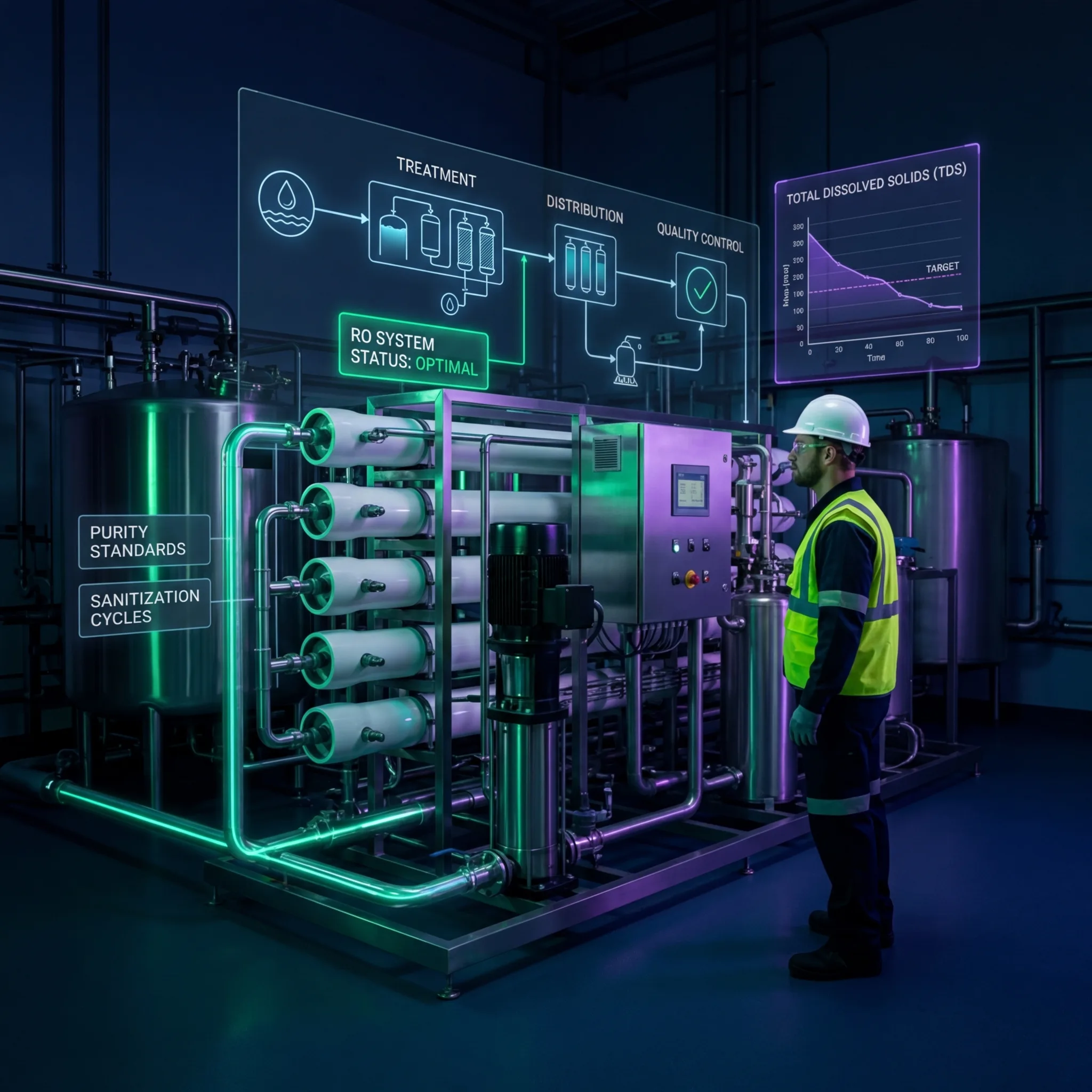
A compliant manufacturer installs water treatment system (softening, filtration, reverse osmosis). Produces high-purity water. Equipment remains clean. Product quality consistent. Customer satisfaction increases.
Water quality directly impacts food safety, product consistency, and equipment longevity.
The Water System Framework
Water Uses in Food Manufacturing:
- Product contact (direct): Beverage formulation, ice, steam
- Product contact (indirect): Equipment cleaning, sanitation
- Utility water: Cooling, steam generation, dust control
- Non-product: Cleaning floors, watering landscaping
Different uses require different purity levels.
Water Quality Standards
FDA Requirements (Bottled Water):
| Parameter | Limit | Measurement Method |
|---|---|---|
| Bacteria | under 1 CFU/mL (E. coli absent) | Culture plating |
| Turbidity | under 0.5 NTU | Nephelometer |
| Total Dissolved Solids | under 500 mg/L | Conductivity |
| Chlorine | under 4 mg/L (residual) | DPD method |
| pH | 6.5-8.5 | pH meter |
| Hardness (Ca+Mg) | under 100 mg/L (soft) | Titration |
Process Water Standards:
More stringent than potable water:
- Bacteria: under 0.1 CFU/mL (often under 0.01 CFU/mL)
- Endotoxins: under 0.25 EU/mL (key for injectable products)
- Conductivity: under 5 uS/cm (high purity)
- Total Organic Carbon (TOC): under 500 ppb
Water Treatment Stages
Stage 1: Pre-treatment (Sediment, Chlorine)
Purpose: Remove suspended solids, chlorine Methods:
- Sediment filter: 20 um (removes sand, silt)
- Carbon filter: Removes chlorine, odor
- Softening: Removes hardness (Ca2+, Mg2+) using ion exchange
Stage 2: Reverse Osmosis (RO)
Purpose: Removes dissolved minerals (90-99% removal) Principle: Membrane separates pure water from concentrated minerals Rejection rates:
- Salts: 95-99%
- Bacteria: 99.9%
- Organic matter: 99%
Output: Highly purified water By-product: Reject water (disposal or recycling)
Stage 3: Polishing (Optional)
Purpose: Further purification if needed Methods:
- Deionization (DI): Removes remaining ions
- Ultrafiltration: Removes particles over 1 nm
- UV sterilization: Kills remaining bacteria
- Ozonation: Alternative to chlorination for storage
Distribution System Design
Storage Tank Specifications:
- Material: 316L stainless steel
- Design: Closed top (prevent contamination)
- Insulation: Maintain temperature (no growth)
- Outlets: Hot water (over 60 degrees C inhibits bacteria growth)
- Circulation: Pump system to maintain temperature
Hot Water Distribution:
- Temperature: Maintain over 60 degrees C in storage, over 50 degrees C at all outlets
- Re-circulation loop: Continuous circulation prevents stagnation
- Thermal tracing: Heated pipes maintain temperature over distance
Microbial Control:
| Temperature | Effect | Retention Time |
|---|---|---|
| Over 65 degrees C | Kills most pathogens | Continuous |
| 50-60 degrees C | Slows bacterial growth | Continuous |
| 37 degrees C | Room temperature (growth) | Must treat/circulate |
| Under 4 degrees C | Slows growth | Acceptable for short term |
Water Quality Monitoring
Critical Testing Parameters:
- Microbial: Monthly culture testing, rapid ATP testing
- Chemical: Conductivity, pH, hardness
- Physical: Turbidity, color, taste/odor
- Sanitation: Chlorine or ozone residual (if used)
Monitoring Frequency:
- Daily: Temperature, visual inspection
- Weekly: ATP testing (rapid indicator)
- Monthly: Full microbiological testing
- Quarterly: Endotoxin (if critical)
- Annually: Comprehensive validation study
Equipment Impact
Hard Water (High Ca2+, Mg2+):
- Scale formation on heat exchangers
- Reduced heat transfer efficiency
- Shortened equipment lifespan
- Solution: Water softening
Soft Water (Low minerals):
- Prevents scale
- Reduces maintenance
- Lower equipment replacement costs
- Longer service life
Cost-Benefit Analysis
| System Type | Capital | Operating/Year | Purity | Payback |
|---|---|---|---|---|
| Tap water | Low | Low | Poor | -- |
| Softening only | Moderate | Moderate | Fair | 3-5 years |
| RO system | Higher | Moderate | Good | 3-4 years |
| Full treatment | High | Moderate | Excellent | 3-5 years |
For food manufacturing companies, proper water system design ensures food safety, product consistency, and equipment longevity.