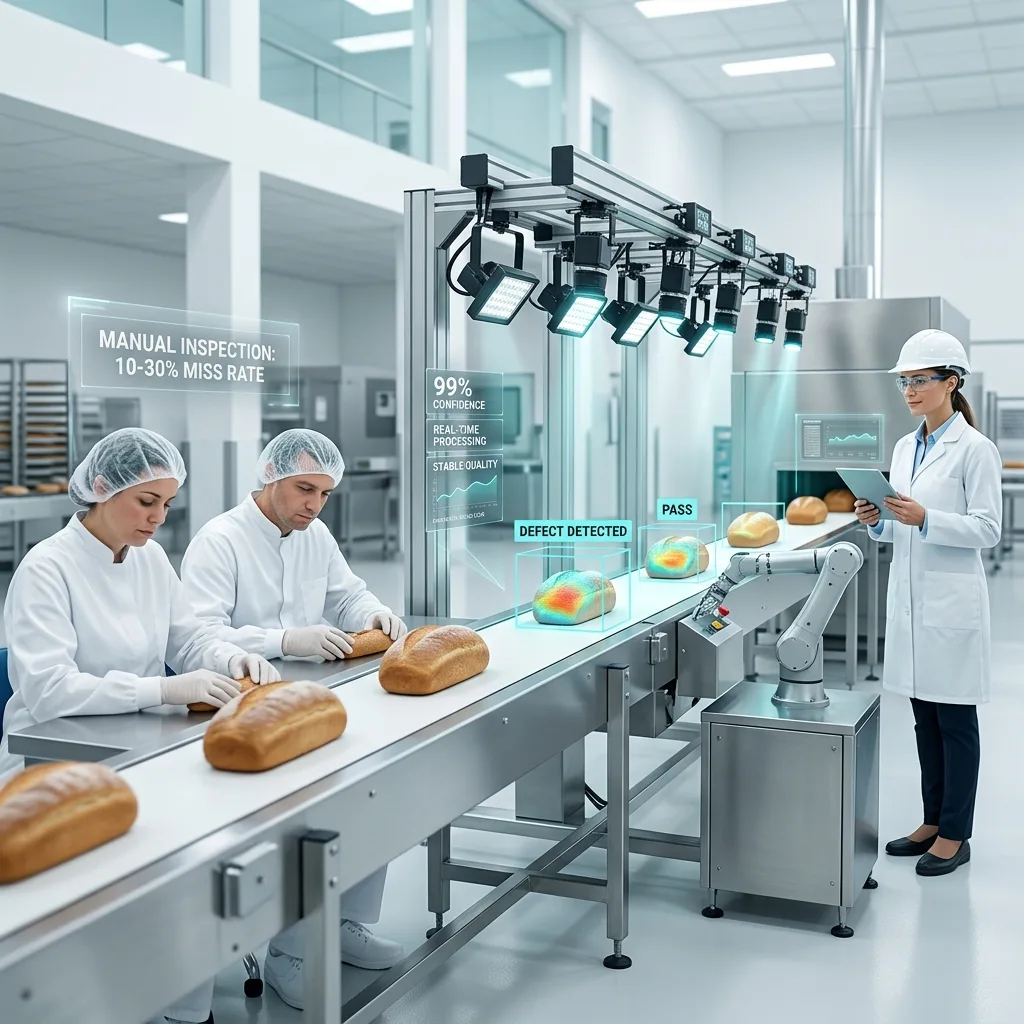
A bakery employs 5 quality inspectors (manual visual inspection). Result: 10-30% defect miss rate, inconsistent standards, $200K/year labor cost, productivity bottleneck.
An automated facility installs AI vision system: High-speed cameras, LED lighting, deep learning algorithms. Result: 95-99% defect detection accuracy, real-time (100-1,000 units/minute throughput), consistent standards, labor reduced to 1 supervisor, productivity +400%.
Vision systems directly impact quality consistency and labor efficiency.
The Vision System Framework
Traditional Inspection Gap:
Manual visual inspection limitations:
- Subjectivity: Variable standards between inspectors
- Miss rate: 10-30% defects not detected
- Speed: 10-50 units/minute typical
- Cost: $30-50/hour x 8 hours = $240-400/day per inspector
- Fatigue: Accuracy degrades throughout shift
AI Vision Solution:
Automated inspection capabilities:
- Objectivity: Consistent, trained algorithm
- Accuracy: 95-99% defect detection
- Speed: 100-1,000 units/minute (100x faster)
- Cost: $0.01-0.05/unit (vs. $1-5 manual)
- Consistency: No fatigue, 24/7 capable
Vision System Components
Component 1: Imaging System
Cameras (high-speed, high-resolution):
- Speed: 200-1,000 frames/second (fast products)
- Resolution: 2-20 megapixels (capture defects)
- Technology: Line-scan or area-scan cameras
- Cost: $10-50K per camera
Component 2: Lighting System
LED arrays (specific wavelengths):
- Purpose: Illuminate defects (shadows, color, texture)
- Technology: Multi-wavelength LEDs (red, green, blue, UV)
- Consistency: Standardized lighting (essential for accuracy)
- Cost: $5-20K system
Component 3: Processing Hardware
Computers (AI algorithm execution):
- Purpose: Real-time image analysis
- Technology: GPU processors (fast inference)
- Speed: 50-500 images/second processing
- Cost: $5-10K
Component 4: Software (AI Model)
Deep learning neural networks:
- Training: Labeled defect images (1,000s of examples)
- Technology: Convolutional neural networks (CNN)
- Accuracy: Improves with more training data
- Cost: $20-100K development (or licensing pre-trained)
Defect Detection Capabilities
Detection Types and Accuracy:
| Defect Type | Detection | Accuracy | Speed |
|---|---|---|---|
| Foreign objects | Yes | 98-99% | Real-time |
| Color/darkness | Yes | 98%+ | Real-time |
| Size/shape | Yes | 95-98% | Real-time |
| Surface damage | Yes | 90-95% | Real-time |
| Missing components | Yes | 99%+ | Real-time |
| Contamination | Yes | 92-97% | Real-time |
Applications by Industry:
| Industry | Defect Detection |
|---|---|
| Bakery | Underbaked, burnt, missing toppings |
| Meat/Poultry | Feathers, contamination, discoloration |
| Produce | Bruising, mold, size inconsistency |
| Confectionery | Cracked, misshapen, color variation |
| Frozen Foods | Ice crystals, contamination, portion size |
System Integration
Workflow:
- Product moves on conveyor - Camera captures image
- AI algorithm analyzes image (milliseconds)
- Decision: Accept/reject made
- Actuation: Pneumatic reject (defective product removed)
- Logging: Defect data recorded (traceability)
Throughput Comparison:
| Metric | Manual | Vision System |
|---|---|---|
| Speed | 10-50 units/min | 100-1,000 units/min |
| Accuracy | 70-90% | 95-99% |
| Labor | 5 people | 1 supervisor |
| Cost/unit | $1-5 | $0.01-0.05 |
| Consistency | Variable | High |
Cost-Benefit Analysis
| Factor | Cost/Impact |
|---|---|
| Vision system equipment | $50-500K |
| Software development | $20-100K |
| Installation/integration | $10-50K |
| Training | $5-10K |
| Total capital | $85-660K |
| Labor savings | $100-200K/year |
| Defect reduction | 50-70% improvement |
| Throughput increase | 5-10x improvement |
| ROI | 1-3 years typical |
For manufacturers, AI vision systems dramatically improve quality and efficiency.