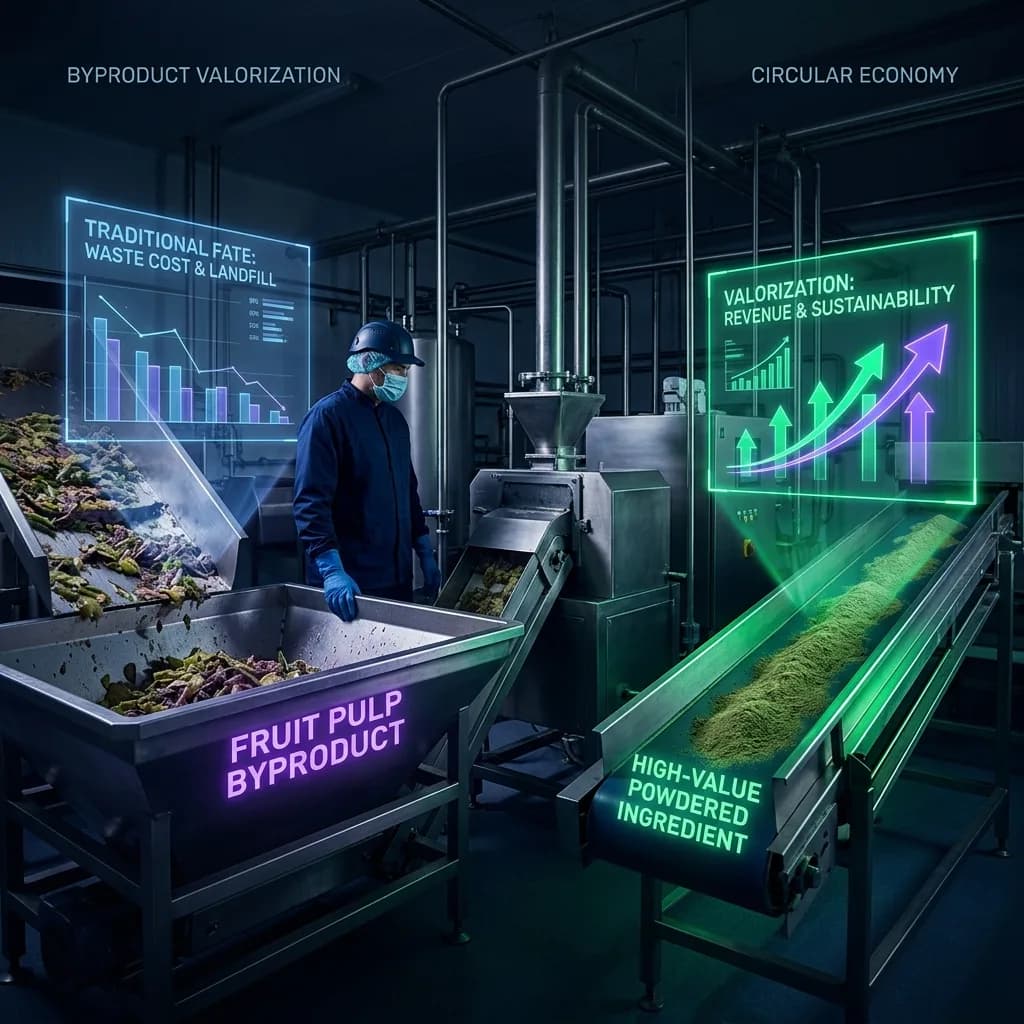
A juice manufacturer discards 40% of fruit as pulp waste (solids after juice extraction). Result: $500K annual disposal costs, environmental burden, lost revenue opportunity.
An innovative company converts pulp to high-value fiber ingredient: Dry pulp, mill to powder, sell as natural fiber additive ($2-4/lb). Result: $500K waste cost eliminated, +$800K new revenue stream. Sustainability credentials premium. Circular economy achieved.
Byproduct valorization directly impacts sustainability and creates new revenue streams.
The Upcycling Framework
What is Upcycling?
Converting food byproducts (waste) into valuable ingredients:
- Traditional: Byproduct = waste, leading to disposal cost
- Upcycling: Byproduct = resource, leading to revenue opportunity
- Value capture: Extract nutrition, functionality from "waste"
- Circular economy: Nothing wasted, everything valuable
Common Food Byproducts:
| Source | Byproduct | Volume | Traditional Fate |
|---|---|---|---|
| Juice production | Fruit pulp | 30-50% of fruit | Landfill, compost |
| Brewing | Spent grain | 85% of grain input | Animal feed (low value) |
| Dairy | Whey (from cheese) | 90% of milk volume | Whey protein or disposal |
| Oil pressing | Oilseed meal | 50-70% of seed | Animal feed |
| Coffee | Spent grounds | 99% of bean weight | Compost, disposal |
Valorization Processes
Process 1: Fiber Extraction (Fruit/Vegetable Pulp)
Example: Orange Juice Pulp
Traditional disposal:
- Pulp: 40-50% of orange weight
- Disposal: $50-100/ton tipping fee
- Annual cost: $500K for large processor
Upcycling Process:
- Separate: Collect pulp from juice extraction
- Wash: Remove residual sugars (improves stability)
- Dry: Spray dryer or drum dryer (reduce moisture to 5-8%)
- Mill: Grind to powder (200 mesh typical)
- Package: Food-grade bags, sell as ingredient
Output Product:
- Citrus fiber powder (90% fiber content)
- Applications: Bakery, beverages (thickening), functional foods
- Market price: $2-4/lb (premium vs. $0 waste)
Economics:
- Processing cost: $0.50-1.00/lb
- Sale price: $2-4/lb
- Margin: $1.50-3.00/lb
- Annual revenue (from 200 tons pulp): $800K-1.2M
Process 2: Protein Recovery (Brewer's Spent Grain)
Example: Craft Brewery Spent Grain
Traditional use:
- Spent grain: 85% of barley input (very wet, 70-80% moisture)
- Use: Animal feed ($20-50/ton, low value)
- Challenge: High moisture = spoilage risk, transport expensive
Upcycling Process:
- Dewater: Press to 50% moisture (reduce weight)
- Dry: Drum dryer to 8-10% moisture (shelf-stable)
- Mill: Grind to flour consistency
- Sift: Separate fine flour from coarse fiber
- Package: Flour for human consumption
Output Product:
- Spent grain flour (15-20% protein, high fiber)
- Applications: Baking (bread, crackers), snack bars
- Market positioning: "Upcycled," sustainable
- Market price: $1-2/lb (10-20x animal feed value)
Economics:
- Processing cost: $0.30-0.60/lb
- Sale price: $1-2/lb
- Volume: 500-1,000 lbs/week (small brewery)
- Annual revenue: $25-100K (small operation)
Process 3: Oil Extraction (Oilseed Meal)
Example: Soybean Meal (Post-Oil Extraction)
Traditional use:
- Soybean meal: 80% of soybean weight after oil extracted
- Use: Animal feed ($300-400/ton)
- Protein content: 44-48%
Upcycling Process:
- Further refine: Extract remaining oil via hexane or mechanical
- Protein concentrate: Isolate protein fraction (70-90% protein)
- Dry: Spray dry to powder
- Grade: Food-grade vs. feed-grade separation
Output Product:
- Soy protein concentrate/isolate (70-90% protein)
- Applications: Plant-based meat, protein powder, functional foods
- Market price: $2-5/lb (10-15x meal value)
Market Examples
Success Story 1: ReGrained (Spent Grain Bars)
- Source: Brewery spent grain (otherwise animal feed)
- Product: Snack bars with spent grain flour
- Positioning: "Upcycled," sustainable snacking
- Market: Natural grocery stores, sustainability-focused
- Premium: 20-30% price premium vs. conventional bars
Success Story 2: Renewal Mill (Okara Flour)
- Source: Soy pulp from tofu/soymilk production (okara)
- Traditional: 50-80% disposal (landfill)
- Product: Okara flour (gluten-free, high-protein, high-fiber)
- Applications: Baking mixes, protein powders
- Market price: $3-5/lb
Success Story 3: Planetarians (Sunflower Protein)
- Source: Sunflower seed meal (post-oil extraction)
- Traditional: Animal feed ($200-300/ton)
- Product: High-protein ingredient (50-70% protein)
- Market: Plant-based meat alternatives
- Market price: $4-6/lb (15-20x feed value)
Certification and Marketing
Upcycled Certified Program:
Third-party certification:
- Verifies: Ingredient sourced from byproduct/waste stream
- Standards: Food safety, traceability, sustainability
- Benefit: Consumer trust, premium positioning
- Cost: $1-5K certification fee
Marketing Advantages:
- Sustainability storytelling: "Rescued" ingredient narrative
- Consumer appeal: Millennials/Gen Z value sustainability
- Premium pricing: 10-30% justified by sustainability
- B2B appeal: Food brands seeking sustainable sourcing
Cost-Benefit Analysis
| Factor | Impact |
|---|---|
| Processing equipment | $50-300K (dryer, mill) |
| Processing cost | $0.30-1.00/lb |
| Market price | $1-5/lb (5-20x waste value) |
| Disposal cost eliminated | $50-100/ton saved |
| New revenue | $500K-2M annual (scale-dependent) |
| Sustainability benefit | Waste reduced 30-50% |
| ROI | 1-3 years typical |
For food manufacturers, upcycling byproducts creates revenue and sustainability credentials.