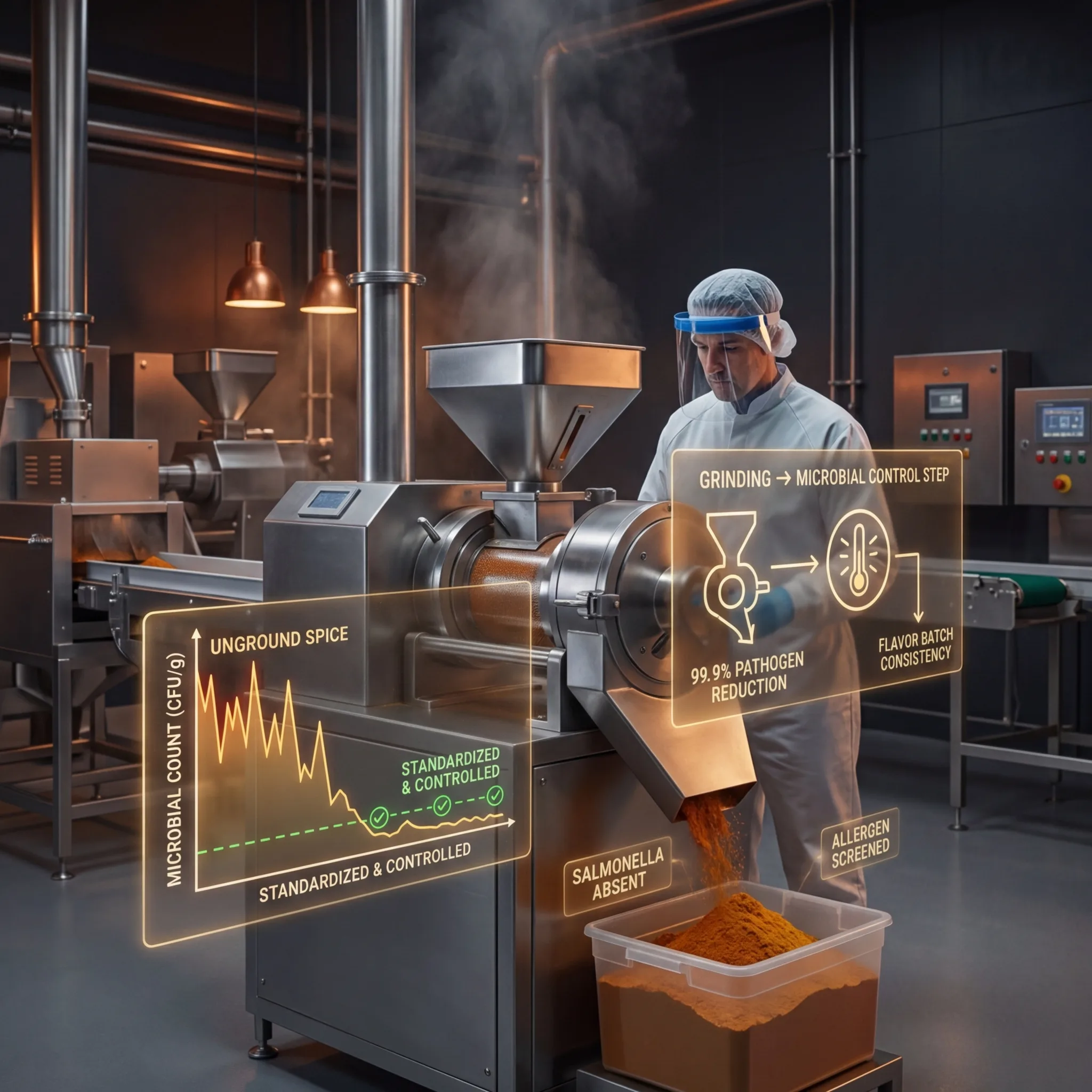
A spice processor grinds whole spices fresh daily. Result: Microbial counts 50,000-100,000 CFU/g (dried spices inherently high). Salmonella detected in 2% of samples. Customer rejects occur. Food safety concerns.
A compliant processor grinds spices, then applies irradiation (10 kGy). Result: Microbial load reduced to under 10 CFU/g (99.9999% reduction). Salmonella eliminated. Customer acceptance guaranteed. Food safety validated. Premium market positioning achieved.
Spice processing with microbial control directly impacts food safety and market access.
The Spice Microbial Challenge
High Microbial Load (Inherent):
Dried spices: 10,000-100,000 CFU/g typical
- Root cause: Dried in field, ground with soil contact
- Agricultural soil: Contains 10^6-10^8 CFU/g
- Drying process: Does not eliminate pathogens (only reduces water)
- Storage: Can increase microbial load (if moisture absorbed)
Pathogen Risk:
- Salmonella: Common in dried spices (0.1-2% contamination rate)
- E. coli: Possible (soil-origin indicator)
- Listeria: Rare but documented
- Clostridium: Spore-forming (hard to eliminate)
Regulatory Reality:
FDA permits higher microbial loads in spices than other foods
- Reason: Spices used in small quantities (risk diluted)
- Limit: under 100 CFU/g for Salmonella acceptable (unusual)
- But: Reputable customers demand under 10 CFU/g minimum
Microbial Control Methods
Method 1: Irradiation (MOST EFFECTIVE)
Technology: Gamma radiation (Cobalt-60) or E-beam
- Dose: 10 kGy typical (FDA approved for spices)
- Effectiveness: 6-log reduction (99.9999% kill)
- Result: under 10 CFU/g typical (from 50,000-100,000 CFU/g)
- Cost: $0.10-0.30 per lb product
- FDA Status: Approved since 1986 (GRAS)
- Labeling: "Irradiated" must appear
- Consumer acceptance: Increasing (99.9999% safe)
Advantages:
- Extremely effective (near-sterilization)
- No residue (no chemical additives)
- No heat damage (preserves flavor/aroma)
- International acceptance (approved globally)
Disadvantages:
- Requires access to irradiation facility (limited availability)
- Cost: Higher than alternatives
- Public perception: Some consumer concern (education needed)
Method 2: Ethylene Oxide (ETO) Gas
Technology: Gas fumigation
- Concentration: 600-1,200 mg/L typical
- Exposure time: 12-24 hours
- Effectiveness: 4-5 log reduction (good, not excellent)
- Cost: $0.05-0.15 per lb
- Trend: Being phased out (EPA restrictions tightening)
Limitations:
- Some chemical residue possible
- Regulatory scrutiny increasing
- Alternative methods preferred
Method 3: Heat Treatment (Mild)
Technology: Controlled heating
- Temperature: 60-75 degrees C (mild, preserves flavor)
- Time: 30-60 minutes
- Effectiveness: 2-3 log reduction (fair)
- Cost: $0.02-0.05 per lb (low)
- Risk: Some flavor/aroma loss possible
Application: Premium spices where flavor preservation critical
Grinding Process
Equipment Selection:
Burr Mill:
- Design: Rotating burrs crush spice
- Consistency: Uniform particle size
- Heat: Minimal (preserves aroma)
- Cost: $20-80K
- Application: Premium spices
Hammer Mill:
- Design: Rotating hammers pulverize
- Consistency: Good (adjustable screen)
- Heat: Moderate (higher than burr)
- Cost: $30-100K
- Application: General-purpose
Micronizer:
- Design: High-speed pins disintegrate
- Fineness: Ultra-fine (under 50 um)
- Heat: Significant (friction generates heat)
- Cost: $200-500K
- Application: Specialty powders only
Standardization
Flavor Standardization (Potency):
-
Measure pungency: Capsaicin content (chili), piperine (pepper)
- Method: HPLC analysis
- Allows blending to target
-
Color matching: Spectrophotometer measurement
- Ensures batch consistency
- Visible quality indicator
-
Blend multiple lots: Achieve consistent flavor
- Example: Multiple chili pepper lots blended
- Result: Consistent heat/flavor every shipment
-
Documentation: Potency certificate for customers
- "Capsaicin 100,000 SCU" (Scoville Heat Units)
- Proof of quality and consistency
Cost-Benefit
| Factor | Cost/Benefit |
|---|---|
| Grinding equipment | $50-200K |
| Irradiation access | $0.10-0.30/lb product |
| Testing/standardization | $5-20K lab equipment |
| Microbial reduction | 10,000 CFU/g to under 10 CFU/g |
| Customer acceptance | 99% (vs. 70% uncontrolled) |
| Premium pricing | +$0.50-1.00/lb possible |
| Payback | 1-2 years |
For spice processors, irradiation-based microbial control ensures food safety and premium market positioning.