
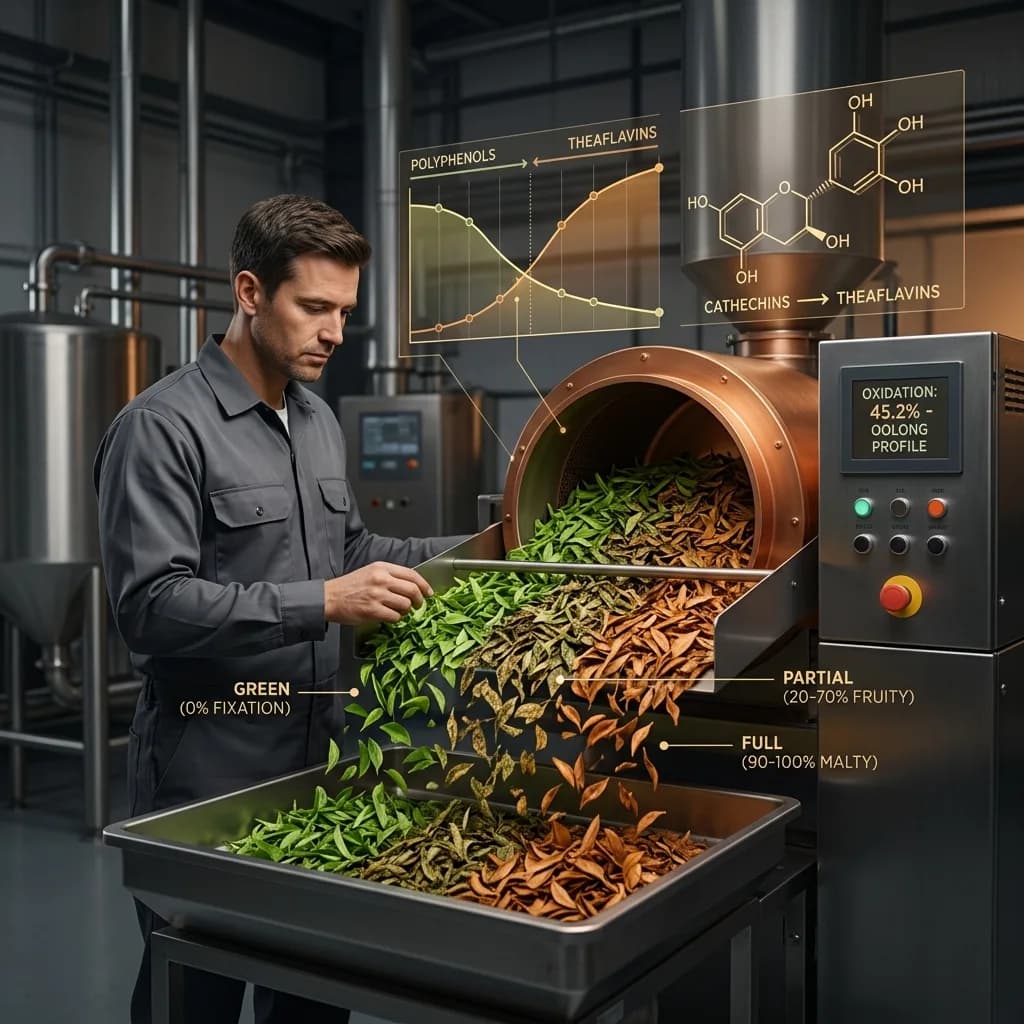
A tea processor produces green tea with bitter, astringent taste (over-oxidized, lost delicate flavor). Result: Consumer rejection, specialty market lost, commodity pricing only ($2-5/lb).
A specialty processor controls oxidation precisely: Steam fixation within 2 hours of harvest (100 degrees C x 30 seconds), inactivates polyphenol oxidase, preserves green color. Result: Fresh, delicate grassy flavor, premium specialty market achieved (+$20-40/lb, 5-10x premium).
Tea processing directly impacts flavor profile and premium market positioning.
The Tea Processing Framework
Tea Chemistry:
Polyphenols (key flavor compounds):
- Catechins: Astringent, beneficial antioxidants
- Theaflavins: Red color, malty flavor (black tea)
- Reaction: Polyphenols oxidize to brown pigments
Processing Type by Oxidation Level:
| Type | Oxidation % | Processing | Flavor |
|---|---|---|---|
| White | 5-10% | Minimal, air dry | Delicate, floral, sweet |
| Green | 0-5% | Steam/pan fixation | Fresh, grassy, vegetal |
| Oolong | 10-70% | Partial oxidation | Complex, fruity, fragrant |
| Black | 90-100% | Full oxidation | Bold, malty, robust |
| Pu-erh | Post-fermented | Microbial aging | Earthy, aged, smooth |
White Tea Processing (Minimal Oxidation)
Process:
- Harvest: Pick young leaf buds (spring, premium)
- Wither: Air dry 12-18 hours (remove moisture, prevent oxidation)
- Dry: Gentle heat 50-60 degrees C (stops fermentation completely)
- Result: Minimal oxidation (5-10%), fresh flavor preserved
Flavor Profile:
- Delicate, subtle sweetness
- Floral notes (jasmine, honeysuckle)
- Light body, clean finish
- Premium price: $30-100/lb
Green Tea Processing (0-5% Oxidation)
Critical Step: Fixation (Enzyme Inactivation)
Purpose: Prevent oxidation immediately after harvest
Method 1: Steam Fixation (Japanese Style)
- Temperature: 100 degrees C steam
- Duration: 30-60 seconds
- Timing: Within 2 hours of harvest (critical!)
- Effect: Inactivates polyphenol oxidase, preserves green
Method 2: Pan Fixation (Chinese Style)
- Temperature: 150-180 degrees C dry heat
- Duration: 3-5 minutes
- Equipment: Large wok or industrial pan
- Effect: Direct heat inactivates enzyme, adds toasted notes
Result: Fresh, grassy flavor, bright green color
Flavor Profile:
- Fresh, vegetal, grass-like
- Clean, crisp taste
- Slight natural sweetness
- Light astringency (pleasant)
- Premium price: $15-50/lb
Black Tea Processing (90-100% Oxidation)
Process:
- Withering: 12-18 hours (70-80% moisture loss)
- Rolling/Crushing: Bruise leaves (release enzymes)
- Oxidation: 1-3 hours in controlled humidity (95%+, 18-22 degrees C)
- Polyphenol oxidase active
- Catechins transform to theaflavins (red pigments, flavor)
- Firing: 85-95 degrees C for 10-15 minutes (stop oxidation, dry)
- Temperature precise: Too hot (burnt), too cool (incomplete)
Result: Dark brown-red leaves, bold malty flavor
Flavor Profile:
- Bold, malty, robust
- Red/brown color (theaflavins)
- Full-bodied, warming
- Slight natural sweetness
- Market price: $3-15/lb (commodity to premium)
Oolong Processing (10-70% Oxidation - "Blue Tea")
Defining Feature: Partial oxidation (controlled)
Process:
- Harvest: Pick mature leaves
- Wither: 1-2 hours (reduce moisture)
- Oxidation: Controlled duration
- Light oolong (10-30%): Grassy notes
- Medium oolong (30-50%): Fruity, floral
- Dark oolong (50-70%): Roasted, complex
- Rolling: Shape leaves (aesthetic)
- Firing: Stop oxidation at precise point
Result: Complex, multi-layered flavor profile
Flavor Profile:
- Complexity: Herbaceous + fruity + roasted
- High quality: $15-80/lb
- Craft market: Strong demand
Quality Control
Oxidation Monitoring:
- Visual: Color progression (green to yellow to brown)
- Chemical: Polyphenol content testing (HPLC)
- Sensory: Taste panel for flavor development
Storage (Post-Processing):
- Temperature: 20-25 degrees C (avoid heat)
- Humidity: 40-50% RH (prevent moisture/oxidation)
- Packaging: Opaque, airtight containers
- Shelf-life: 6-12 months (green tea shorter, black longer)
Cost-Benefit Analysis
| Factor | Cost/Impact |
|---|---|
| Fixation equipment | $10-50K (steam/pan) |
| Oxidation control | Climate chamber $20-100K |
| Quality control | Testing $10-20K/year |
| Green tea cost | $2-5/lb to $20-40/lb (premium) |
| Black tea cost | $2-5/lb to $10-15/lb (quality improvement) |
| Market premium | 5-20x possible with specialty grade |
| Consumer loyalty | +60% repeat purchase (quality) |
For tea processors, precise oxidation control enables specialty market and premium pricing.