A vegetable processor uses manual knife cutting. Result: Inconsistent sizes (5-25 mm cubes). Labor-intensive. Risk of worker injury. Variable product appearance.
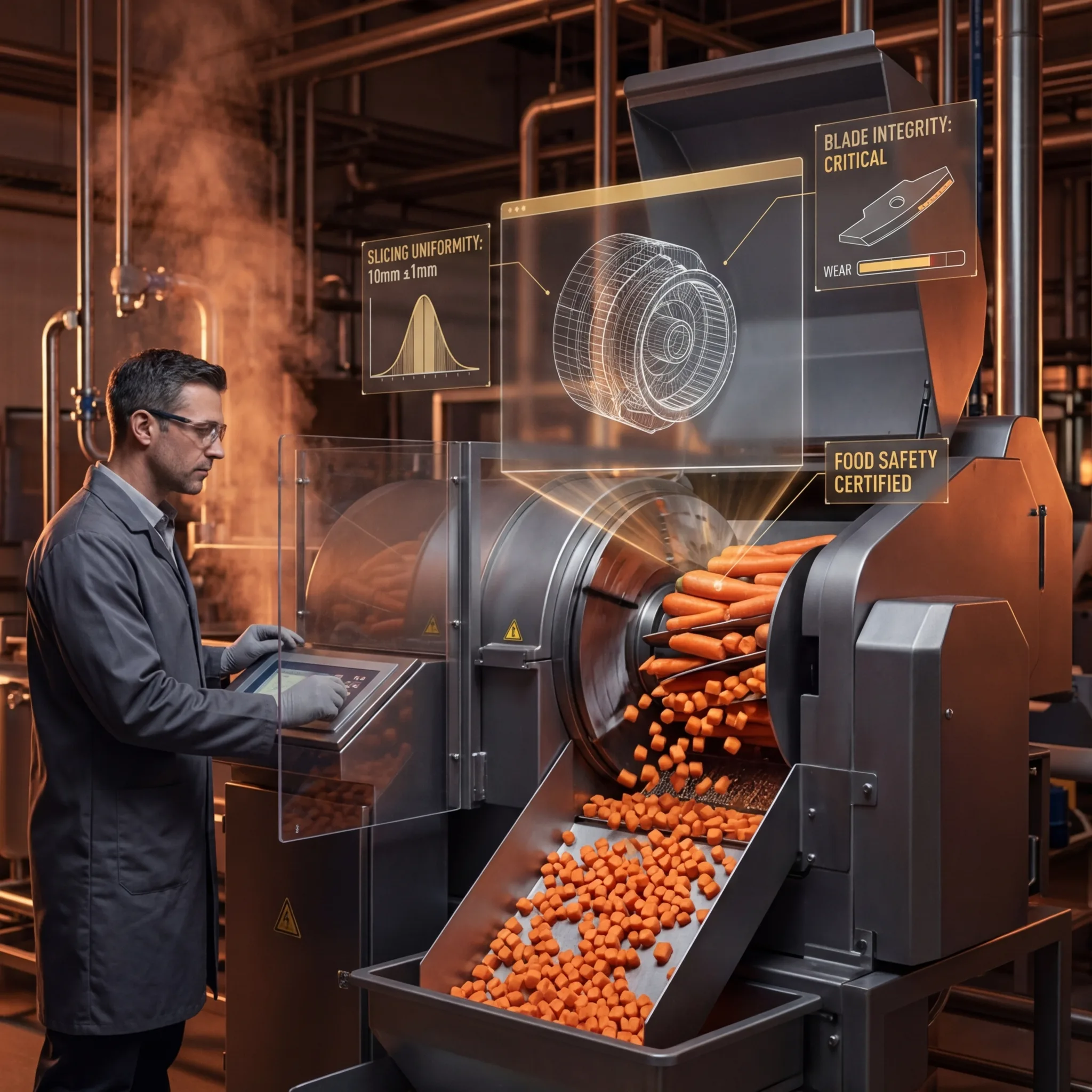
A compliant facility installs industrial dicer with 10 mm cutting program. Achieves 9-11 mm uniformity (95% specification compliance). Labor reduced 80%. Safety improved. Product appearance consistent. Customer satisfaction increases.
Slicing and dicing equipment selection directly impacts product consistency and operational safety.
The Cutting Framework
Cutting Requirements:
- Size specification: mm precision (10 +/- 1 mm typical)
- Uniformity: Tight distribution (CV under 5%)
- Throughput: kg/hour required
- Product quality: No bruising, clean cuts
- Safety: Minimize food handler contact
Cutting Equipment Types
Rotary Slicer:
Design: Rotating circular blade against feed material
- Application: Vegetables, fruits, cheese
- Thickness range: 0.5-10 mm adjustable
- Throughput: 200-1,000 kg/hour
- Cut quality: Thin, uniform slices
Key Parameters:
- Blade sharpness: Critical (dull blade = crushing, not cutting)
- Blade speed: 500-1,500 rpm typical
- Feed pressure: Consistent (maintains uniform thickness)
- Blade replacement: Every 200-500 hours operation
Dicer (Cubing Equipment):
Design: Multiple rotating blades create cubes
- Application: Vegetables (onion, carrot, celery), fruits
- Size range: 5-25 mm cubes (multiple blade configurations)
- Throughput: 500-2,000 kg/hour
- Product output: Uniform cubes suitable for soup, salad
Dicing Process:
- Feed material into hopper
- First blade array: Slices material
- Second blade array: Cross-cuts into strips
- Third blade array: Cubes the strips
- Output: Uniform cubes
Cut Size Specification:
10 mm cubes mean:
- 10 mm x 10 mm x 10 mm nominal
- Specification tolerance: 9-11 mm typically (+/-1 mm)
- Measurement: Caliper or imaging analysis
Shredder:
Design: Rotating drum with blade pattern
- Application: Cheese, vegetables
- Output: 2-5 mm shreds or julienne
- Throughput: 200-500 kg/hour
- Cut quality: Thin strips
Blade Maintenance
Sharpness Monitoring:
Blade dullness indicators:
- Product quality decline: Larger chunks, uneven cuts
- Motor current increase: Harder to cut (dull blade)
- Throughput decrease: Slower cutting
Blade Life:
Typical: 200-500 hours operation before replacement Factors affecting life:
- Material hardness (harder = faster wear)
- Cut frequency (more cuts = faster wear)
- Blade material (high-carbon steel vs. stainless vs. ceramic)
Blade Replacement Cost:
- Dicer blade set: $500-2,000
- Labor (30 min - 1 hour): $50-150
- Production downtime: Significant (plan carefully)
Preventive Maintenance:
- Daily: Clean blades, remove product residue
- Weekly: Sharpen (if system allows) or monitor sharpness
- Monthly: Full inspection, lubrication
- Quarterly or per schedule: Professional sharpening or replacement
Food Safety Considerations
Product Contamination Prevention:
- Blade contact: Only food contact (no bare hands)
- Cleaning: Disassemble for thorough cleaning
- CIP compatibility: Design for washdown if possible
- Sanitary standards: NSF/ANSI compliance
Safety Procedures:
- Lockout/tagout during cleaning
- Guards prevent hand entry
- Emergency stop (E-stop) readily accessible
- Training on proper loading/unloading
Cut Size Uniformity Measurement
Sampling Plan:
- Collect 100 pieces per shift
- Measure length, width, depth (3 dimensions)
- Calculate average and standard deviation
Acceptance Criteria:
Specification: 10 mm cubes +/- 1 mm
- Target: 10 mm average
- Tolerance: 9-11 mm range
- Accept if: 95%+ of pieces within 9-11 mm
- Adjust if: over 5% outside specification
Uniformity Example:
100 samples measured:
- 5 pieces: 8 mm (too small, reject)
- 90 pieces: 10 mm (nominal, accept)
- 5 pieces: 12 mm (too large, reject)
- Result: 90% within spec (failure - requires blade sharpening)
After blade sharpening:
- 0 pieces: 8 mm (too small)
- 98 pieces: 10 mm (nominal, accept)
- 2 pieces: 11 mm (borderline, acceptable)
- Result: 98% within spec (pass)
Equipment Selection Criteria
| Factor | Manual | Rotary Slicer | Dicer | Decision |
|---|---|---|---|---|
| Cost | Low | Moderate | High | Budget constraint |
| Speed | Low | High | Very High | Throughput need |
| Uniformity | Poor | Good | Excellent | Quality requirement |
| Safety | Poor | Good | Excellent | Worker protection |
| Labor | High | Low | Very Low | Cost analysis |
For food manufacturers, proper cutting equipment selection optimizes product consistency, improves safety, and reduces labor costs.