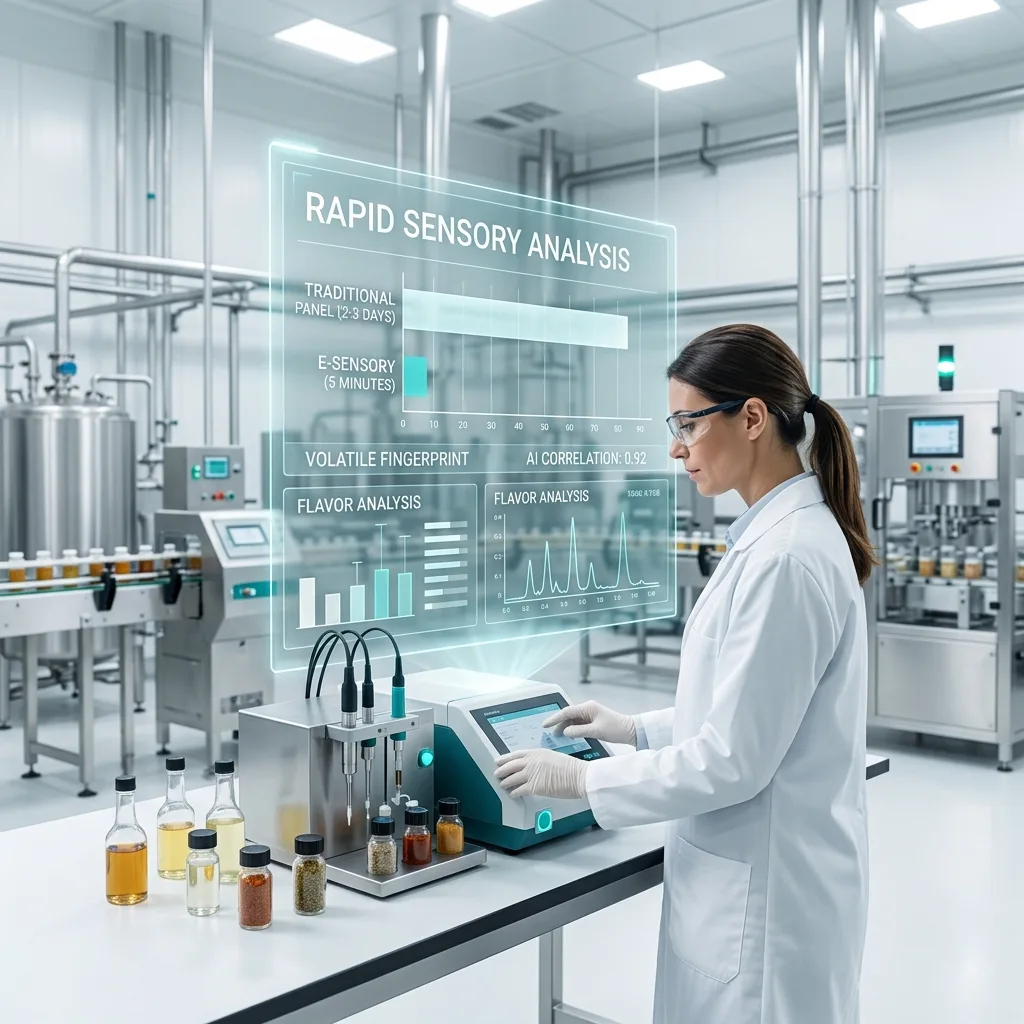
A food manufacturer waits 2-3 days for trained panel sensory results. Result: Production delays, batch holds, slow quality decisions, throughput bottleneck.
An automated quality facility deploys electronic nose system: Real-time volatile analysis, 5-minute results, correlates with trained panel (r=0.92, high accuracy). Result: Immediate quality decisions, batch release same-day, throughput +40%, labor costs reduced 60%.
Rapid sensory testing directly impacts quality throughput and decision speed.
The Electronic Sensory Framework
Traditional Sensory Gap:
Trained panel testing:
- Recruitment: 10-20 trained panelists (expensive, 20+ hours training each)
- Frequency: 2-3 tests/week (3-5 days lag)
- Cost: $500-2,000 per session
- Labor-intensive: Time-consuming, subjective
E-Sensory Solution:
Electronic sensors:
- Speed: 5-15 minutes per sample
- Cost: $5-20 per test (vs. $500-2,000)
- Consistency: Objective, reproducible
- Availability: 24/7 operation possible
Electronic Nose (E-Nose) Technology
What is It?
Array of chemical sensors detecting volatile organic compounds (VOCs)
Technology:
| Sensor Type | Detection | Application |
|---|---|---|
| Metal oxide | General VOCs | Odor profiling |
| Conductive polymer | Specific odors | Spoilage detection |
| QCM (quartz crystal) | Mass change | Organic vapor |
| Optical | Color change | Aromatic compounds |
Sensor Array:
Typically 10-30 different sensors (each responds differently)
- Pattern: Creates unique "fingerprint" for each sample
- Recognition: AI/machine learning identifies patterns
- Result: Sample classification (fresh, spoiled, off-flavor, etc.)
How It Works:
- Sample preparation: Volatile compounds released (heated 60-80 degrees C)
- Sensor exposure: Compounds contact sensor array
- Signal generation: Each sensor produces unique response pattern
- Pattern analysis: AI algorithm classifies sample
- Result: Immediate identification (5-10 minutes)
Applications:
- Off-Flavor Detection: Rancid, musty, moldy (spoilage)
- Batch Consistency: Verify aroma profile matches standard
- Shelf-Life Prediction: Track oxidation, degradation over time
- Raw Material QC: Verify ingredient freshness
Accuracy:
Correlation with trained panel: r = 0.85-0.95 (high)
- 85-95% accuracy in classification
- Faster than human panel (5 min vs. 2-3 days)
- Cost-effective: $5-20/test vs. $500-2,000
Equipment Cost: $50-150K initial
Electronic Tongue (E-Tongue) Technology
What is It?
Array of electrochemical sensors detecting taste compounds
Taste Compounds Detected:
| Taste | Sensor Type | Detection |
|---|---|---|
| Sweet | Electrochemical | Sugar, sweeteners |
| Sour | pH/ion selective | Acid concentration |
| Salty | Ion selective | Sodium, salt |
| Bitter | Conductive polymer | Bitter compounds |
| Umami | Electrochemical | Glutamate, MSG |
How It Works:
- Sample preparation: Dilute taste sample
- Sensor immersion: Electrodes contact liquid
- Potential measurement: Each sensor measures electrical potential
- Pattern analysis: AI recognizes taste pattern
- Result: Quantitative taste profile (5-15 minutes)
Applications:
- Sweetness Measurement: Alternative to Brix (faster, automated)
- Salt Verification: QC for sodium-reduced products
- Bitterness Detection: Coffee, chocolate, beverage QC
- Flavor Profile: Reproducible taste assessment
Accuracy:
Correlation with trained panel: r = 0.80-0.90
- 80-90% accuracy in taste attributes
- Faster than sensory panel
- Less subjective than human taste
Equipment Cost: $50-150K initial
Rapid Testing Workflow
Example: Morning QC (Fresh Juice)
| Time | Action |
|---|---|
| 8:00 AM | Batch produced |
| 8:15 AM | Sample to e-nose |
| 8:20 AM | E-nose result: "Fresh" (matching reference) |
| 8:21 AM | QA decision: Release batch |
| 9:00 AM | Batch shipped |
vs. Traditional (2-3 days waiting)
Cost-Benefit Analysis
| Metric | E-Sensory | Trained Panel |
|---|---|---|
| Time/test | 5-15 min | 2-3 days |
| Cost/test | $5-20 | $500-2,000 |
| Consistency | High (objective) | Variable (subjective) |
| Throughput | 50+ tests/day | 2-5 tests/day |
| Labor | Minimal (automated) | High (panelist time) |
| Equipment | $50-150K | Training cost |
| ROI | 1-2 years | Recurring cost |
For QA managers, rapid sensory testing dramatically improves decision speed and reduces costs.