A food manufacturer offers 80 SKUs (stock keeping units) across its product line. Each SKU requires:
- Production line setup
- Quality testing
- Inventory carrying
- Sales and marketing support
- Customer service complexity
Only 20 of the 80 SKUs generate 80% of revenue. The remaining 60 SKUs are low-volume, low-margin distractions.
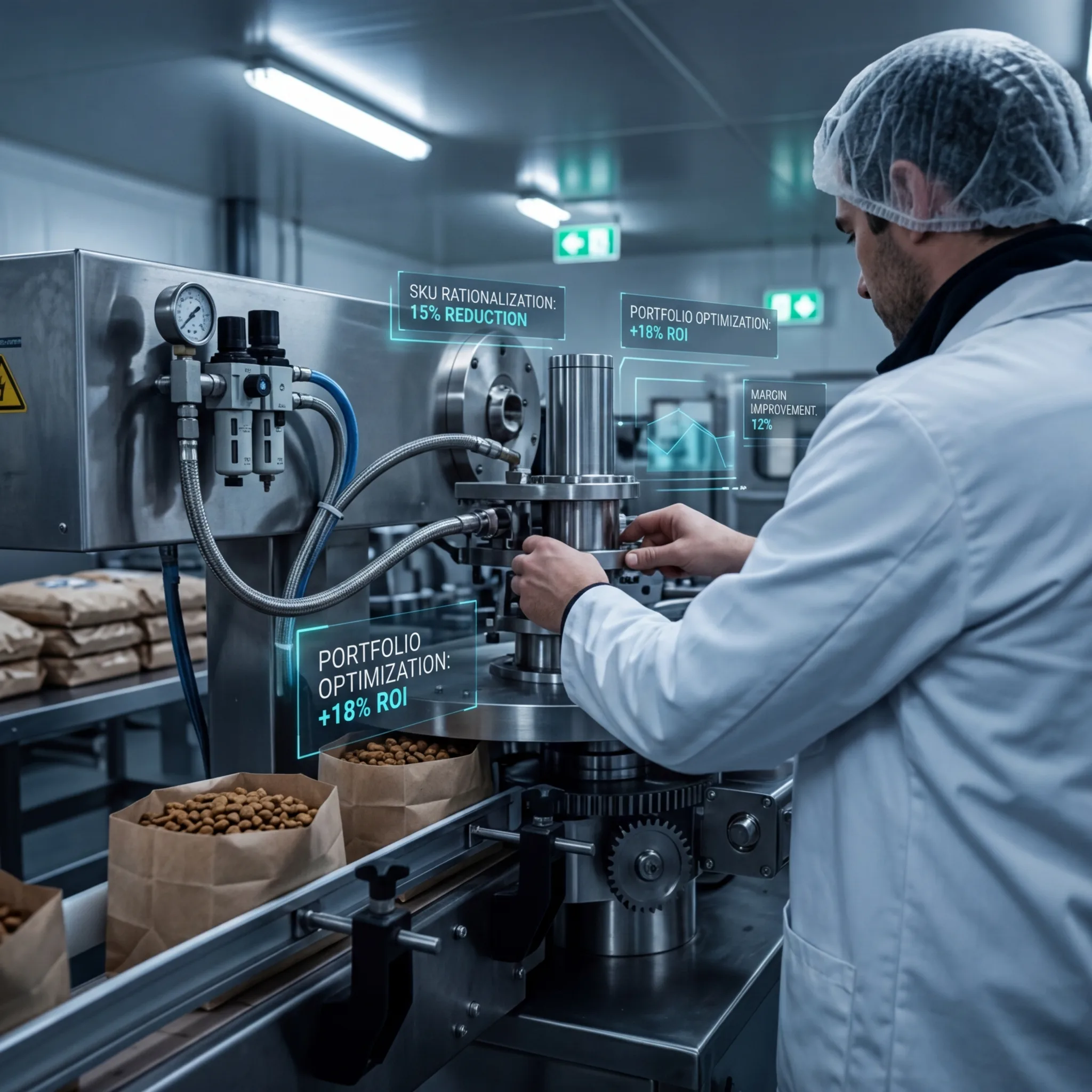
Portfolio optimization means rationalizing the SKU count to focus on profitable products.
The SKU Profitability Analysis
Analyze each SKU across multiple dimensions:
| SKU | Volume | Price | Cost | Gross Margin | % of Revenue | Customer Count | Inventory Days |
|---|---|---|---|---|---|---|---|
| #1 | High | Premium | Moderate | 45% | 18% | 12 | 45 |
| #2 | High | Standard | Moderate | 38% | 16% | 24 | 50 |
| #3 | Medium | Premium | Low | 52% | 12% | 4 | 30 |
| #60 | Low | Standard | High | 15% | 0.5% | 1 | 90 |
| #79 | Very Low | Discount | High | 8% | 0.2% | 1 | 120 |
| #80 | Very Low | Discount | High | 5% | 0.1% | 1 | 180 |
The Rationalization Decision Framework
Keep Decision:
- Volume: Over 1% of revenue (meaningful sales)
- Margin: Over 30% (profitable)
- Customer base: Over 3 accounts (not customer-specific)
- Strategic fit: Aligns with brand positioning
Evaluate Decision:
- Volume: 0.5-1% of revenue
- Margin: 20-30%
- Evaluate if customer retention depends on it
- Consider phase-out vs. retention
Eliminate Decision:
- Volume: Under 0.5% of revenue
- Margin: Under 20%
- Only 1-2 customers requiring it
- Operational burden exceeds benefit
The Cost of SKU Proliferation
Manufacturing cost per SKU beyond the "core 20":
| Cost Category | Impact per SKU |
|---|---|
| Setup/changeover | $1K-$3K per production run |
| Quality testing | $500-$1K |
| Inventory carrying (excess) | $2K-$5K annually |
| SKU management (IT, planning) | $1K-$2K |
| Slow-moving obsolescence | $0-$5K |
| Total annual burden | $5K-$16K per low-volume SKU |
For 60 low-volume SKUs: $300K-$960K annual burden from products generating only 20% of revenue.
The Rationalization Roadmap
Phase 1: Analysis (Month 1)
- Profitability analysis for all SKUs
- Customer impact analysis (which customers buy which SKUs)
- Operational burden assessment
Phase 2: Decision (Month 2)
- Classify SKUs: Keep, Evaluate, Eliminate
- Communicate decisions with customers
- Develop phase-out plan for eliminated SKUs (3-12 month transition)
Phase 3: Execution (Month 3-6)
- Notify customers of phase-out
- Encourage migration to replacement SKUs
- Support transition period
- Execute phase-out
The Financial Impact
A manufacturer rationalizing from 80 SKUs to 30 core SKUs:
- Eliminated SKUs: 50
- Average burden per SKU: $10K
- Annual cost elimination: $500K
- Revenue impact: Under 1% (low-volume products)
- Gross margin improvement: 2-3% (fewer discounts, better mix)
On $50M revenue:
- Cost reduction: $500K
- Margin improvement: 2% x $50M = $1M
- Total benefit: $1.5M annually
The Risks to Manage
- Customer retention: Ensure replacement SKUs meet needs
- Sales impact: Phase-out prevents revenue cliff
- Market opportunity: Don't eliminate emerging profitable products
For food manufacturing companies, strategic SKU rationalization eliminates low-volume burdens, improves profitability, and enables focus on core differentiating products.