A poultry processor uses manual evisceration with inconsistent inspection. Result: Occasional contamination (fecal matter on meat). Customer complaints. Recalls occur. Food safety audit failures.
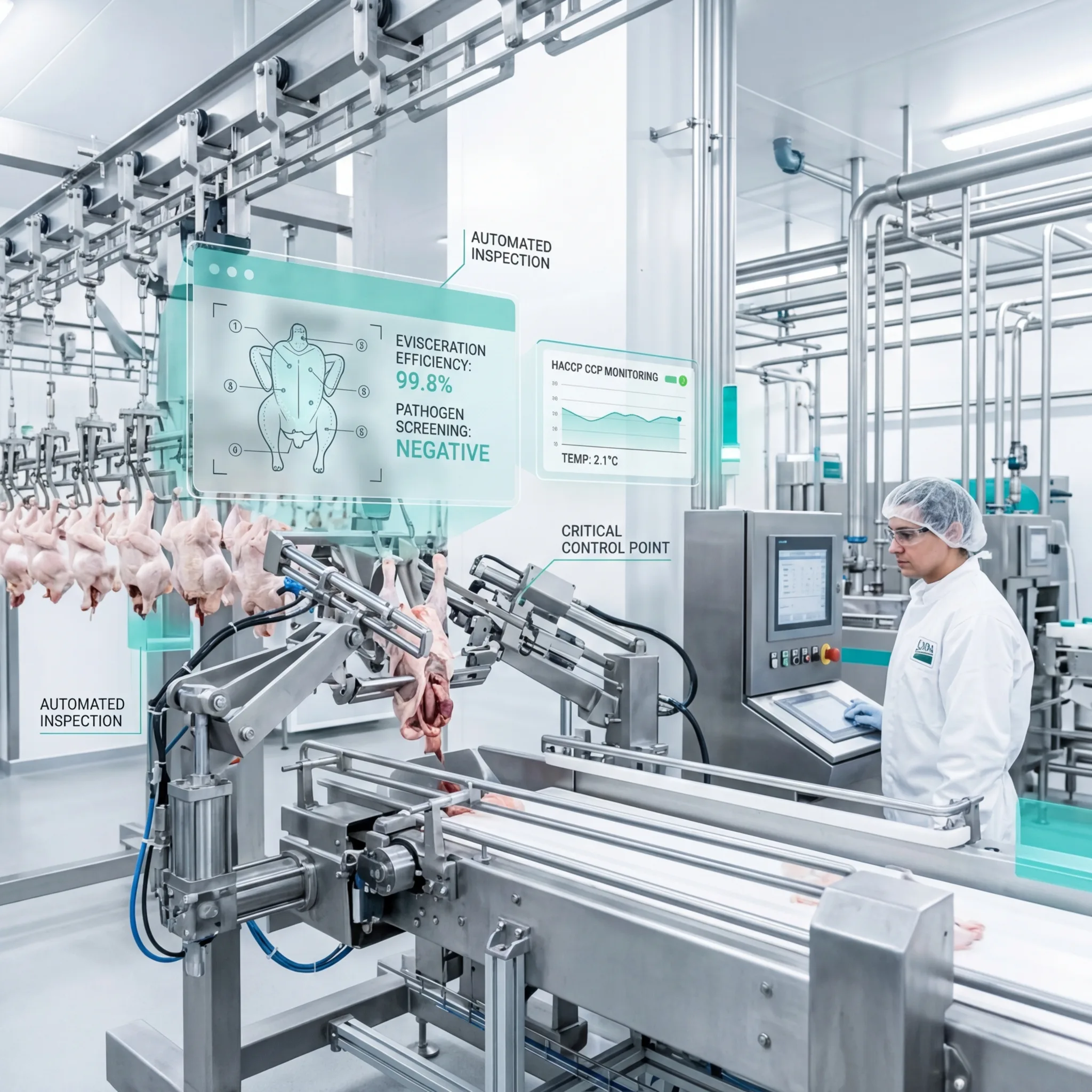
A modern facility installs automated evisceration with continuous USDA inspection. Mechanical system removes organs precisely (prevents rupture). Visual + pathogen inspection validates safety. HACCP CCPs monitored in real-time. Zero recalls in 3 years. Perfect safety record maintained.
Poultry processing safety directly impacts consumer confidence and regulatory compliance.
The Poultry Processing Framework
Critical Food Safety Points:
Poultry carries high pathogenic load (Salmonella, E. coli, Listeria)
- Source: Intestinal contents, bile, feces
- Risk: Cross-contamination during processing
- Control: Strict HACCP procedures mandatory (USDA requirement)
Processing Steps
Step 1: Scalding (53-63 degrees C)
Purpose: Loosen feathers (soften skin, open pores)
- Temperature: 53-63 degrees C (range critical)
- Time: 30-60 seconds typical
- Too hot (over 65 degrees C): Damages skin, opens bacteria entry
- Too cool (under 50 degrees C): Poor feather removal
Equipment: Large hot-water tank with continuous circulation
- Maintains consistent temperature
- Automatic timer controls duration
Step 2: Plucking (Mechanical)
Equipment: Rotating drum with rubber fingers
- Friction removes feathers (pulling motion)
- Efficiency: 95-99% feather removal
- Byproduct: Feathers (animal feed, down insulation)
Step 3: Evisceration (CRITICAL CONTAMINATION POINT)
Manual Evisceration (Traditional):
- Operator cuts carcass, removes organs by hand
- Risk: High (knife cuts intestines leading to contamination)
- Yield: Lower (potential damage to meat)
- Safety: Variable (operator-dependent)
Mechanical Evisceration (Modern):
- Automated system locates organs
- Vacuum or mechanical removal (prevents rupture)
- Organs removed intact (no contamination)
- Consistency: Excellent (same result every bird)
- Yield: Higher (minimal damage)
- Safety: Excellent (controlled, repeatable)
HACCP Critical Control Point (CCP #1):
- Objective: Prevent intestinal rupture and cross-contamination
- Monitor: Visual inspection + microbiological testing
- Action: Reject any contaminated carcasses
- Documentation: Track every bird status
Step 4: Inspection (USDA/FDA Mandatory)
Visual Inspection:
- Examine entire carcass for contamination
- Check organs removed (no remnants)
- Verify no fecal material present
- Reject if contamination detected
Pathogen Testing:
- Sample testing: Random carcasses tested
- Salmonella limits: under 25% positive (regulatory standard)
- E. coli O157:H7: Zero tolerance
- Listeria: Zero tolerance
HACCP CCP #2:
- Objective: Verify no pathogens present
- Method: Rapid testing or culture
- Result documentation: Required by FDA
- Traceability: Link each carcass to test result
Step 5: Chilling (0-4 degrees C)
Purpose: Cool product to safe temperature, prevent growth
- Temperature: Must reach under 4 degrees C
- Time: Within 2 hours of processing
- Monitor: Temperature sensors throughout
HACCP CCP #3:
- Objective: Prevent bacterial growth
- Monitor: Continuous temperature logging
- Action: Reject if temperature exceeds 10 degrees C
- Documentation: Time-temperature verification
Yield Optimization
Whole Bird Processing:
Raw bird: 100 lbs
- Scalding/plucking/evisceration loss: 15-20%
- Chilling loss: 3-5%
- Packaged whole bird: 75-80%
- Byproduct: Offal (organs, blood), feathers (waste stream)
Cut-Up Operations:
Whole bird: 100 lbs
- Carcass: 70-75 lbs (meat removal)
- Byproducts: 10-15 lbs (livers, gizzards, hearts, feet)
- Waste: 10-15 lbs (bones, trim)
Byproduct Value Recovery:
- Livers: +$0.50-1.00/bird
- Gizzards: +$0.30-0.50/bird
- Hearts: +$0.20/bird
- Feet: +$0.10-0.20/bird (international market)
- Total byproduct: 10-15% additional margin
Economics Example (1,000 bird batch):
- Whole birds: 1,000 x 5 lbs = 5,000 lbs x $1.50/lb = $7,500
- Byproducts: 1,000 x $1.50 value = $1,500
- Feathers: 200 lbs x $0.50/lb = $100
- Total value: $9,100 (+21% byproduct revenue)
Food Safety Validation
HACCP Plan Documentation:
CCP #1 (Evisceration):
- Target: No visible contamination
- Monitor: Visual inspection 100% of birds
- Frequency: Every single bird
- Action limit: Any contamination = reject
CCP #2 (Inspection):
- Target: under 25% Salmonella (regulatory limit)
- Monitor: Test 60 samples per day (regulatory requirement)
- Frequency: Daily sampling
- Action: If over 25% positive, halt production, investigate
CCP #3 (Chilling):
- Target: All birds under 4 degrees C within 2 hours
- Monitor: Temperature sensors in chill tank
- Frequency: Continuous monitoring, logged hourly
- Action: If any bird over 10 degrees C, investigate, correct
Validation Study:
- Test for Salmonella/E. coli before/after each process step
- Verify no cross-contamination between steps
- Confirm temperature control effectiveness
- Document all results (FDA requirement)
Regulatory Compliance
USDA Inspection:
- Mandatory for all commercial operations
- Inspector on-site during processing
- Continuous visual inspection authority
- Can halt production if food safety issue detected
- Carcass condemnation possible
FDA Oversight:
- HACCP plan required (21 CFR Part 123)
- Preventive Controls (FSMA requirements)
- Allergen management
- Traceability (track-back capability)
Equipment Investment
| Component | Cost | Purpose |
|---|---|---|
| Scalding tank | $30-50K | Temperature control |
| Plucker | $40-80K | Feather removal |
| Evisceration system | $100-200K | Automated removal |
| Inspection station | $20-40K | Verification |
| Chill tank | $50-100K | Temperature control |
| HACCP monitoring | $30-50K | Documentation, sensors |
| Total capital | $270-520K | Complete line |
ROI: 2-4 years (safety compliance + waste reduction + byproduct value)
For poultry processors, HACCP-compliant processing with automated evisceration and continuous inspection ensures regulatory compliance and zero recalls.