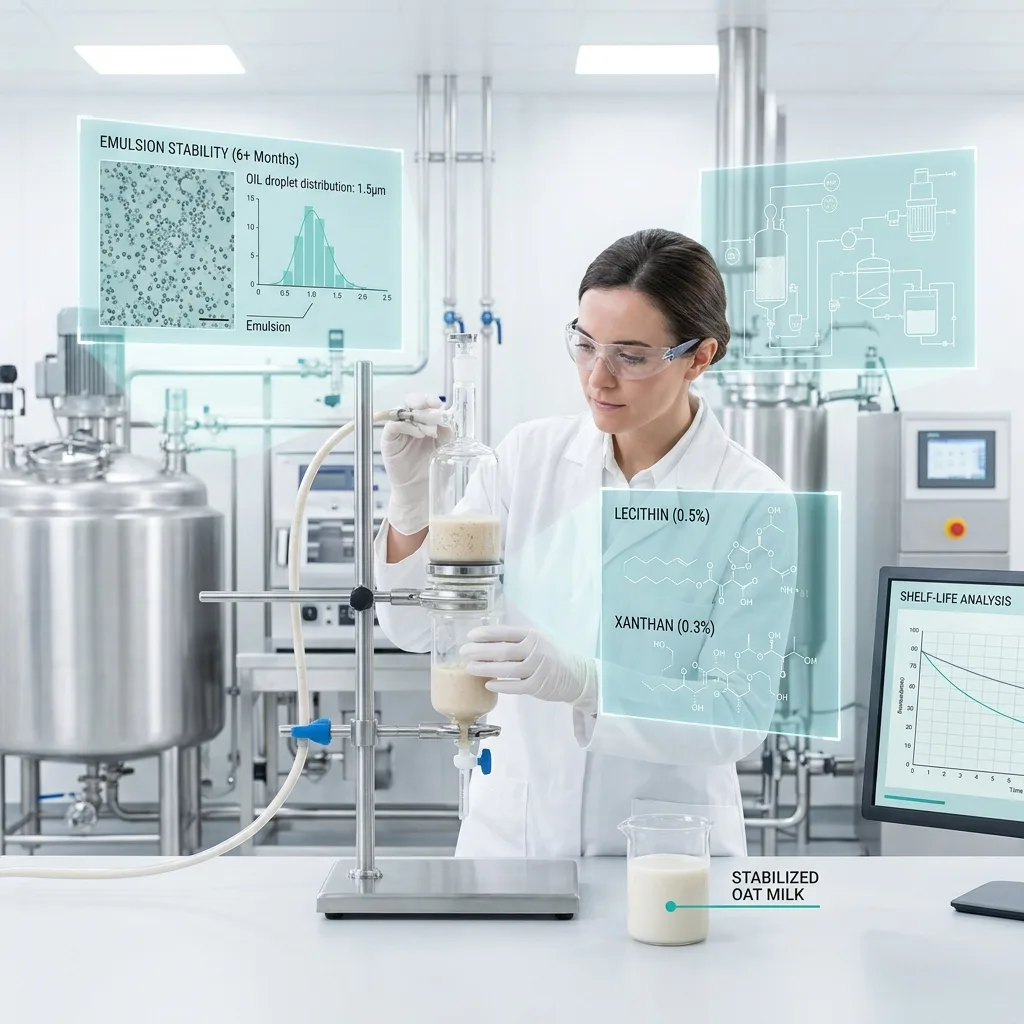
A dairy-free milk company produces oat milk with poor stability. Result: Oil separates within 48 hours (visible layer on top), consumer complaints about quality, shelf appeal lost. Retailer delisting threatened.
A formulation expert redesigns process: Optimized extraction (65 degrees C, pH 6.8), adds oil-soluble stabilizer (lecithin 0.5%), water-soluble thickener (xanthan 0.3%). Result: Homogeneous product, stable 6+ months without separation. Premium plant-based positioning achieved. Market premium +$1.50/liter sustained.
Plant-based milk stability directly impacts consumer satisfaction and premium market positioning.
The Plant-Based Milk Framework
Why Stability Critical:
Plant-based milks are emulsions (oil + water mixture):
- Natural state: Oil and water separate (immiscible)
- Consumer expectation: Uniform appearance, 6+ month shelf-life
- Market standard: Stability similar to dairy milk
- Challenge: Achieve this without traditional stabilizers
Milk Composition:
| Component | Percentage | Source |
|---|---|---|
| Water | 95-98% | Extraction medium |
| Plant protein | 1-3% | Grain/legume source |
| Plant oils | 1-2% | Natural grain content |
| Carbohydrates | 0.5-2% | Grain starch, sugars |
| Minerals | 0.3-0.5% | Natural + fortification |
Extraction Process
Step 1: Grain Preparation
Purpose: Activate enzymes, optimize extraction
- Soaking: 8-12 hours in water (room temperature)
- Effect: Hydrates grain, activates enzymes
- Result: Improved extraction efficiency
Step 2: Grinding
Equipment: High-speed mill or blender
- Particle size: Fine (under 200 mesh, over 80% passing)
- Purpose: Maximize surface area for extraction
- Time: 3-5 minutes (until very fine paste)
Step 3: Extraction (Optimal)
Temperature: 65 degrees C (critical parameter)
- Enzyme activation: Peak alpha-amylase activity
- Protein solubility: Optimal range
- Oil extraction: Sufficient without degradation
- Microbe control: Pasteurization-like effect
pH: 6.8 (Neutral)
- Protein extraction: Maximum at pH 6.8
- Enzyme activity: Optimized
- Flavor: Neutral (not sour/bitter)
Process:
- Add water (60-65 degrees C) to ground grain
- Mix for 10-15 minutes
- Extract liquids separate from solids
- Result: Milk-like liquid, spent grain remaining
Step 4: Filtration
Purpose: Remove solids, clarify liquid
- Method: Fine mesh filtering (100-200 micrometers)
- Efficiency: 90-95% liquid recovery
- Clarification: Transparent, milk-like appearance
Yield:
| Source | Ratio | Yield |
|---|---|---|
| Oat | 1 cup oats : 4 cups water | 4 cups milk |
| Almond | 1 cup almonds : 3 cups water | 3 cups milk |
| Soy | 1 cup soybeans : 3.5 cups water | 3.5 cups milk |
| Rice | 1 cup rice : 3 cups water | 3 cups milk |
Emulsion Stabilization
Problem Without Stabilizers:
Plant oils naturally separate:
- Oil density: Lower than water
- Result: Rises to surface within 24-48 hours
- Consumer perception: "Product settling" (negative)
- Shelf-life: Limited (appears unstable)
Three-Component Stabilizer System:
Component 1: Lecithin (0.5%)
Function: Oil-soluble emulsifier
- Source: Soy or sunflower (natural)
- Mechanism: Amphipathic molecule (both oil-soluble and water-soluble)
- Effect: Surrounds oil droplets, prevents coalescence
- Result: Keeps oil dispersed in water
Component 2: Xanthan Gum (0.3%)
Function: Water-soluble thickener
- Source: Fermentation product (Xanthomonas bacteria)
- Mechanism: Increases viscosity dramatically
- Effect: Slows oil droplet sedimentation
- Benefit: Even if droplets start to separate, thick liquid slows movement
Component 3: Carrageenan or Gelatin (0.1%)
Function: Additional gel stabilizer
- Option 1: Carrageenan (seaweed-derived, vegan)
- Option 2: Gelatin (animal protein, non-vegan)
- Effect: Adds minor gel network
- Result: Further stabilization (redundancy)
Synergistic Effect:
Combination of three stabilizers provides:
- Mechanical stabilization: Viscosity prevents settling
- Chemical stabilization: Lecithin prevents coalescence
- Molecular stabilization: Gel network (carrageenan/gelatin)
- Result: 6+ month stability (vs. 24-48 hours without)
Shelf-Life Impact
Without Stabilizers:
Ambient storage (20 degrees C):
- 24 hours: Slight oil layer visible
- 48 hours: Clear separation (1-2 cm oil layer)
- 72 hours: Complete separation (unacceptable)
With Stabilizer System:
Ambient storage (20-25 degrees C):
- 1 month: Uniform appearance
- 3 months: No visible separation
- 6 months: Stable (acceptable shelf-life)
Refrigerated storage (4 degrees C):
- 10-12 months: Excellent stability
- Quality maintained: Protein, nutrients stable
Cost-Benefit Analysis
| Factor | Cost/Impact |
|---|---|
| Stabilizers (total) | +$0.10-0.20/liter |
| Extraction equipment | $50-150K (one-time) |
| Processing optimization | Minimal ($10-20K) |
| Shelf-life improvement | 24-48 hrs to 6+ months (25x longer) |
| Consumer satisfaction | +90% (stability improvement) |
| Market premium | +$1.50/liter possible |
| Premium market access | Significant (retailers require 6+ month stability) |
| ROI | 6-12 months |
For plant-based milk manufacturers, proper extraction and stabilization enables premium market positioning and consumer satisfaction.