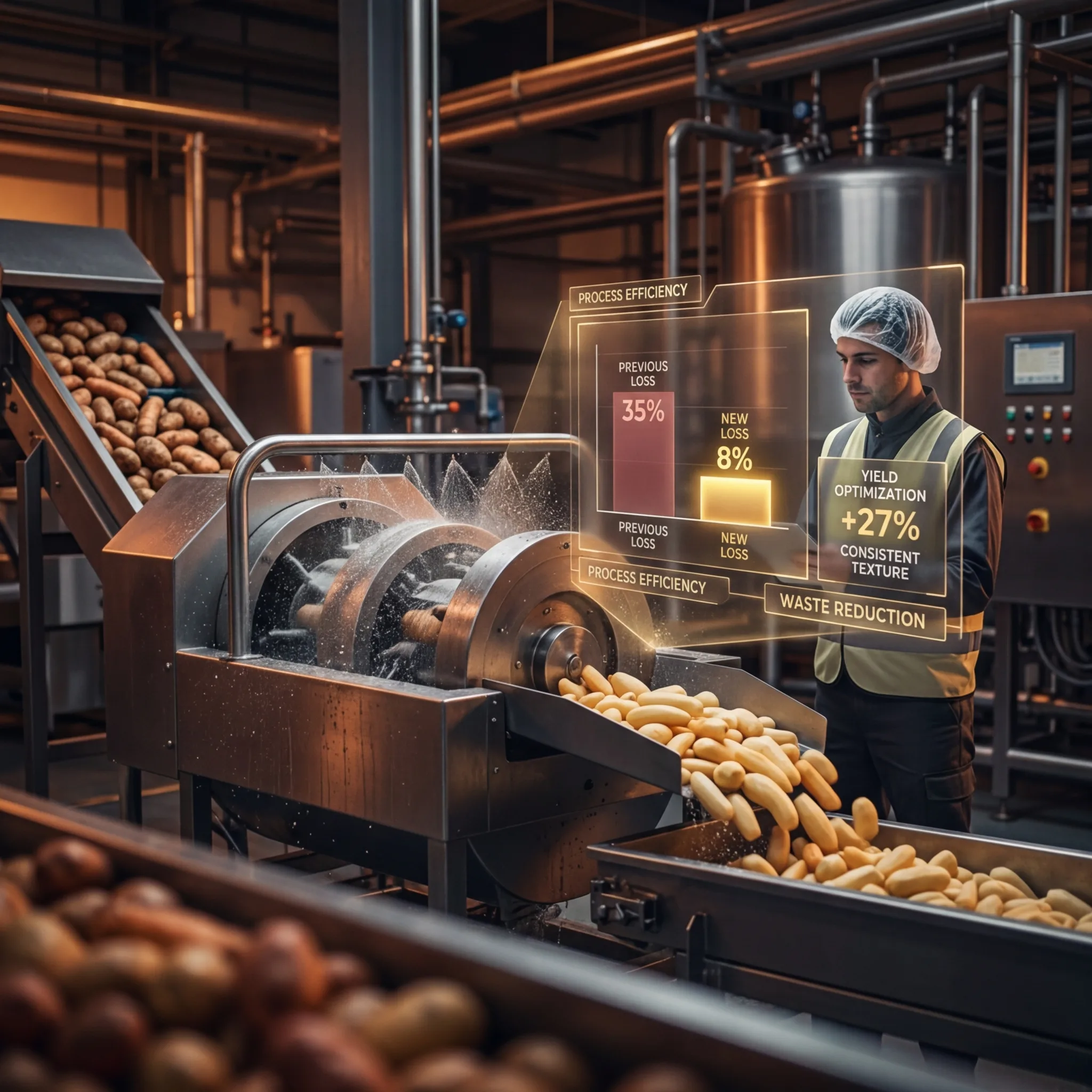
A fruit processing company uses manual knife peeling. Result: 35% material loss (waste). Labor cost excessive. Inconsistent thickness. Yield poor.
A modern facility installs abrasive peeler with water-jet assist. Loss reduces to 8%. Thickness consistent. Labor eliminated. Yield improves 27%.
Peeling equipment selection directly impacts product yield and operational efficiency.
The Peeling Framework
Objectives:
- Remove skin: Eliminate unwanted surface layer
- Minimize loss: Maximum yield (minimize waste)
- Consistent depth: Uniform thickness
- Preserve quality: Avoid bruising, maintain texture
- Food safety: Remove surface pathogens
Peeling Methods
Abrasive Peeling (Mechanical):
Design: Rotating abrasive surface removes skin by friction
- Application: Root vegetables (potato, carrot), fruits (apple, pear)
- Material removal: Precisely controlled depth (typically 1-3 mm)
- Throughput: 500-5,000 kg/hour (depending on equipment)
- Water use: High (cooling + waste removal)
Process:
- Feed vegetables into rotating drum with abrasive coating
- Gentle rubbing action removes skin
- Water spray removes peeled skin and debris
- Finished product exits via conveyor
Yield Calculation:
Whole vegetable: 100 kg Removed (peel + loss): 12 kg (12%) Finished product: 88 kg yield
Advantages: Low damage, high yield, gentle on product Disadvantages: High water use, environmental concerns
Lye Peeling (Chemical):
Design: Caustic soda (NaOH) weakens skin attachment, mechanical removal follows
- Application: Fruits (tomatoes, peaches), vegetables (onions)
- Chemical exposure: Brief (15-60 seconds)
- Temperature: 65-95 degrees C (accelerates peeling)
Process:
- Submerge vegetables in caustic solution
- Heat to target temperature
- Chemical weakens skin/cell attachment
- Cool to stop reaction
- Water spray or mechanical scrubber removes skin
- Acid neutralization rinse (remove caustic residue)
- Water rinse (safety verification: pH 6.5-8.5)
Chemical Concentration:
- Typically 3-8% NaOH (by weight)
- Contact time: 15-60 seconds
- Temperature: 65-95 degrees C
- Result: Easier mechanical removal
Yield Calculation:
Whole tomato: 1,000 kg Removed (skin only): 40 kg (4%) Finished product: 960 kg yield (vs. 880 kg manual peeling)
Advantages: Very high yield, minimal damage, uniform depth Disadvantages: Chemical handling, safety procedures, neutralization rinse required
Knife Peeling (Precision):
Design: Rotating cutting head with adjustable blade depth
- Application: Specialty products, irregular shapes
- Depth control: 0.5-5 mm adjustable
- Throughput: Lower (200-500 kg/hour)
- Precision: Excellent for premium products
Comparison Table:
| Method | Yield | Speed | Cost | Quality | Damage |
|---|---|---|---|---|---|
| Manual | 65-70% | Low | Very High | Variable | High |
| Abrasive | 88-92% | High | Moderate | Good | Low |
| Lye | 95-98% | High | Moderate | Excellent | Very Low |
| Knife | 90-95% | Moderate | High | Excellent | Low |
Environmental Considerations
Water Use:
- Abrasive peeler: 10-30 L per 100 kg product (high)
- Lye peeler: 5-15 L per 100 kg (moderate)
- Water reuse: Possible with settling/filtration
Caustic Disposal:
- Chemical waste streams must be neutralized (pH 6.5-8.5)
- Acid used for neutralization: Hydrochloric or citric acid
- Residual salt disposal: Via wastewater treatment
Cost Impact:
Lye peeling system cost: $100K-300K Annual caustic+acid+disposal: ~$10-20K Environmental compliance: Critical
Quality Metrics
Yield Measurement:
Yield (%) = [(Final weight / Initial weight) - 1] x 100
Example: 1,000 kg input to 950 kg output Yield loss: (950/1000 - 1) x 100 = -5% (95% retention)
Depth Consistency:
Specification: 2 +/- 0.5 mm peel depth Measurement: Cross-section microscopy or caliper
Consistency under +/-1 mm considered excellent
Cost-Benefit Analysis
| Factor | Manual | Abrasive | Lye |
|---|---|---|---|
| Capital | Low | $50-100K | $100-300K |
| Operating | High labor | Moderate | Moderate |
| Yield | 70% | 90% | 96% |
| Product quality | Variable | Good | Excellent |
| Environmental | Minimal | Water use | Chemical handling |
| ROI | -- | 2-3 years | 3-5 years |
For produce manufacturers, proper peeling equipment selection optimizes yield, reduces labor, and improves product consistency.