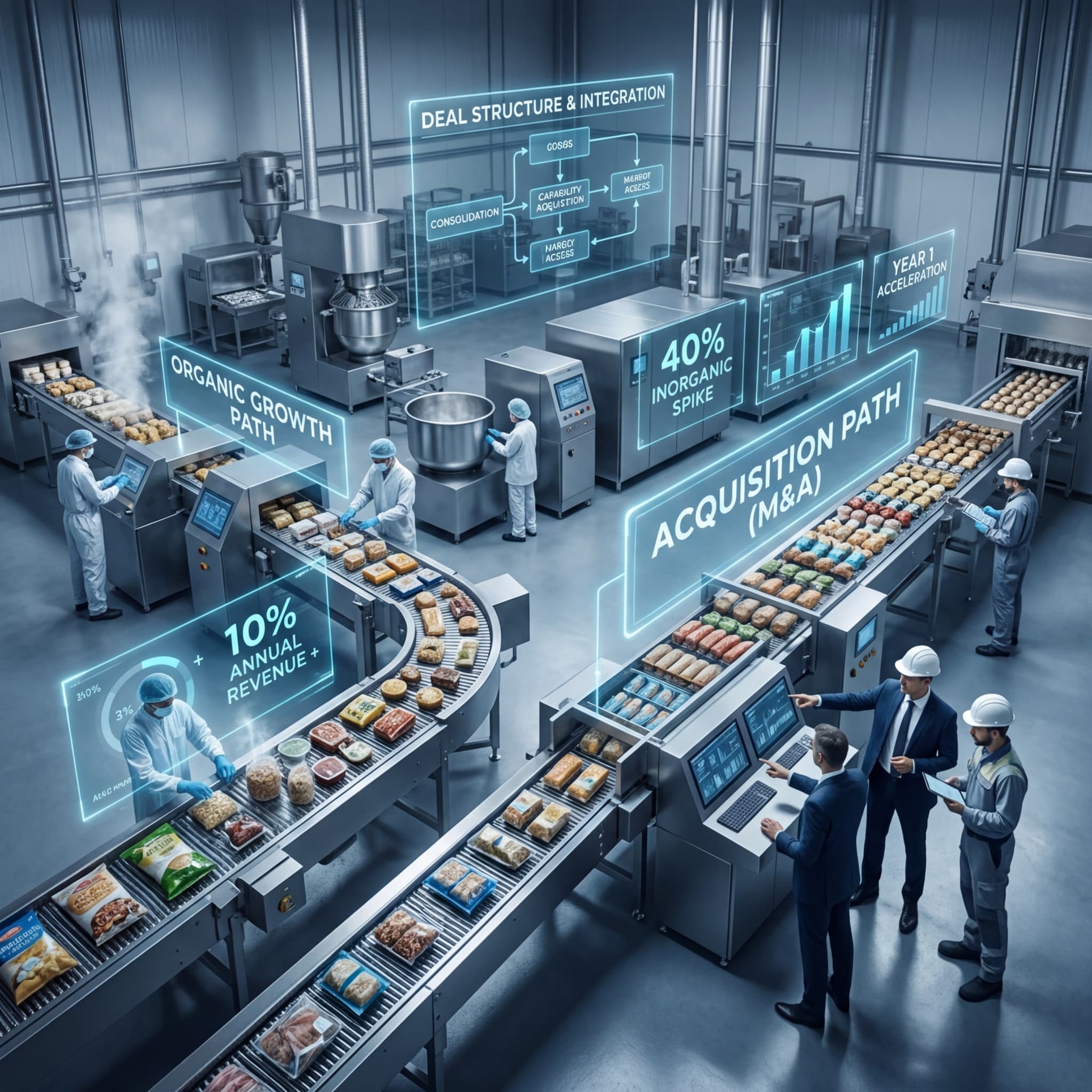
A food manufacturer achieves 5% annual organic growth—adding $2.5M revenue annually to a $50M base.
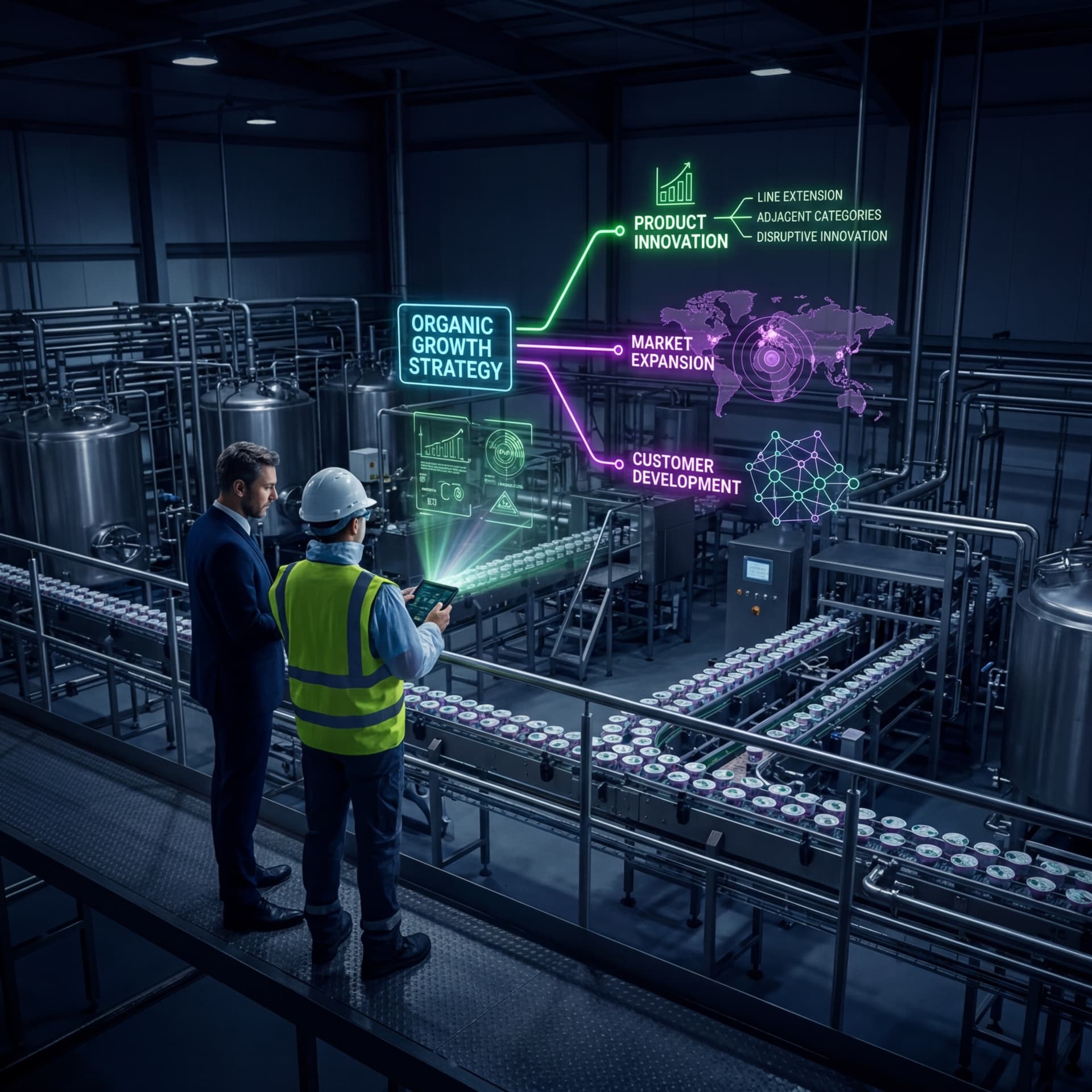
While steady, this growth rate only doubles revenue in 14 years. Acceleration requires intentional strategy across three levers: product innovation, market expansion, and customer development.
Product Innovation Strategy
Approach 1: Line Extension (Low Risk, Lower Growth)
- New flavors, sizes, or formats of existing products
- Example: Add organic yogurt line to existing conventional yogurt
- Investment: $200K-$500K per innovation
- Revenue impact: $500K-$1M annually per successful product
- Success rate: 70%+ (lower risk)
Approach 2: Adjacent Categories (Medium Risk, Medium Growth)
- Leverage core capabilities into related categories
- Example: Dairy manufacturer adds dairy-free alternative
- Investment: $500K-$2M per innovation
- Revenue impact: $1-5M annually per successful product
- Success rate: 40-50%
Approach 3: Disruptive Innovation (High Risk, High Growth)
- New business models or consumer experiences
- Example: Direct-to-consumer subscription model for customized nutrition
- Investment: $1-5M per innovation
- Revenue impact: $5M+ annually if successful
- Success rate: 10-20%
Balanced Portfolio Approach:
- 60% line extensions (steady, predictable growth)
- 30% adjacent categories (moderate growth, calculated risk)
- 10% disruptive innovations (high upside if successful)
Market Expansion Strategy
Geographic Expansion:
- Currently: New York and New Jersey
- Expansion: Pennsylvania, Connecticut, Massachusetts (Northeast corridor)
- New revenue: 3-5 new customers in each state = 15-25 additional customers
- Average customer value: $200K = $3M-5M new revenue
- Timeline: 2-3 years to build relationships and distribution
Customer Segment Expansion:
- Current: Regional grocery chains, specialty retailers
- Expansion: Quick-service restaurants, colleges/universities, corporate cafeterias
- Different customer needs (volume, pricing, product specs)
- New revenue: Similar to geographic expansion
Channel Expansion:
- Current: Distributor, direct sales
- Expansion: Direct-to-consumer e-commerce
- Lower margin (no distributor margin) but direct customer relationships
- New revenue: $500K-$2M annually if executed well
Customer Development Strategy
Account Penetration (Existing Customers):
- Average customer currently buys 1-2 product lines
- Opportunity: Introduce additional products to existing customer base
- Strategy: Account manager education, sampling, pricing incentives
- Typical lift: 10-20% increase in revenue per customer = $1M-$2M annually
Customer Upselling:
- Move customers from value tier to premium tier products
- Requires demonstrating quality/value difference
- Premium products have 5-10% higher margin
- Revenue lift: 5-10% + margin improvement = $2M-$3M impact
Share of Wallet Expansion:
- Current: Customers may source from multiple suppliers
- Opportunity: Become primary supplier through:
- Service excellence (on-time delivery, problem resolution)
- Product innovation (more SKUs to meet needs)
- Pricing/volume incentives (reward loyalty)
- Potential: 20-30% additional share = $1-2M per large customer
Organic Growth Roadmap
| Year | Product Innovation | Market Expansion | Customer Development | Total Growth |
|---|---|---|---|---|
| Year 1 | 1% (new SKUs) | 1% (new customers) | 2% (penetration) | 4% |
| Year 2 | 2% (innovation) | 2% (geographic) | 2% (upsell) | 6% |
| Year 3 | 2% (innovation) | 1% (expansion) | 2% (share) | 5% |
Combined 3-year impact: 15% average annual growth = $50M to $76M
For food manufacturing companies, intentional organic growth strategy across product innovation, market expansion, and customer development accelerates revenue growth while improving customer relationships and product portfolio.