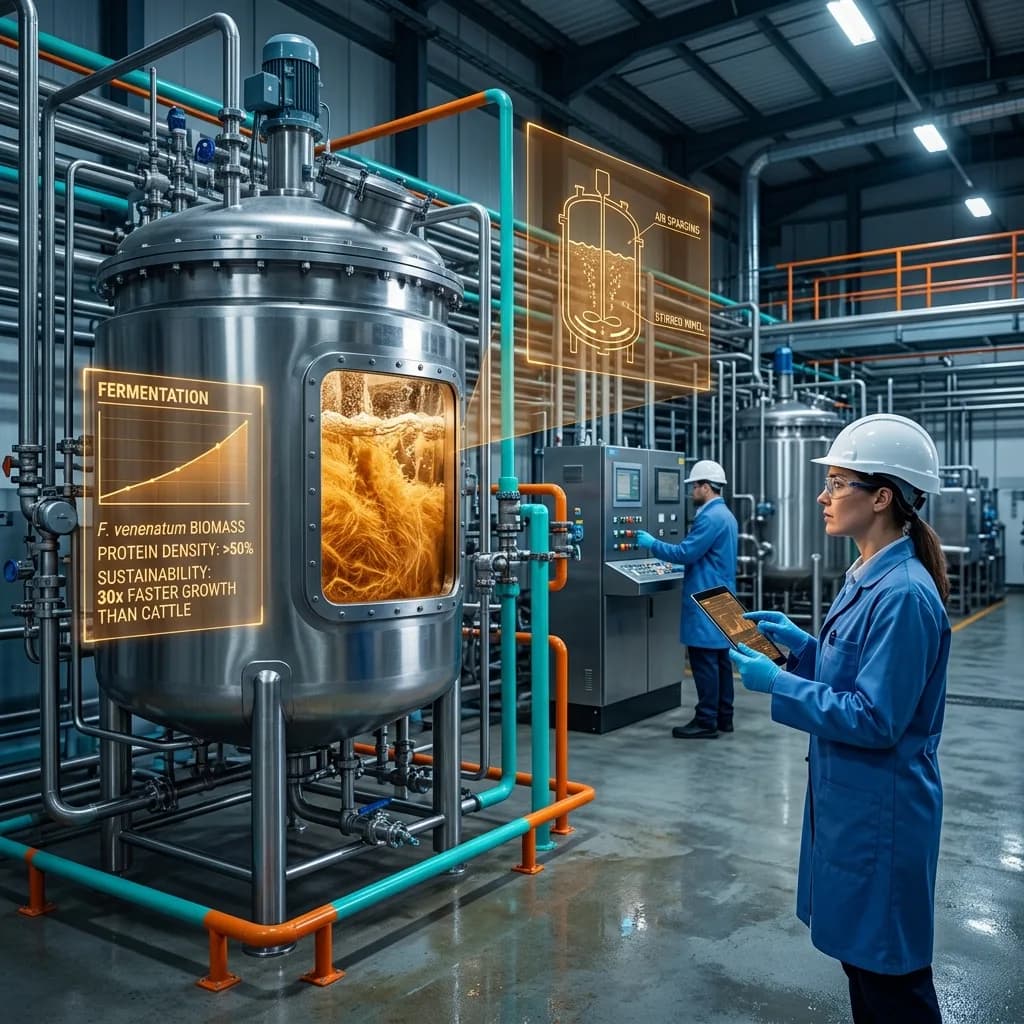
A food company seeks sustainable protein beyond soy and pea sources. Develops mycoprotein fermentation using approved fungal organism. Result: 30-40x faster growth than cattle, 10x land efficiency. Sustainability credentials premium. Market opportunity in alternative protein $10B+ category.
Mycoprotein fermentation enables revolutionary protein sustainability with minimal environmental footprint.
The Mycoprotein Framework
What is Mycoprotein?
Protein derived from fungal fermentation:
- Organism: Fusarium venenatum (approved food organism)
- Process: Fermentation in bioreactor (like brewing beer)
- Output: Filamentous fungal biomass (over 50% protein)
- Status: Approved EU/UK markets, FDA pathway active USA
Historical Context:
- Developed: 1960s-1980s in UK
- Approval: UK (1985), EU (2002), approval expanded globally
- Commercial history: 30+ years, millions of consumers
- Safety record: Excellent (no adverse events attributed)
- Brand: Quorn products (meat alternatives)
Fermentation Process
Step 1: Culture Preparation
Purpose: Inoculate bioreactor with active mycelium
- Source: Master culture bank (stored frozen)
- Activation: Thaw, rehydrate, grow in liquid culture
- Verification: Viability check (purity test)
- Time: 24-48 hours
Step 2: Bioreactor Inoculation
Equipment: Stainless steel bioreactor (100-10,000 liters typical)
Media Composition:
| Component | Purpose |
|---|---|
| Glucose | Carbon source (primary nutrient) |
| Nitrogen source | Protein synthesis |
| Minerals | K, P, Mg, S, Fe, Zn (trace metals) |
| Trace elements | B vitamins, cofactors |
| Water | Solvent (sterilized) |
Media Preparation:
- Formulation: Precise nutrient ratios (laboratory tested)
- Sterilization: Autoclave (121 degrees C, 15-20 minutes)
- Purpose: Kill contaminating organisms
- Result: Sterile growth environment
Step 3: Fermentation (40-Hour Cycle)
Conditions:
- Temperature: 28 degrees C (optimal for Fusarium venenatum)
- pH: 5.0-6.0 (maintained via automated pH control)
- Aeration: Vigorous (fungal growth is aerobic)
- Agitation: Stirring to distribute oxygen
- Duration: 40 hours (specific growth phase)
Monitoring:
- Biomass density: Tracked via optical density (OD)
- pH: Continuous monitoring (adjusted if needed)
- Oxygen: Dissolved oxygen over 30% (target)
- Foam: Antifoam agents prevent overflow
Growth Kinetics:
| Phase | Hours | Biomass Growth |
|---|---|---|
| Lag | 0-4 | Minimal (adaptation) |
| Exponential | 4-28 | Rapid doubling (peak growth) |
| Stationary | 28-40 | Slowed (nutrient limitation) |
| Harvest point | 40 | Optimal protein, minimal over-growth |
Step 4: Harvesting
Purpose: Separate mycelium biomass from liquid media
Equipment: Industrial centrifuge
- Speed: 3,000-5,000 rpm
- Time: 5-10 minutes
- Separation: Mycelium (solids) vs. media (liquid)
- Yield: 90-95% recovery typical
Output: Wet mycelium paste (70-80% moisture)
Step 5: Heat Treatment (Blanching)
Purpose: Inactivate allergens, improve safety, improve texture
Process:
- Temperature: 60-80 degrees C
- Time: 10-20 minutes
- Effect: Denatures heat-labile proteins (allergen reduction)
- Result: Enhanced food safety profile
Step 6: Drying
Method 1: Spray Drying
- Equipment: Spray dryer
- Temperature: 180 degrees C inlet, 80 degrees C outlet
- Time: Seconds (very fast)
- Result: Fine powder
Method 2: Freeze Drying
- Temperature: -40 degrees C
- Vacuum: High vacuum chamber
- Time: 12-24 hours
- Result: Light, porous powder (premium)
Protein Yield:
Raw mycelium: 15-20% protein (dry basis) After drying: Concentrated to 50-60% protein (depending on process)
Nutritional Profile
Protein Composition:
| Amino Acid | Level | Completeness |
|---|---|---|
| Complete protein | Yes | All 9 essential amino acids |
| BCAA (branched-chain) | Moderate | ~18% of protein |
| Digestibility | High | 85-90% PDCAAS |
Additional Nutrients:
- Fiber: 6-8% (natural inclusion)
- B vitamins: Riboflavin, B12 (naturally present)
- Minerals: Iron, zinc (good bioavailability)
- Fat: 3-5% (mostly unsaturated)
Advantages Over Plant Proteins:
- Complete amino acid profile (not missing lysine like grains)
- B12 naturally present (uncommon in plant-based)
- Neutral flavor (less beany than soy)
- Naturally fibrous texture (great for meat analogs)
Sustainability Advantage
Comparison to Cattle Beef:
| Metric | Mycoprotein | Beef | Reduction |
|---|---|---|---|
| Land use | Very low | High | 95% less |
| Water use | Low | High | 75-80% less |
| Carbon emissions | Very low | High | 90%+ less |
| Growth time | 40 hours | 2-3 years | 95% faster |
| Yield efficiency | ~90% protein | ~25% protein (dry) | 3-4x better |
Sustainability Messaging: Premium market positioning in eco-conscious segment
Market Status and Regulatory
Approved Markets:
- EU: Approved (established track record)
- UK: Approved post-Brexit
- Singapore: Approved (first Asia approval)
- USA: FDA pathway active (approval expected 2024-2025)
Consumer Products (Quorn brand examples):
- Meat-free steaks
- Ground meat substitute
- Nuggets, sausages
- Protein powder
Cost Position:
Currently premium vs. commodity soy ($3-4/lb vs. $0.50-1/lb), but:
- Scale increasing: Price declining
- Sustainability premium: Justified
- Targeted at premium market: Health-conscious, eco-aware
Cost-Benefit Analysis
| Factor | Impact |
|---|---|
| Bioreactor equipment | $500K-2M (one-time) |
| Media costs | $2-4/kg biomass |
| Processing costs | $2-3/kg finished product |
| Total production cost | $4-7/kg (~$2-3/lb) |
| Growth efficiency | 30-40x faster than cattle |
| Land use | 95% reduction |
| Market premium | +$2-4/lb sustained (eco-positioning) |
| ROI | 3-5 years (scale-dependent) |
For innovators, mycoprotein fermentation offers revolutionary sustainability with established safety record.