A seasoning manufacturer blends dry ingredients using a generic mixer designed for sand. Result: Inconsistent blend uniformity. Active ingredients segregate during transport. Customer complaints on product variability.
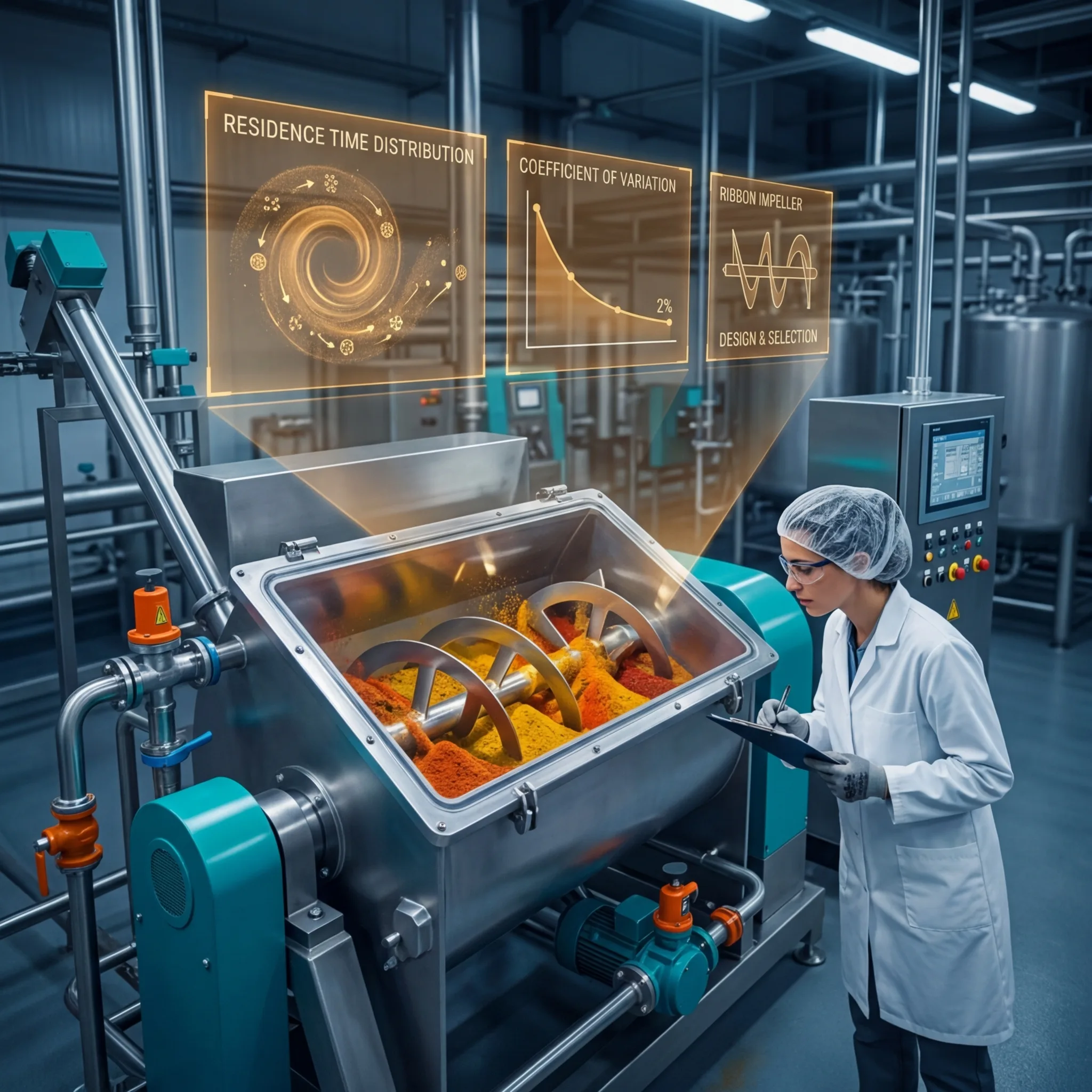
A compliant manufacturer selects a ribbon mixer designed for food blending with proper batch time and discharge system. Achieves 2% coefficient of variation (excellent uniformity). Customer satisfaction increases.
Mixer selection directly impacts product quality, consistency, and shelf-life.
The Mixing Equipment Framework
Key Mixer Selection Criteria:
- Product Type: Dry powder, liquid, paste, slurry
- Volume: Batch size and throughput
- Viscosity: Affects mixing time and power consumption
- Particle Size Distribution: Impacts segregation risk
- Shear Sensitivity: Some products degrade with high-shear mixing
- Residence Time: Uniformity vs. processing time trade-off
- Cleanability: CIP requirements and changeover time
Common Mixer Types
Ribbon Mixer (Dry Blending):
- Design: Horizontal drum with helical ribbon impeller
- Application: Dry powders, spices, premixes
- Blend time: 5-20 minutes
- Uniformity: 2-5% coefficient of variation (good)
- Advantages: Simple, reliable, easy to clean
- Disadvantages: Segregation risk if particle size ratio exceeds 3:1
High-Shear Mixer (Emulsions, Pastes):
- Design: Rotor-stator assembly creating intense shear
- Application: Emulsions (mayonnaise, dressings), pastes
- Blend time: 2-10 minutes
- Energy input: High (50-100 HP for 100L batch)
- Advantages: Fine particle reduction, quick mixing
- Disadvantages: Heat generation, high power cost
Planetary Mixer (Bakery, Confectionery):
- Design: Multiple impellers (paddle, hook, whip) rotating around bowl
- Application: Dough, batters, fillings
- Blend time: 5-15 minutes
- Consistency: Very uniform
- Advantages: Multiple actions (mixing, kneading, whipping)
- Disadvantages: Batch-only, complex cleaning
Continuous Blender (High-Volume):
- Design: Ribbon in horizontal drum with constant feed
- Application: High-volume dry blending, flour enrichment
- Throughput: 500-2000 kg/hour
- Residence time: 30-60 seconds
- Advantages: High capacity, consistent output
- Disadvantages: Segregation risk, setup complexity
Mixer Design Parameters
Residence Time Distribution (RTD):
RTD describes how long particles remain in mixer (variance in exit time).
Ideal: All particles mix equally (narrow RTD) Reality: Some fast particles exit early, some slow particles exit late
Narrower RTD = better uniformity
- Reduce particle size
- Increase mixer intensity
- Optimize batch time
Coefficient of Variation (CV):
CV = (Standard Deviation / Mean) x 100%
Acceptance criteria:
- Excellent: CV under 2%
- Good: CV 2-5%
- Acceptable: CV 5-10%
- Poor: CV over 10%
Mixing Time vs. Segregation Trade-Off:
| Mixing Time | Uniformity | Segregation Risk |
|---|---|---|
| Too short (1-2 min) | Poor | High |
| Optimal (5-10 min) | Excellent | Low |
| Too long (30+ min) | Excellent | Increases (wear/friction) |
Optimize for balanced performance, typically 8-12 minutes for ribbon mixers.
Scaling Considerations
Lab to Pilot to Commercial Scale:
| Parameter | Lab (5L) | Pilot (50L) | Commercial (500L) |
|---|---|---|---|
| Batch time | 10 min | 12 min | 15 min |
| Power input | 0.1 kW | 1 kW | 7.5 kW |
| Specific energy | 600 J/kg | 650 J/kg | 750 J/kg |
Scaling Rules:
- Increase batch time (geometry increases residence time variability)
- Increase specific energy (kW per kg to maintain mixing intensity)
- Test at commercial scale before full production
CIP Integration
Design for cleaning:
- Quick-disconnect inlet/outlet
- Spray ball inside mixer
- Drain valve at lowest point
- Product contact surfaces smooth (Ra under 0.8 micrometers)
- Removable paddles for inspection
Equipment Selection Worksheet
| Criterion | Weight | Score (1-10) | Equipment A | Equipment B |
|---|---|---|---|---|
| Uniformity capability | 30% | -- | 8 | 9 |
| Batch time | 20% | -- | 7 | 8 |
| Cleaning ease | 20% | -- | 9 | 7 |
| Cost | 15% | -- | 8 | 6 |
| Maintenance | 15% | -- | 8 | 7 |
| Weighted Score | 100% | -- | 7.9 | 7.9 |
For food manufacturing companies, proper mixer selection and operation optimization ensures consistent product quality, reduces waste, and improves efficiency.