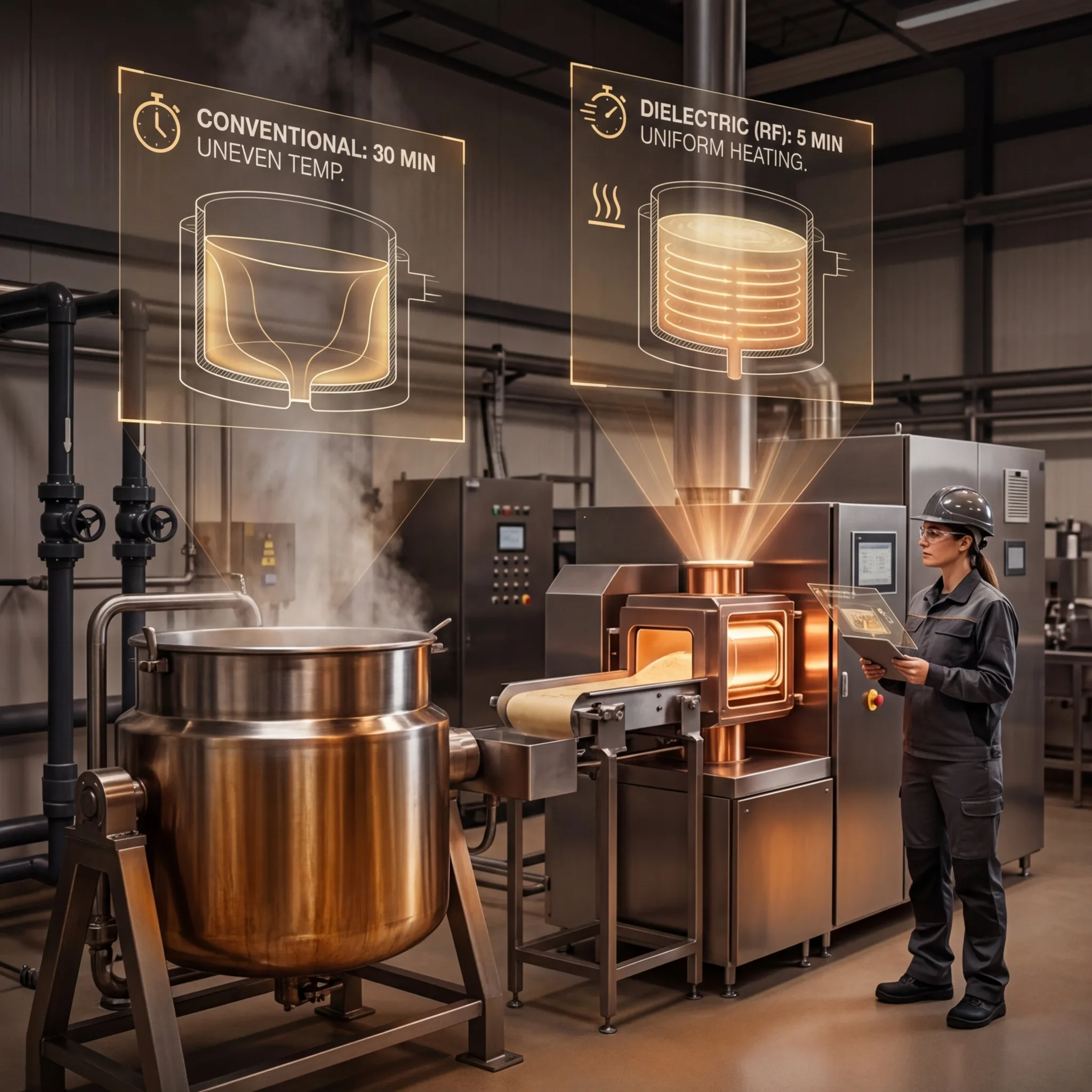
A sauce manufacturer heats product conventionally in steam-jacketed kettle (30 minutes). Result: Surface overcooks (browning, flavor loss), center under-heated. Texture degradation. Heat damage to flavor compounds. Quality inconsistent.
A modern facility installs RF heating system. Product heats volumetrically (entire volume heats uniformly). 5 minutes total time. Texture perfect. Flavor preserved. Quality premium tier achievable.
Microwave and RF heating directly impact processing time and product quality.
The Rapid Heating Framework
Conventional vs. Dielectric Heating:
Conventional (Conduction):
- Heat applied to surface
- Conducts inward slowly
- Surface hottest (overcooking risk)
- Time: 30-60 minutes typical
Dielectric (Microwave/RF):
- Electromagnetic energy penetrates volume
- Heats throughout simultaneously
- More uniform temperature
- Time: 5-15 minutes typical
Microwave Heating
Principle:
Electromagnetic radiation at 2.45 GHz
- Polar molecules (water, fats) rotate rapidly
- Friction generates heat
- Direct energy conversion (volumetric heating)
Penetration Depth:
Frequency: 2.45 GHz (standard microwave)
- Penetration: 3-5 cm typical (depends on dielectric properties)
- Limitation: Thick products may have cold spots in center
Equipment:
Industrial Microwave Tunnel:
- Design: Conveyor through microwave cavity
- Power: 30-100 kW typical
- Throughput: 500-2,000 kg/hour
- Application: Reheating, precooking, tempering
Advantages:
- Rapid heating
- Energy efficient (direct conversion)
- Compact equipment
Disadvantages:
- Non-uniform heating (standing waves create hot/cold spots)
- Limited penetration
- Moisture loss possible
Radio Frequency (RF) Heating
Principle:
Lower frequency electromagnetic radiation (13.56 or 27.12 MHz)
- Polar molecules rotate (similar to microwave)
- Lower frequency = deeper penetration
- More uniform heating throughout product
Penetration Depth:
Frequency: 13.56 MHz (common RF frequency)
- Penetration: 10-20 cm (much deeper than microwave)
- Result: Thick products heat uniformly
Equipment:
RF Dielectric Heater:
- Design: Product passes between electrode plates
- Power: 50-200 kW typical
- Throughput: 500-3,000 kg/hour
- Application: Thick products, batch heating, post-bake drying
RF Process:
- Product placed between electrodes (parallel plates)
- RF field applied (oscillating electric field)
- Product heats volumetrically
- Uniform temperature achieved throughout
- Product removed (no residual heat source)
Advantages:
- Very uniform heating (deep penetration)
- Rapid processing (5-10 minutes vs. 30-60)
- Thick products feasible
- Quality preservation (less heat damage)
Disadvantages:
- High capital cost ($200K-500K)
- Complex operation (requires skilled operators)
- Product must have sufficient dielectric properties
Food Safety Validation
Cold Spot Identification:
RF/microwave creates non-uniform heating patterns
- Federal requirement: Validate that cold spots reach lethal temperature
- Method: Thermocouples in multiple locations (grid pattern)
- Requirement: All locations at or above target temperature (e.g., 70C for pathogens)
Validation Study:
- Place 20-30 thermocouples in product (3D grid)
- Run heating cycle
- Record temperatures at all locations
- Identify coldest spot
- Verify cold spot at or above 70C (or target)
- Establish process parameters (time, power)
Acceptance Criteria:
All points must reach minimum safe temperature
- Example: 70C for 2 minutes (pathogen reduction)
- If any point under 70C: Increase time or power, re-validate
Quality Advantages
Compared to Conventional Heating:
| Factor | Conventional | Microwave/RF |
|---|---|---|
| Time | 30-60 min | 5-15 min |
| Uniformity | Poor (surface hot) | Good (volumetric) |
| Nutrient retention | 70-80% | 85-95% |
| Flavor | Some degradation | Minimal degradation |
| Texture | May overcook surface | Better preservation |
| Energy efficiency | 40-60% | 60-80% |
Reason: Shorter time = less exposure to heat = less degradation
Application Examples
Microwave:
- Tempering frozen meat (thawing)
- Precooking bacon
- Pasteurizing ready meals
- Reheating prepared foods
RF Heating:
- Post-bake drying (crackers, cookies)
- Thick product pasteurization (casseroles)
- Insect disinfestation (grains)
- Rapid warming of viscous products
Equipment Selection
| Factor | Microwave | RF |
|---|---|---|
| Product thickness | under 5 cm | over 5 cm |
| Uniformity need | Moderate | High |
| Penetration | Shallow | Deep |
| Capital cost | $100-300K | $200-500K |
| Energy efficiency | 60-70% | 60-80% |
| Application | Surface/thin | Thick/bulk |
For specialty food manufacturers, microwave and RF heating enable rapid processing with superior quality preservation.