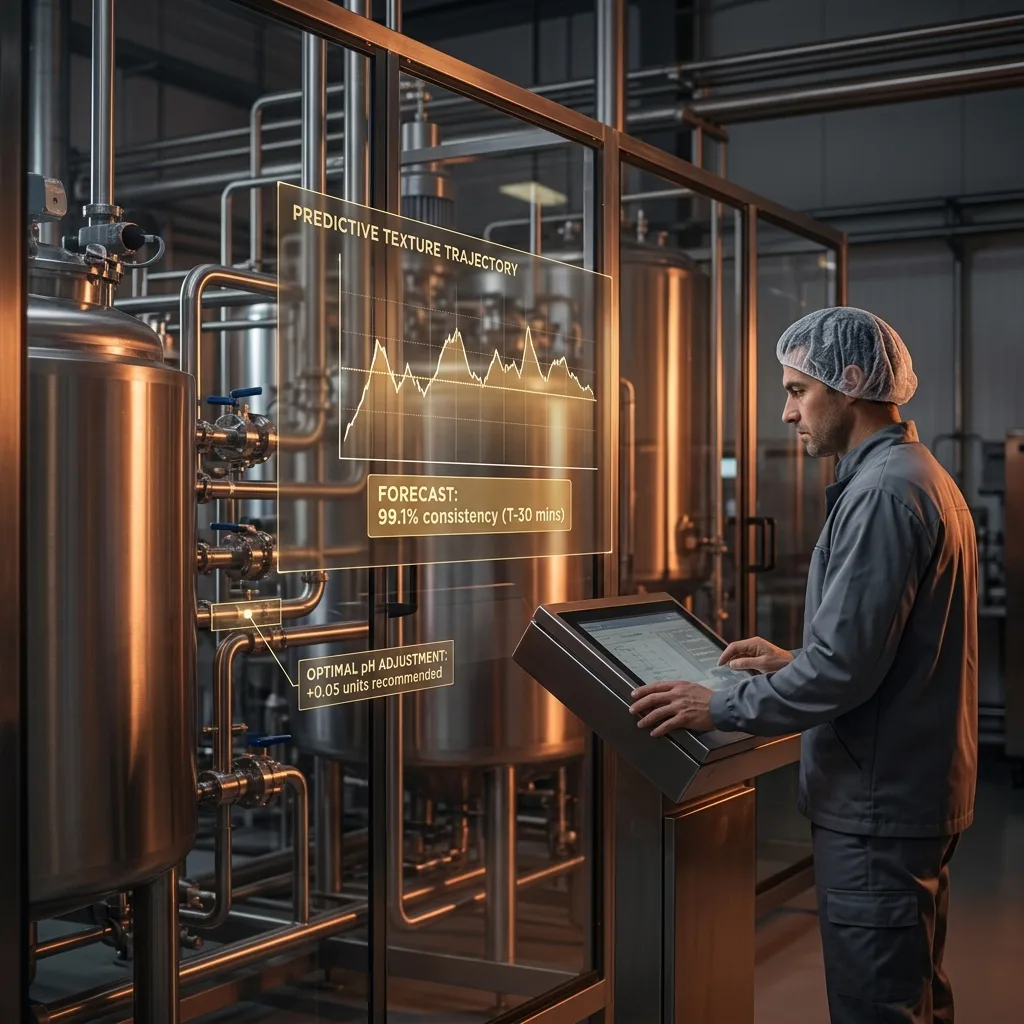
A dairy facility experiences batch-to-batch texture variation (10-15% inconsistency). Result: Rework needed, consumer complaints, premium market lost, production inefficiency.
An advanced facility deploys machine learning system: Real-time sensors (temperature, pH, moisture) feed AI model, predicts quality 30 minutes ahead. Result: Proactive adjustments prevent defects, texture consistency 99%+, zero rework, throughput +15%, premium quality positioned, customer satisfaction +40%.
Machine learning directly impacts product consistency and predictive quality assurance.
The Machine Learning Framework
What is Machine Learning?
AI system learns from data patterns:
- Training: Model learns from historical data
- Prediction: Forecasts future outcomes
- Optimization: Recommends process adjustments
- Continuous improvement: Model improves over time
- Advantage: Captures non-linear relationships humans miss
vs. Traditional Process Control:
| Method | Speed | Accuracy | Adaptation | Cost |
|---|---|---|---|---|
| Manual adjustment | Slow (hours) | 80-90% | Subjective | Low |
| PLC/SCADA | Real-time | 85-95% | Programmed rules | Medium |
| Machine learning | Real-time | 92-98% | Adaptive/learning | High |
Machine Learning Process
Step 1: Data Collection
Gather historical data:
- Process parameters: Temperature, pH, moisture, pressure, flow rate
- Equipment sensors: Speed, timing, vibration
- Environmental: Ambient temperature, humidity
- Product: Quality metrics (texture, color, consistency)
- Timeframe: Minimum 6-12 months continuous data
Step 2: Data Preparation
Clean and organize:
- Remove errors: Sensor glitches, outliers
- Normalize: Scale variables (0-1 range)
- Engineer features: Create new predictive variables
- Balance: Equal representation of good/bad outcomes
Step 3: Model Training
AI algorithm learns patterns:
- Algorithm options: Neural networks, random forest, gradient boosting
- Training set: 70% of historical data
- Validation set: 30% (verify accuracy)
- Outcome: Model learns to predict quality
Step 4: Validation and Testing
Verify accuracy:
- Blind test set: New data model hasn't seen
- Accuracy metrics: Precision, recall, F1 score
- Threshold: Typically over 92% accuracy required
- Production readiness: Deploy if performance acceptable
Step 5: Deployment and Monitoring
Real-time operation:
- Integration: Sensors feed data continuously
- Prediction: Model predicts quality 30-60 min ahead
- Alerts: Flags deviation from optimal path
- Adjustment: Recommends process changes
- Feedback: Learns from actual outcomes
Applications
Application 1: Yogurt Fermentation Prediction
Challenge: Achieve target pH (4.35) consistently
ML approach:
- Train model on 12 months fermentation data
- Input variables: Temperature, time, culture viability, milk composition
- Model predicts: End-point pH achievement (4.35 +/-0.05)
- Forecast: 30 minutes before completion
- Action: Recommend cooling time adjustment
- Result: 99%+ consistency, zero rework
Application 2: Meat Seasoning Optimization
Challenge: Consistent taste batch-to-batch
ML approach:
- Inputs: Meat source, fat content, seasoning batch, mixing time, temperature
- Output: Predicted taste score (consumer panel-trained)
- Prediction: Forecast final taste before completion
- Optimization: Recommend ingredient adjustments
- Improvement: Taste consistency +90-95%
Application 3: Jam Color Consistency
Challenge: Consistent color despite fruit variation
ML approach:
- Inputs: Fruit type, ripeness, sugar ratio, cooking time, temperature
- Output: Final color (Lab* color space)
- Prediction: Real-time monitoring during cooking
- Adjustment: Recommend temperature change if off-target
- Result: Color variation under 5% (vs. 15% manual)
Benefits
Consistency: Predictable product quality Efficiency: Fewer batches reworked Speed: Quicker decision-making Adaptation: Learns from new conditions Optimization: Finds optimal parameter combinations Cost savings: Reduced waste, increased throughput
Cost-Benefit Analysis
| Factor | Cost/Impact |
|---|---|
| Data infrastructure | $50-200K |
| ML model development | $30-100K |
| Integration/deployment | $20-50K |
| Ongoing maintenance | $5-20K/year |
| Total investment | $100-370K |
| Rework reduction | 10-15% to 1-2% |
| Throughput increase | +15-25% |
| Consistency improvement | +90-95% |
| Premium product | +$1-5/unit possible |
| ROI | 18-36 months |
For process-intensive manufacturers, machine learning enables predictive quality assurance.