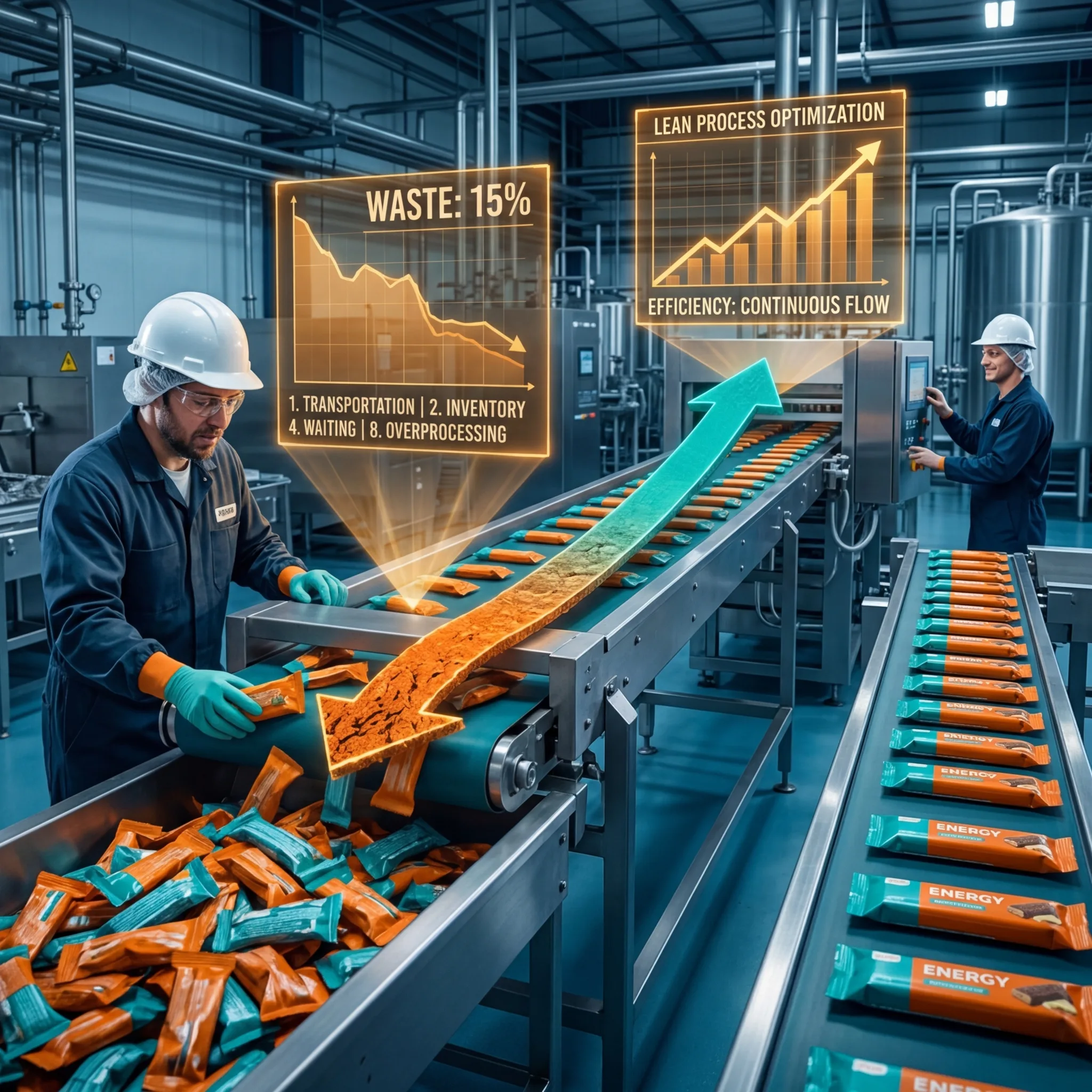
A food manufacturer produces 1,000 units daily. But only 850 reach customers as quality product. 150 units (15%) wasted through inefficiency, quality issues, overproduction.
Lean manufacturing systematically eliminates waste, increasing output from same resources.
The 8 Wastes of Manufacturing
1. Transportation:
- Unnecessary movement of materials between processes
- Example: Raw ingredients stored far from production
- Solution: Organize layout minimizing material movement
2. Inventory:
- Excess raw materials, work-in-process, finished goods
- Ties up working capital, increases storage cost
- Solution: Just-in-time (JIT) inventory reducing stock levels
3. Motion:
- Unnecessary operator movement during work
- Reaching, bending, walking between stations
- Solution: Ergonomic workstation design
4. Waiting:
- Idle time waiting for next process step
- Equipment waiting for setup
- Solution: Balanced production flow reducing bottlenecks
5. Overprocessing:
- Extra steps not adding customer value
- Example: Excessive inspection/testing
- Solution: Focus on value-added steps only
6. Overproduction:
- Making more than customer needs now
- Increases inventory, storage cost
- Solution: Produce to demand signals (pull system)
7. Defects:
- Quality issues requiring rework or scrap
- Most expensive waste
- Solution: Prevent defects vs. inspect after
8. Skills Underutilized:
- Employee ideas not sought/implemented
- Knowledge wasted
- Solution: Engage employees in improvement
Lean Implementation Roadmap
Phase 1: Training and Awareness (Month 1)
- Educate leadership on lean principles
- Conduct plant-wide lean overview training
- Identify lean coordinator/leader
Phase 2: Value Stream Mapping (Month 2)
- Document current process flow (raw material to customer)
- Identify waste and value-added steps
- Design future (improved) state
Phase 3: Pilot Projects (Months 3-6)
- Select 2-3 high-waste processes
- Form improvement teams
- Implement changes on pilot
Phase 4: Scaling (Months 6-12)
- Expand to additional processes
- Continuous refinement based on pilot learnings
- Sustain through monitoring and continuous improvement
Lean Tools
5S (Workplace Organization):
- Sort: Remove unnecessary items
- Set: Organize remaining items
- Shine: Clean and organize
- Standardize: Create standard procedures
- Sustain: Maintain discipline
Value Stream Mapping:
- Visual representation of process flow
- Identify value-added vs. waste steps
- Design future state
Kaizen (Continuous Improvement):
- Small, incremental improvements
- Employee-driven
- Ongoing refinement mindset
Standard Work:
- Document best practice
- Teach all operators same method
- Foundation for improvement
Lean Impact Example
Baseline (Current State):
- Production: 1,000 units/day
- Scrap: 8% (80 units)
- Rework: 5% (50 units)
- Total waste: 13% (130 units)
- Labor: 10 operators
After Lean (6-Month)
- Production: 1,100 units/day (10% improvement from eliminating downtime)
- Scrap: 3% (33 units)
- Rework: 2% (22 units)
- Total waste: 5% (55 units)
- Labor: 9 operators (productivity improvement)
Financial Impact:
- Revenue improvement: 100 additional units x $500 = $50K/day = $12.5M annually
- Scrap/rework reduction: 75 units x $50 = $3.75K/day = $940K annually
- Labor productivity: 1 FTE saved = $80K annually
- Total benefit: approximately $13.5M annually
Critical Success Factors
- Management commitment: Resource allocation, time for implementation
- Employee engagement: Frontline input, empowerment
- Patience: Sustained effort over months/years
- Measurement: Track metrics before/after
- Communication: Share progress, celebrate wins
For food manufacturing companies, systematic lean implementation eliminates waste while improving efficiency, quality, and profitability.