
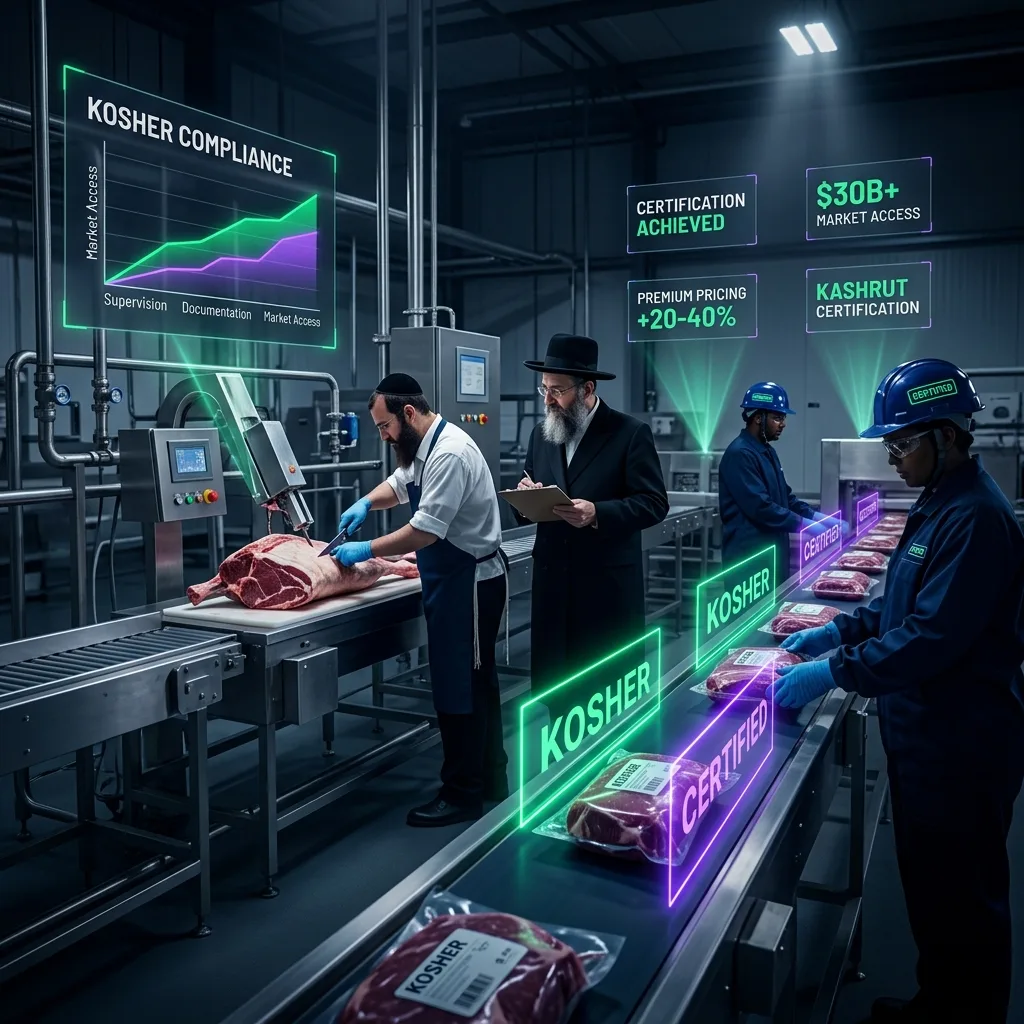
A meat processor packages beef products for general market. Result: Cannot access kosher market ($30B+ global), religious consumers excluded, premium segment lost.
A dedicated facility implements kosher processing: Separate equipment, trained shochet (kosher slaughterman), rabbinical supervision, batch certification. Result: Full kosher certification achieved, rabbinical seal on package, kosher market access ($30B+), premium +20-40% pricing sustained, religious community trust established.
Kosher certification directly impacts market access and premium positioning.
The Kosher Processing Framework
What is Kosher?
Food prepared according to Jewish dietary law (Kashrut):
- Definition: Permitted by Jewish law (Halakhah)
- Religious requirement: Observant Jews only consume kosher
- Market significance: $30B+ global market
- Certification: Third-party rabbinical verification required
Consumer Base:
- Observant Jews: 13+ million in USA
- Holiday observers: Additional seasonal demand
- Health-conscious: Non-religious consumers attracted to kosher standards
- Vegetarian/ethical: Kosher standards appeal to values-driven consumers
Kosher Dietary Laws
Permitted Animals (Meat):
Requirements: Must have BOTH characteristics
- Cloven hoof (split hoof)
- Cud-chewing (ruminant)
Permitted:
- Cattle (beef)
- Sheep (lamb, mutton)
- Goat (goat meat)
Prohibited:
- Pork (has cloven hoof, but doesn't chew cud)
- Rabbit (chews cud, but no cloven hoof)
- Predators (lions, bears, wolves)
- Horses, camels, other non-conforming animals
Fish:
Requirement: Must have BOTH characteristics
- Fins (swimming apparatus)
- Scales (protective covering)
Permitted:
- Salmon, tuna, herring, cod (fins + scales)
Prohibited:
- Shellfish: Lobster, crab, shrimp (no scales)
- Catfish, eel (no scales)
- Bottom-feeders (shellfish designation)
Dairy and Meat:
Restriction: Cannot mix meat and dairy
- Separate meals: Meat meal, then dairy meal later
- Separate utensils: Meat dishes never used for dairy
- Separate preparation: Different cutting boards, pots
Produce:
Requirement: Free of insects (considered non-kosher)
- Challenge: Leafy greens easily infested
- Solution: Thorough inspection/washing required
- Special markets: Pre-certified kosher produce available
Kosher Slaughter (Shechita)
Certification Requirement: Only method that makes meat kosher
Process:
- Training: Shochet (trained slaughterman) certified by rabbinical authority
- Prayer: Jewish blessing recited before slaughter
- Method: Rapid, single cut to neck (specific technique)
- Knife: Razor-sharp, certified, no irregularities (checked before each animal)
- Examination: Post-slaughter inspection for defects (negating slaughter)
- Certification: Rabbi verifies animal meets standards
Comparison to Standard Slaughter:
- Standard: Mechanical stunning (electric, bolt)
- Kosher: No stunning (consciousness requirement)
- Advantage: Religious requirement met
- Debate: Animal welfare considerations (ongoing discussion)
Kosher Certification Process
Step 1: Facility Audit
Rabbi inspects:
- Equipment: Separate for meat/dairy (if both produced)
- Cleaning: Verification of sanitation standards
- Ingredients: All suppliers certified kosher
- Procedures: Written protocols for kosher compliance
Step 2: Slaughter Supervision
On-site rabbi:
- Witnesses each slaughter
- Verifies shochet qualifications
- Inspects knife before slaughter
- Post-slaughter examination (checking for defects)
- Approves/rejects animals based on inspection
Step 3: Processing Verification
Ongoing oversight:
- Production batches monitored
- Ingredients verified kosher
- Cross-contamination prevention verified
- Documentation maintained
Step 4: Certification Issuance
Rabbinical authority:
- Issues certification letter
- Authorizes kosher symbol on package (Hechsher)
- Renewal: Annual re-certification required
- Ongoing compliance: Rabbi may audit without notice
Kosher Certification Bodies
Major Organizations:
| Organization | Region | Stringency | Market Reach |
|---|---|---|---|
| Orthodox Union (OU) | USA/Global | Strict | Highest (most recognized) |
| Star-K | USA/Global | Moderate-strict | High |
| Kof-K | USA/Global | Moderate | High |
| Rabbinical Assembly | USA/Global | Conservative | Moderate |
| Israeli Rabbinate | Israel/Global | Variable | Recognized in Israel |
Symbol Recognition:
- Consumers look for Hechsher (certification symbol)
- Well-known symbols: OU, Star-K (highest consumer recognition)
- Premium positioning: Certification symbol on packaging
Cost-Benefit Analysis
| Factor | Cost/Impact |
|---|---|
| Facility modifications | $50-200K |
| Shochet training | $5-15K |
| Rabbinical supervision (annual) | $1-5K (initial), $500-2K (ongoing) |
| Certification body fees | $500-2K/year |
| Documentation/compliance | $2-5K/year |
| Market access | $30B+ global kosher market |
| Premium pricing | +20-40% justified |
| Target consumers | 13M+ USA (religious + ethical) |
| ROI | 2-3 years (dedicated kosher facility) |
For meat processors, kosher certification enables premium market access and religious consumer trust.