A juice manufacturer uses traditional thermal evaporation. Result: Juice concentrated but flavor flat (heat destroys volatile compounds). Product tastes cooked. Consumer rejection. Premium market lost.
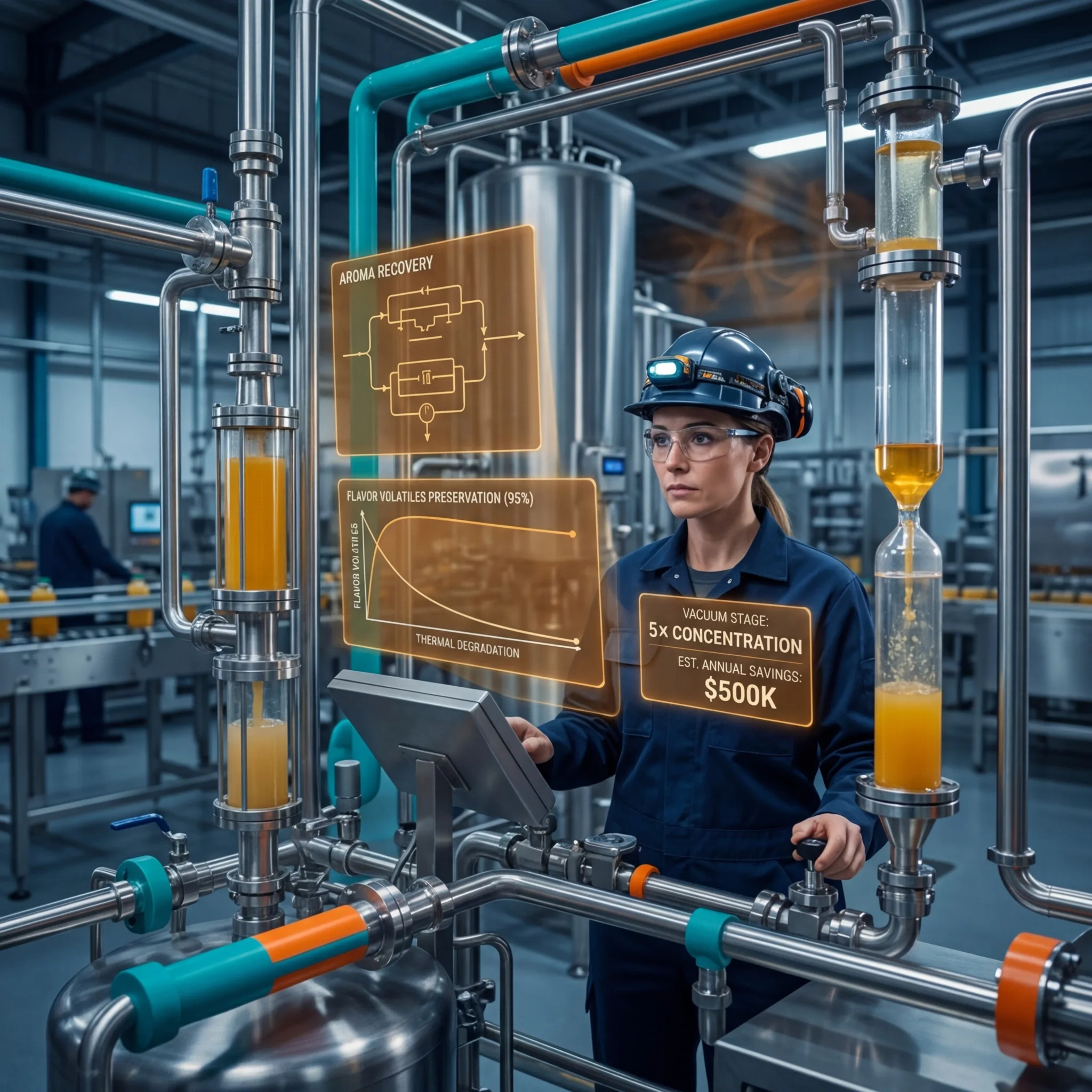
A modern processor uses vacuum evaporation + aroma recovery. Juice concentrated to 50% solids (5x lighter for shipping), aroma compounds captured separately, then recombined. Result: Concentrated juice tastes fresh (aroma restored). Reduced shipping costs ($500K annually saved). Premium quality maintained.
Juice concentration with flavor preservation enables cost efficiency while maintaining quality.
The Juice Concentration Framework
Why Concentrate Juice?
Benefits of concentration:
- Volume reduction: 5-10x smaller (shipping cost savings)
- Weight reduction: 80-90% weight loss
- Shelf-life: Concentrated juice stores longer (less water)
- Ingredient form: Easier to transport, blend
Juice Composition:
| Component | Percentage | Impact |
|---|---|---|
| Water | 85-90% | Bulk, adds weight |
| Sugars | 10-15% | Sweetness, nutrient |
| Acids | 0.5-2% | Flavor, preservation |
| Volatiles | under 0.1% | Aroma (easily lost) |
| Fiber/solids | 1-5% | Nutrition, texture |
Challenge: Volatiles (aroma) destroyed by heat during concentration
Concentration Methods
Method 1: Thermal Evaporation (Traditional)
Process: Heat juice to evaporate water
- Temperature: 50-80 degrees C (low to preserve flavor)
- Time: 30-60 minutes typical
- Equipment: Large evaporation chamber
- Result: Water removed, juice concentrated
Problem: Heat destroys aroma compounds
- Volatiles: Lost at over 40 degrees C (aromatics escape)
- Flavor: Cooked, flat taste results
- Quality: Reduced premium value
Method 2: Vacuum Evaporation (Better)
Process: Lower pressure reduces boiling point
- Pressure: 0.1-0.5 bar (vacuum)
- Temperature: 30-50 degrees C (much lower than atmospheric)
- Benefit: Lower temp preserves more aroma
- Result: Better flavor, but some loss still occurs
Pressure-Temperature Relationship:
| Pressure (bar) | Boiling Point (degrees C) | Volatiles Loss |
|---|---|---|
| 1.0 (atmospheric) | 100 | 70-80% lost |
| 0.5 (moderate vacuum) | 65 | 40-50% lost |
| 0.1 (high vacuum) | 45 | 20-30% lost |
| 0.05 (ultra-high) | 37 | 10-15% lost |
Method 3: Vacuum Evaporation + Aroma Recovery (Best)
Process: Three-stage approach:
Stage 1: Aroma Capture
- Before evaporation: Volatile compounds captured
- Method: Condenser captures aromatic vapors
- Storage: Frozen or sealed (-18 degrees C)
- Preservation: Aroma protected from heat
Stage 2: Juice Concentration
- Process: Vacuum evaporation (no volatiles present)
- Temperature: 30-50 degrees C safe (no flavor loss)
- Result: Concentrated juice (50-65% solids)
Stage 3: Aroma Recombination
- Process: Add captured aroma back to concentrate
- Timing: Just before packaging
- Result: Fresh juice flavor restored
- Quality: Near-fresh juice taste achieved
Advantage: Combines benefits
- Small volume (cheaper shipping)
- Fresh flavor (like fresh-squeezed)
- Extended shelf-life (concentrated form)
Freeze Concentration (Alternative)
Process: Partial freezing, ice removal
- Temperature: -5 to -10 degrees C (gentle)
- Time: 8-12 hours (slow)
- Mechanism: Water freezes, juice stays liquid
- Equipment: Crystallizer vessel
- Result: 50-70% concentration, excellent flavor
Advantages:
- Very low temperature (minimal aroma loss)
- No vacuum equipment needed
- Premium quality preserved
Disadvantages:
- Very slow process
- High energy cost (refrigeration)
- Lower concentration achieved (not as dense)
Shelf-Life Impact
Fresh Juice: 3-7 days (water promotes spoilage)
Concentrated Juice (50% solids):
- Ambient: 6-12 months (low water inhibits microbes)
- Refrigerated: 12-24 months
- Frozen: 24+ months
Reason: Water activity (Aw) reduced
- Fresh juice: Aw 0.99 (microbes thrive)
- Concentrate: Aw 0.85 (microbes inhibited)
Cost-Benefit
| Factor | Impact |
|---|---|
| Vacuum evaporator | $300-800K |
| Aroma recovery system | $100-300K |
| Total capital | $400-1,100K |
| Volume reduction | 5-10x smaller |
| Shipping cost | -70-80% reduction |
| Flavor quality | Fresh-like (preserved) |
| Shelf-life | 3-7 days to 12-24 months |
| Payback | 2-4 years |
For juice manufacturers, vacuum evaporation with aroma recovery enables cost-efficient shipping while maintaining premium quality.