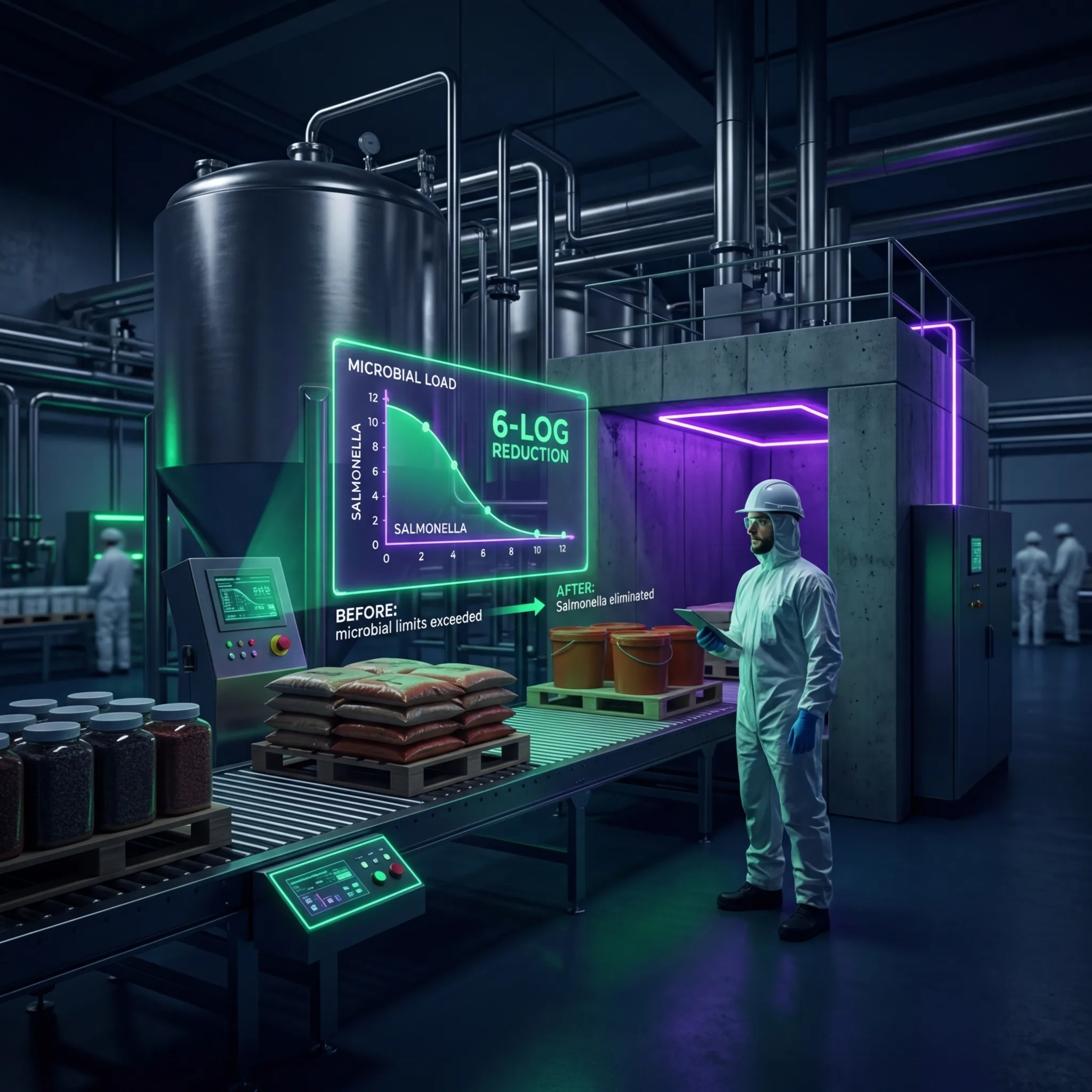
A spice processor struggles with microbial limits exceeding FDA standards. Result: Products frequently exceed Salmonella limits (over 10 CFU/g). Recalls occur. Market access limited. Export to EU impossible.
A compliant processor installs irradiation partnership arrangement (gamma facility). Microbial load reduced 6-log (over 99.9999%). Salmonella consistently eliminated (under 1 CFU/g). Market access restored. Export markets enabled. Premium positioning achieved.
Irradiation technology directly impacts food safety and market access.
The Irradiation Framework
Principle:
Ionizing radiation damages microbial DNA, causing cell death
- No heat applied (cold processing)
- No radioactive residue (food not radioactive after treatment)
- FDA approved for specific foods since 1980s
Dose Measurement:
Unit: Gray (Gy) or kiloGray (kGy)
- 1 Gy = absorption of 1 Joule of energy per kg
- 1 kGy = 1,000 Gy
Irradiation Types
Gamma Radiation:
Source: Cobalt-60 (Co-60) or Cesium-137 (Cs-137)
- Penetration: Deep (full pallets possible)
- Energy: 1.17-1.33 MeV (Co-60)
- Facility: Shielded concrete bunker
- Safety: Radioactive source requires strict licensing
Advantages:
- Deep penetration (uniform treatment)
- Mature technology
- High capacity
Disadvantages:
- Radioactive source (public concern)
- High capital cost ($2M-10M+)
- Strict regulatory requirements
Electron Beam (E-beam):
Source: Linear accelerator (electrons)
- Penetration: Moderate (5-10 cm maximum)
- Energy: 5-10 MeV typical
- Facility: Smaller than gamma (less shielding)
- Safety: No radioactive material (turns off)
Advantages:
- No radioactive source
- Faster processing (on/off capability)
- Lower public concern
Disadvantages:
- Limited penetration (shallow products only)
- High capital cost ($1M-5M)
- Energy consumption high
X-ray Irradiation:
Source: X-rays generated by electron impact on metal target
- Penetration: Deep (similar to gamma)
- Energy: 5-7 MeV
- Facility: Moderate shielding
- Status: FDA approved, limited commercial deployment
Dose Levels and Applications
| Dose (kGy) | Purpose | Application |
|---|---|---|
| 0.05-0.15 | Insect disinfestation | Grains, fruits |
| 0.5-1.0 | Delay ripening | Fruits, vegetables |
| 1-3 | Reduce spoilage microbes | Fresh produce |
| 3-10 | Pathogen reduction | Spices, meat, poultry |
| 10-50 | Sterilization | Medical devices, herbs |
FDA-Approved Applications:
- Spices and herbs: Up to 30 kGy
- Fresh produce: Up to 1 kGy
- Meat and poultry: Up to 4.5 kGy (fresh), 7 kGy (frozen)
- Shellfish: Up to 5.5 kGy
Microbial Reduction
Example: Spice Treatment (10 kGy)
Pre-treatment: 10,000 CFU/g (Salmonella, E. coli, molds) Post-treatment: under 10 CFU/g Reduction: over 99.9% (3-4 log reduction)
Pathogen-Specific:
- Salmonella: D-value ~0.5 kGy (90% kill)
- 10 kGy = 20 D-values = over 18 log reduction
- E. coli O157:H7: D-value ~0.3 kGy
- Listeria: D-value ~0.5 kGy
Practical Result: Pathogens effectively eliminated
Quality Impact
Minimal Quality Changes (at approved doses):
- Color: Minimal change (under 5% difference)
- Flavor: Slight changes possible (high doses)
- Texture: No change (unlike thermal processing)
- Nutrients: Vitamin retention over 95% (better than thermal)
Advantages over Thermal Processing:
No heat = No cooking = Fresh-like quality maintained
Equipment and Process
Gamma Facility Design:
- Shielded room: 2-meter thick concrete walls
- Source rack: Cobalt-60 rods (activity: 1-5 million Curies)
- Product conveyor: Automated transport through radiation field
- Dose mapping: Ensure uniform dose distribution
- Safety systems: Interlocks, alarms, radiation monitoring
Processing:
- Product loaded on pallets or totes
- Conveyor transports through radiation field
- Exposure time: 10-30 minutes typical (dose-dependent)
- Dosimeters verify dose received
- Product exits facility (no residual radioactivity)
Regulatory and Labeling
FDA Requirements:
- Facility registration required
- Dose limits by food category
- Labeling: "Treated with radiation" or Radura symbol
- Record keeping: Dose, date, product
Consumer Perception:
Challenge: Public concern about "radiation" Solution: Education ("cold pasteurization," "electronic pasteurization") Trend: Increasing acceptance (food safety benefits recognized)
Cost-Benefit Analysis
| Factor | Cost/Impact |
|---|---|
| Capital cost | $2-10M (gamma facility) |
| Operating cost | $0.05-0.20 per kg |
| Microbial reduction | 99.9%+ pathogens eliminated |
| Market access | Export to EU, premium markets |
| Recall prevention | $500K-2M saved per recall avoided |
| Payback | 5-10 years (high volume) |
For spice, produce, and meat processors, irradiation technology provides unmatched microbial reduction and market access.