A cold-pressed juice company pasteurizes with heat (72C). Result: Heat damages fresh taste, destroys probiotics, vitamin C loss 25%. "Cold-pressed" claim becomes misleading.
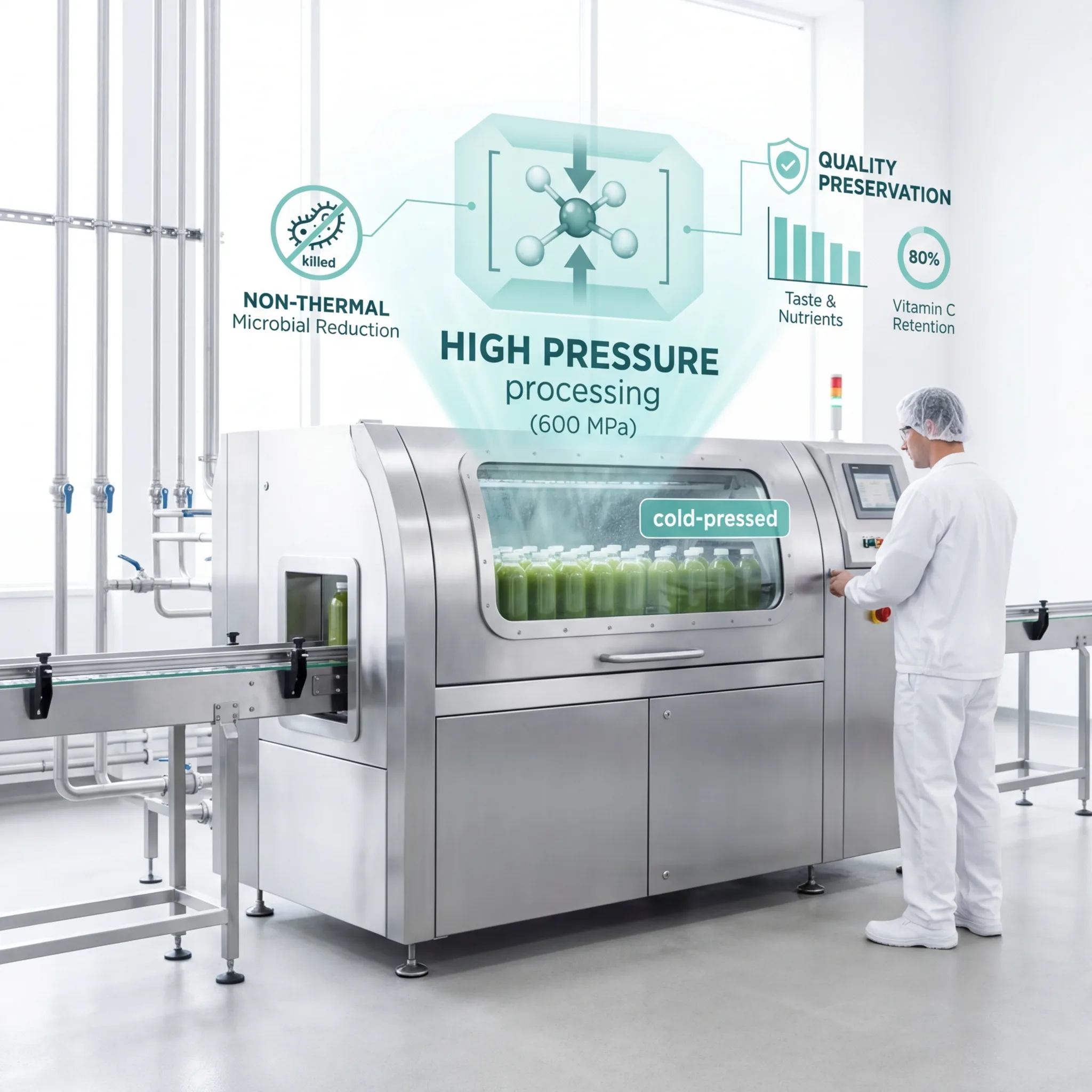
An innovative facility installs HPP system. Pressurized at 600 MPa (87,000 psi) for 3 minutes. Microbes inactivated without heating (product stays 4C). Fresh taste preserved. Probiotics survive. Vitamin C retained 95%. True "cold-pressed" claim enabled.
HPP technology enables microbial reduction while preserving "cold" quality claims.
The HPP Framework
Principle:
Ultra-high pressure (400-600 MPa) applied isostatically (uniform pressure from all directions)
- Pressure: 400-600 MPa typical (87,000 psi)
- Temperature: Room temperature or chilled
- Time: 2-10 minutes typical
- Result: Microbial inactivation without heat
Pressure Effects on Microbes:
High pressure disrupts:
- Cell membrane integrity (compromises integrity)
- Protein structures (denatures critical enzymes)
- DNA/RNA functionality (disrupts replication)
- Result: Cell death (microbial inactivation)
Key Advantage:
Non-thermal process = Fresh quality maintained
HPP Process
Basic Steps:
- Product loading: Fill pressure vessel with product
- Pressurization: Compress to 400-600 MPa (rapid, ~3 minutes)
- Hold: Maintain pressure for 3-10 minutes
- Depressurization: Release pressure (rapid, ~1 minute)
- Output: Inactivated product at room temperature
Entire Process: Under 15 minutes total (including pressurization)
Microbial Inactivation
Log Reduction Achieved:
- 400 MPa: 3-4 log reduction (99-99.99%)
- 500 MPa: 4-5 log reduction (99.99-99.999%)
- 600 MPa: 5-6 log reduction (99.999-99.9999%)
Pathogen Effectiveness:
| Pathogen | Pressure (MPa) | Log Reduction |
|---|---|---|
| E. coli O157:H7 | 400 | 4-5 log |
| Salmonella | 400 | 3-4 log |
| Listeria | 500 | 5-6 log |
| Yeasts/molds | 300-400 | 2-3 log |
Spore Resistance:
Bacterial spores are pressure-resistant
- Limitation: Lower pressure (under 300 MPa) required for food safety
- Advantage: Sufficient for most vegetative pathogens
Equipment Design
HPP Machine Components:
-
Pressure vessel: Steel cylinder (resistant to extreme pressure)
- Bore size: 300-600 mm diameter
- Length: 1-2 meters
- Rating: 600+ MPa pressure vessels
-
Pump system: Hydraulic intensifier (generates high pressure)
- Flow rate: 100-300 L per cycle
- Cycle time: 10-15 minutes
-
Product chamber: Package/container inside pressure vessel
- Material: Flexible packages or rigid containers
- Maximum: Fills entire chamber
-
Pressure monitoring: Real-time sensors
- Accuracy: +/-1 MPa
- Recording: Automatic documentation
Batch Process:
Vessel loaded, pressure applied, pressure held, release
- Capacity: 300-600 L per batch (depending on vessel size)
- Batches per hour: 4-6 typical
Quality Impact
Compared to Thermal Pasteurization (72C):
| Factor | Thermal (72C) | HPP (600 MPa) |
|---|---|---|
| Taste | Cooked flavor | Fresh taste |
| Vitamin C | 70-75% retained | 95-98% retained |
| Probiotics | Inactivated (killed) | Survive |
| Color | Browning possible | Bright, fresh |
| Texture | Some change | Unchanged |
| Shelf-life | 21 days | 30-45 days |
Why Quality Better?
HPP doesn't rely on heat damage mechanisms
- Proteins denatured differently (don't develop "cooked" flavors)
- Vitamins preserved (no thermal degradation)
- Probiotics survive (not heat-sensitive)
- Fresh character maintained
Applications
Ideal for HPP:
- Fresh juices (orange, citrus)
- Smoothies with probiotics
- Raw prepared meals
- Guacamole and fresh sauces
- Raw seafood
- Ready-to-eat meat products
Not Suitable:
- Thick products (pressure penetration issues)
- Products requiring heat (flavor development)
- Highly acidic products (alternative preservation methods sufficient)
Regulatory and Labeling
FDA Status:
HPP approved since 2000
- 21 CFR 430.2000 authorizes HPP
- Recognized as safe for most products
Labeling:
Can claim "Pasteurized by HPP" or "Pressure Treated"
- No special labeling requirement
- "Never heated" claims possible
- Consumer recognition growing
Equipment Cost and ROI
| Item | Cost |
|---|---|
| HPP Machine | $1-4 Million |
| Installation | $200-500K |
| Operating cost | $0.30-0.60 per L |
| Shelf-life benefit | 3x extension possible |
| Premium pricing | +50-100% market value |
| Payback | 3-5 years (premium products) |
ROI Driver: Premium market positioning (fresh-pressed, probiotic-rich, minimally processed)
For premium beverage and specialty food manufacturers, HPP enables "cold pasteurization" with superior quality preservation.