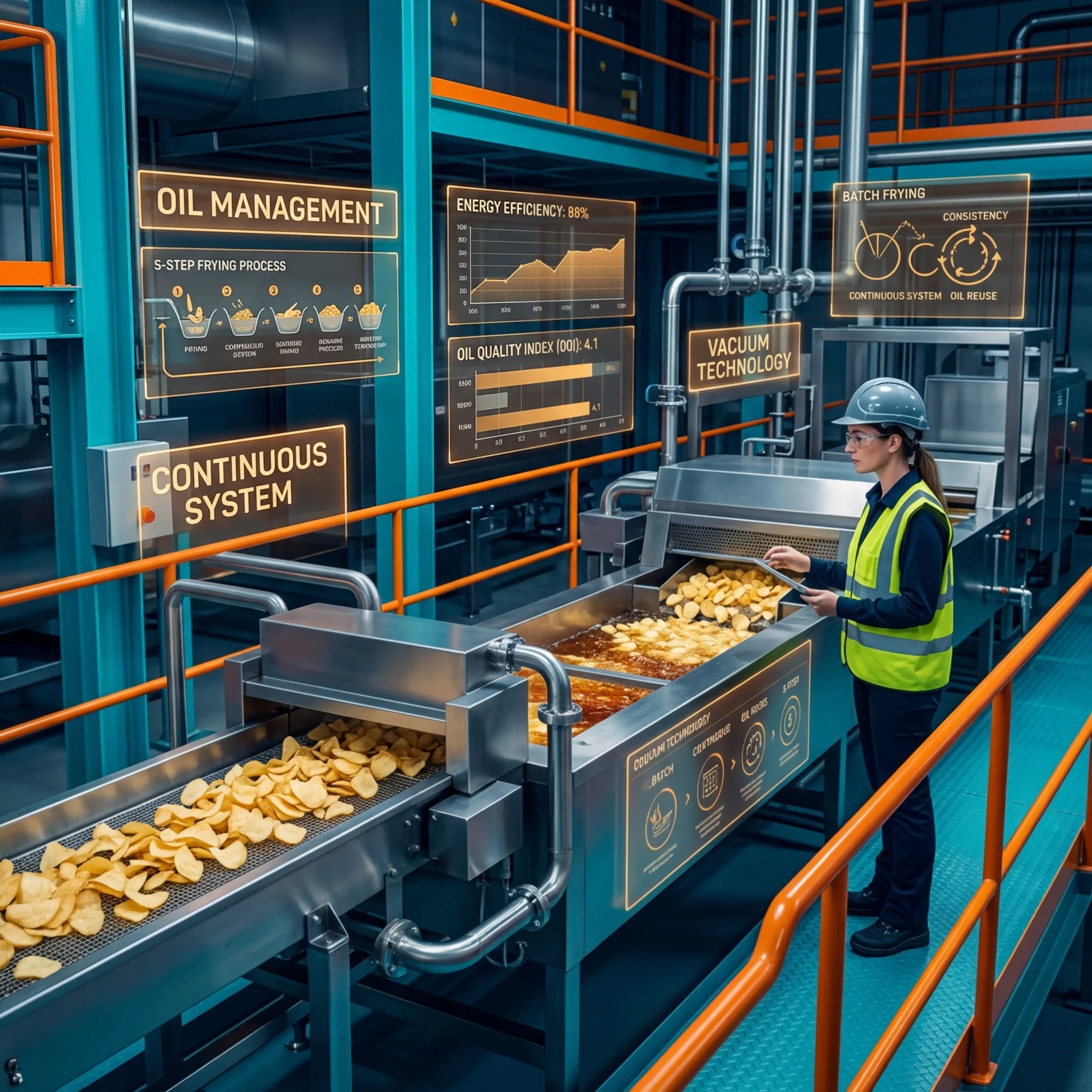
A chip manufacturer operates inefficient batch fryers with cold oil management issues. Result: Oil darkens quickly (absorbs burned particles). Reuse limited to 5 cycles. Flavor degradation evident. Cost high.
A modern facility installs continuous fryer with integrated filtration. Oil stays clean, reusable 30+ cycles. Flavor consistency maintained. Oil cost per unit drops 60%. Product quality premium tier achievable.
Frying equipment selection directly impacts product quality, oil efficiency, and profitability.
The Frying Framework
Core Frying Process:
- Oil heating: Reach target temperature (150-190 degrees C depending on product)
- Product immersion: Moisture removes, surface browns (Maillard reaction)
- Oil absorption: ~10-20% product weight absorbed (varies by product)
- Color development: Golden to brown (controlled by time/temperature)
- Oil removal: Draining (gravity or centrifugation)
Frying Equipment Types
Batch Fryer (Basket System):
Design: Stationary heated oil tank, product in basket, manual immersion
- Application: Small batches, specialty items, artisanal production
- Capacity: 5-50 kg per batch
- Time: 3-10 minutes per batch (depends on product thickness)
- Temperature: 150-180 degrees C (manual control common)
- Throughput: 50-150 kg/hour typical
Process:
- Heat oil to target temperature
- Submerge basket in hot oil
- Agitate basket (if available) for even frying
- Lift basket when target color achieved
- Drain oil (gravity drain)
- Cool product
Advantages: Simple, low capital cost, batch traceability Disadvantages: Slow, labor-intensive, temperature variation
Continuous Fryer (Belt or Screw Conveyor):
Design: Product moves through hot oil on conveyor
- Application: High-volume production (chips, snacks, fried dough)
- Capacity: 200-2,000 kg/hour (depending on model)
- Residence time: 30 seconds to 3 minutes (adjustable speed)
- Temperature: Precise control (+/-1 degrees C) via thermostat
- Throughput: Continuous (very high productivity)
Process:
- Product enters conveyor-belt fryer
- Travels through hot oil zone
- Exact residence time = exact color development
- Exits into draining section
- Oil recovery (gravity or centrifuge)
Advantages:
- High capacity
- Consistent product (exact time/temperature)
- Minimal labor
- Oil filtration can be integrated
Disadvantages:
- High capital cost ($100K-500K+)
- Complex operation
- Specific to product type
Vacuum Fryer (Low-Temperature):
Design: Operates under reduced pressure, enabling low-temperature frying
- Temperature: 80-100 degrees C (vs. 160-180 degrees C conventional)
- Advantages: Less nutrient loss, less acrylamide formation
- Application: Premium snacks, health-conscious products
- Capital cost: Premium ($300K-1M+)
- Throughput: Moderate (100-300 kg/hour typical)
Benefits:
- Nutrient retention: 20-30% better than conventional
- Acrylamide reduction: over 50% (health concern compound)
- Oil degradation slower (cooler temperature)
- Color control: Lighter (less browning)
Oil Management
Oil Quality Monitoring:
Critical parameters (daily testing):
- Total Polar Materials (TPM): Should be under 25%
- Acidity (FFA): Should be under 0.5%
- Color: Should remain light (comparison to standards)
- Viscosity: Should not increase dramatically
Oil Change Frequency:
| Equipment | TPM Accumulation | Oil Life |
|---|---|---|
| Batch fryer (manual) | Fast (5-8 cycles) | 2-3 days |
| Continuous fryer (filtration) | Slow (20-40 cycles) | 7-14 days |
| Vacuum fryer | Slowest (30-50 cycles) | 10-20 days |
Cost Impact:
Batch fryer: Change oil every 3 days
- 250 L tank x $8/L = $2,000 per change
- 3 changes/week = $6,000/week oil cost
Continuous with filtration: Change oil every 10 days
- Same tank, integrated filtration removes particles
- 1 change/week = $2,000/week oil cost
- Savings: $4,000/week = $200K annually
Safety Considerations
Temperature Management:
- Too hot (over 190 degrees C): Acrylamide formation, flavor deterioration
- Too cold (under 140 degrees C): Oil absorption excessive, greasy product
- Optimal: 160-180 degrees C for most snacks
Fire Prevention:
- Automatic temperature cutoff (safety device)
- Extinguishing system (Class B fire extinguisher)
- No water near oil (water + hot oil = explosion)
Personnel Safety:
- Hot oil can cause severe burns
- Proper PPE required (heat-resistant gloves, apron)
- Lockout/tagout during cleaning/maintenance
Equipment Selection Summary
| Type | Capacity | Quality | Cost | Oil Life |
|---|---|---|---|---|
| Batch | Low | Variable | Low | Short (3 days) |
| Continuous | High | Consistent | High | Medium (10 days) |
| Vacuum | Medium | Excellent | Very High | Long (20 days) |
For snack and prepared food manufacturers, proper frying equipment selection optimizes product quality, oil efficiency, and profitability.