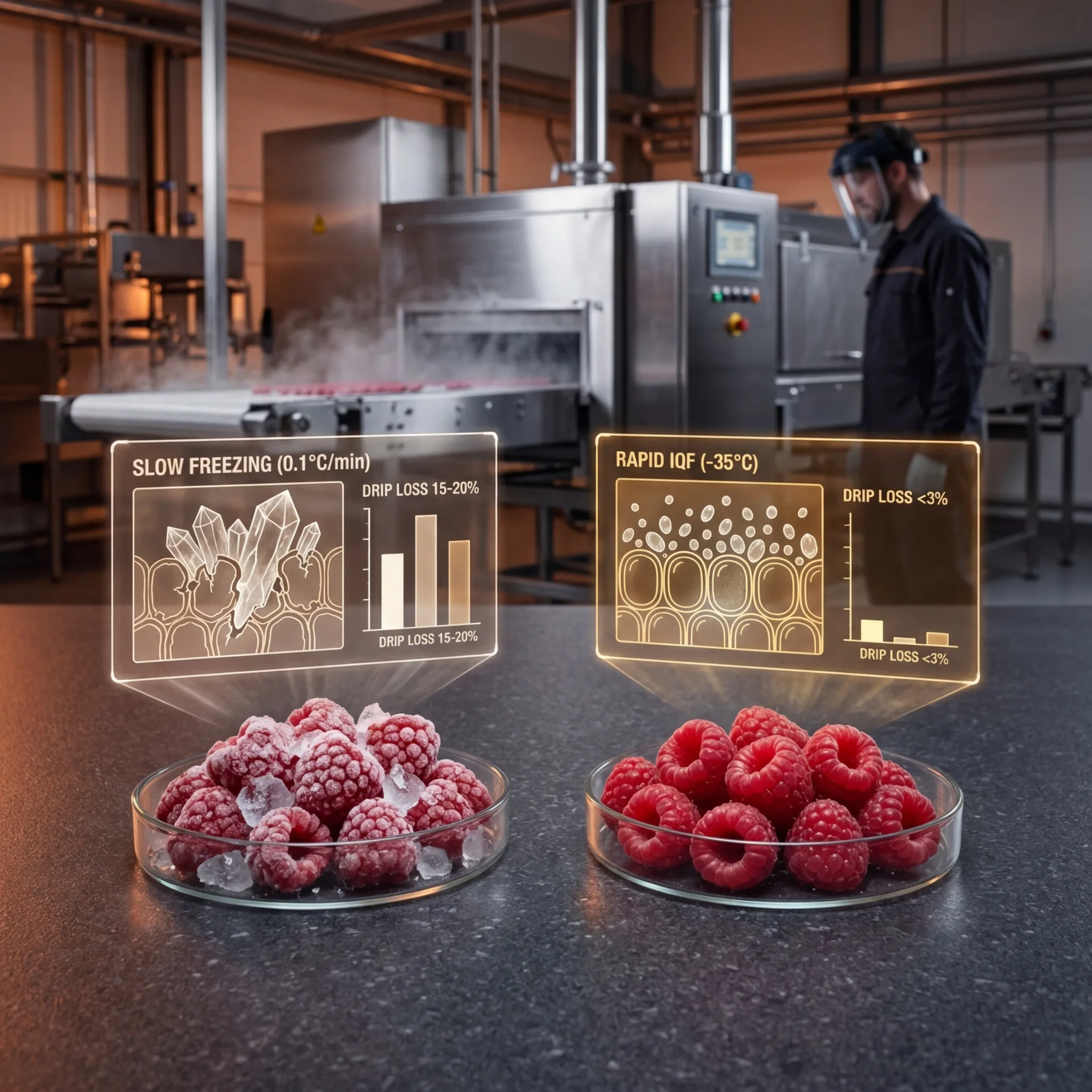
A frozen food manufacturer uses slow freezing (overnight in -18C freezer). Result: Large ice crystals form (10-100 micrometers), damaging cell structure. Thawed product mushy, drip loss 15-20%. Quality poor.
A modern facility installs IQF tunnel with -35C rapid freezing. Small crystals form (under 5 micrometers), cell structure preserved. Thawed product texture excellent, drip loss under 3%. Premium positioning achieved.
Freezing equipment selection directly impacts frozen product quality and thaw characteristics.
The Freezing Framework
Ice Crystal Formation:
Slow freezing: Large crystals (50-200 micrometers)
- Formation: 8-12 hours typical
- Ice crystals penetrate cell walls (rupture)
- Thaw drip: High (15-20% of weight)
- Texture loss: Significant
- Quality: Acceptable only for processing (not premium)
Rapid freezing: Small crystals (under 5 micrometers)
- Formation: 15-30 minutes typical
- Crystals remain small (extracellular)
- Thaw drip: Low (under 3%)
- Texture preservation: Excellent
- Quality: Premium product
Crystallization Theory:
Freezing rate (C/min) inversely affects crystal size
- Slow (0.1C/min): Large crystals, cell damage
- Moderate (1C/min): Medium crystals, acceptable
- Fast (10C/min): Small crystals, premium quality
Target: Rapid freezing (5-10C/min minimum) for premium products
Freezing Equipment Types
Blast Freezer (Static):
Design: High-velocity cold air circulation (-30 to -40C)
- Capacity: 50-200 kg per load
- Air velocity: 3-5 m/s
- Time: 30 min - 2 hours (depending on product size)
- Temperature: -30 to -40C
- Application: Individual items (chicken breasts, steaks, fish fillets)
Advantages:
- Flexible (batch-based)
- Lower capital cost ($20K-50K)
- Multiple product types
Disadvantages:
- Labor-intensive (loading/unloading)
- Batch operation (intermittent)
- Products may stick together
IQF (Individually Quick Frozen) Tunnel:
Design: Continuous belt conveyor through cold chamber with nitrogen or mechanical refrigeration
- Throughput: 500-5,000 kg/hour (high capacity)
- Temperature: -35 to -40C
- Residence time: 10-20 minutes
- Air velocity: Very high (creates fluidized bed effect)
- Application: Small items (peas, berries, shrimp, diced vegetables)
IQF Advantage: Product Separation
Fluidized bed prevents product pieces from touching
- Each piece freezes individually
- No clumps (free-flowing frozen product)
- Portion control easier for customers
Process:
- Product enters on conveyor belt
- High-velocity cold air blows upward (creates suspension)
- Product pieces freeze individually (not touching)
- Exit as free-flowing frozen product
Advantages:
- High capacity (continuous operation)
- Individual pieces (no clumping)
- Premium quality (rapid freezing)
- Minimal labor
Disadvantages:
- High capital cost ($150K-500K)
- Complex operation
- Energy-intensive
Plate Freezer:
Design: Product placed between refrigerated metal plates
- Contact freezing (-30C plate temperature)
- Capacity: 100-500 kg per cycle
- Time: 1-3 hours (for thick products)
- Pressure: Gentle contact ensures good heat transfer
- Application: Blocks (fish blocks, meat patties, formed products)
Advantages:
- Efficient heat transfer (conduction)
- Uniform block shape
- Moderate cost
- Space-efficient (vertical stacking)
Disadvantages:
- Limited to flat/block products
- Slower than IQF
- Batch operation
Freezing Rate Comparison
| Method | Freezing Rate | Crystal Size | Drip Loss | Quality |
|---|---|---|---|---|
| Slow freezer | 0.1-0.5C/min | Large (50-200 micrometers) | 15-20% | Processing only |
| Blast freezer | 1-3C/min | Medium (10-30 micrometers) | 5-10% | Good |
| IQF tunnel | 5-15C/min | Small (under 5 micrometers) | under 3% | Premium |
| Plate freezer | 2-5C/min | Small-Medium | 3-8% | Good-Excellent |
Product Quality Impact
Texture Preservation:
Small ice crystals (IQF):
- Cell structure intact
- Texture close to fresh after thawing
- Premium market positioning
Large ice crystals (slow freezing):
- Cell rupture during freezing
- Mushy texture after thawing
- Acceptable only for cooked/processed products
Nutritional Impact:
Rapid freezing preserves:
- Vitamins (minimal oxidation)
- Flavor compounds (less volatile loss)
- Color (enzyme inactivation faster)
Equipment Selection Criteria
| Factor | Small Batch | Medium Volume | High Volume |
|---|---|---|---|
| Product type | Various | Consistent | Single/few SKUs |
| Capacity needed | under 100 kg/day | 500-2,000 kg/day | over 5,000 kg/day |
| Quality target | Good | Good-Premium | Premium |
| Equipment choice | Blast freezer | Plate or IQF | IQF tunnel |
| Capital investment | $20-50K | $50-150K | $150-500K+ |
| Payback period | 2-4 years | 2-3 years | 3-5 years |
Operational Considerations
Energy Consumption:
IQF tunnel: 100-300 kW (high energy use)
- Cost: $10-30 per hour operation
- Justification: Premium pricing + high throughput
Blast freezer: 20-50 kW (moderate)
- Cost: $2-5 per hour
- Justification: Lower throughput acceptable
Maintenance:
- Defrost cycles: Required weekly (frost buildup reduces efficiency)
- Compressor service: Annual maintenance critical
- Conveyor maintenance (IQF): Belt cleaning, tracking adjustment
For frozen food manufacturers, proper freezing equipment selection ensures premium product quality and optimal thaw characteristics.