Most food manufacturing facilities track financial metrics: revenue, gross margin, EBITDA. But financial metrics are lagging indicators—they report historical results.
Operational KPIs are leading indicators—they predict financial performance by measuring what drives results.
A facility with declining operational metrics will show declining financials 3-6 months later. A facility monitoring operational KPIs catches problems before they damage financials.
The Core KPI Framework
Tier 1: Productivity Metrics (Operational Reality)
These measure how effectively equipment and labor produce output:
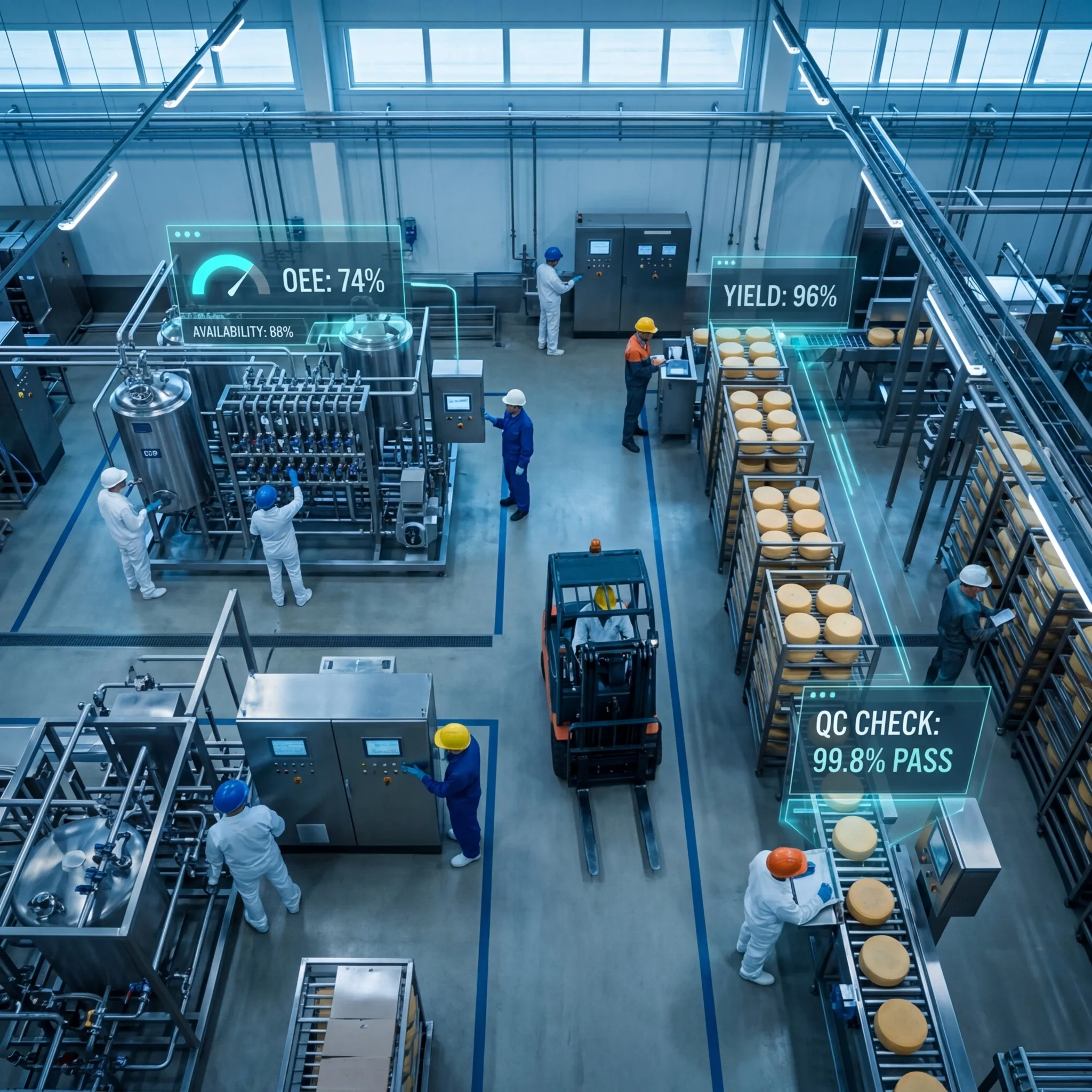
Overall Equipment Effectiveness (OEE) = Availability x Performance x Quality
- Availability: % of planned production time equipment actually runs
- Performance: Speed of production vs. maximum capability
- Quality: % of defect-free products produced
Example: A CIP system runs 92% of planned time (downtime), achieves 85% of target speed (performance loss), and produces 91% conforming product (quality loss). OEE = 92% x 85% x 91% = 71%
Industry benchmark: 70-75% for food manufacturing. Top performers: 80%+
Yield % = (Actual Output / Expected Output) x 100
Example: Production plan targets 10,000 units. Actual output: 9,500 units. Yield = 95%.
Industry benchmark: 92-96% depending on product complexity.
Tier 2: Quality Metrics (Customer Satisfaction)
These measure product quality and customer experience:
First-Pass Yield (FPY) = Units passing inspection without rework / Total units produced
Example: 500 units produced, 475 pass inspection without rework. FPY = 95%.
Industry benchmark: 95%+ for food manufacturing.
Defect Rate = (Defective units / Total units produced) x 100
Example: 10 defective units out of 10,000 produced. Defect rate = 0.1%.
Industry benchmark: Under 0.5% for food products.
On-Time Delivery Rate = (Orders delivered on time / Total orders) x 100
Example: 98 of 100 orders delivered on schedule. OTDR = 98%.
Industry benchmark: 95%+.
Tier 3: Cost Metrics (Financial Reality)
Cost per Unit = Total Production Cost / Units Produced
Example: $500K monthly production cost / 100K units = $5 per unit.
Industry benchmark: Varies by product, but track trend for improvement.
Scrap and Waste % = (Scrap cost / Total production cost) x 100
Example: $50K scrap / $500K production cost = 10% scrap.
Industry benchmark: 2-5% for food manufacturing. Under 2% is excellent.
The Tracking Discipline
Effective KPI tracking requires:
- Daily measurement: Production metrics measured daily; roll up to weekly/monthly
- Transparent dashboards: Visual display showing actual vs. target
- Accountability: Individual owner for each KPI (plant manager, production supervisor)
- Action triggers: Defined action when KPI drops below threshold (meeting, root cause analysis, corrective action)
Example: When OEE falls below 70%, automatic escalation occurs. Root cause analysis identifies issue. Corrective action proposed within 48 hours.
Why KPIs Matter for PE Investors
PE firms evaluate targets based on operational KPI improvements. A seller showing stable OEE at 75% provides confidence. A seller with declining OEE suggests problems.
For food manufacturing companies, establishing KPI frameworks and tracking discipline demonstrates operational maturity while providing the leading indicators to catch and fix problems before they damage financial performance.