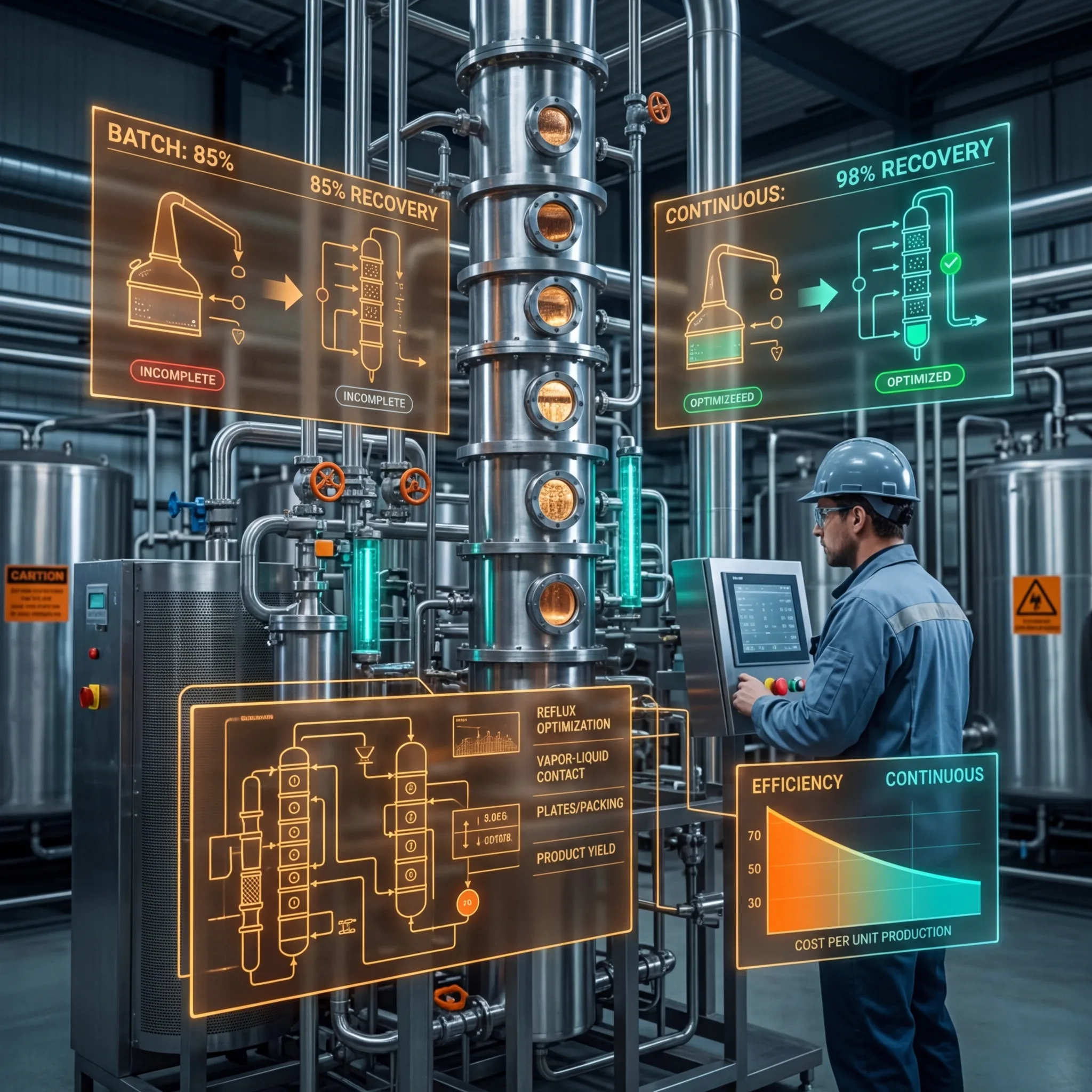
A spirits distillery operates inefficient batch distillers with low ethanol recovery. Result: Product yield only 85%. Feedstock cost excessive. Profit margin compressed.
A modern distillery installs continuous column distiller with reflux optimization. Recovery improves to 98%. Cost per unit production drops 15%. Profitability increases significantly.
Distillation equipment selection directly impacts product recovery, energy efficiency, and production economics.
The Distillation Framework
Core Principle: Boiling Point Difference
Components separate based on different boiling points. Lower boiling point liquid vaporizes first, is captured, then condensed.
Key Parameters:
- Feed composition: % ethanol (or target component)
- Reflux ratio: Separation efficiency vs. energy cost
- Plates/packing: Surface area for vapor-liquid contact
- Column height: More stages = better separation
- Temperature: Must be precisely controlled
Batch Distillation System
Design Process:
- Charging: Load liquid into still (pot)
- Heating: Apply heat (steam jacketed kettle)
- Vaporization: Lower boiling point liquid boils first
- Condensation: Vapor passes through condenser into liquid
- Collection: Collect distillate (purified component)
Batch Timeline:
- Charging: 30 minutes
- Heating to boil: 30 minutes
- Distillation run: 2-4 hours
- Cooling: 30 minutes
- Total per batch: 3.5-5 hours
Capacity Example:
- Batch size: 500 L wine (10% ethanol)
- Ethanol recovered: 50 L pure ethanol (98% recovery)
- Batches/day: 3-4 (with cooling)
- Daily production: 150-200 L ethanol
Advantages:
- Simple, low capital cost
- Easy product changeover
- Batch traceability
Disadvantages:
- High labor requirement
- Intermittent operation
- Energy-intensive (repeated heating/cooling)
Continuous Distillation Column
Design Process:
Column contains:
- Reboiler: Bottom section (heating, vaporization)
- Column body: Middle section (multiple plates or packing)
- Condenser: Top section (vapor condensation)
- Reflux: Portion of condensed product returned to column for better separation
Separation Theory:
More vapor-liquid contact = better separation
- Simple still: 1 theoretical plate (poor separation)
- Batch with packing: 10-20 theoretical plates (good)
- Continuous column: 50-100+ theoretical plates (excellent)
Reflux Ratio Impact:
| Reflux Ratio | Separation Quality | Energy Cost | Throughput |
|---|---|---|---|
| 1:1 | Moderate | Low | High |
| 5:1 | Good | Moderate | Moderate |
| 10:1 | Excellent | High | Low |
Design selection: Balance separation quality with energy/economics
Continuous Operation:
- Constant feed rate: 50-200 L/hour (depending on column)
- Product removal: Continuous distillate stream
- Residue removal: Continuous bottoms stream
- Daily production: 500-2,000 L/day (50-100x batch capacity)
Advantages:
- High throughput
- Consistent product quality
- Lower energy per unit (steady state)
- Minimal labor
Disadvantages:
- Higher capital cost ($50K-500K+)
- Complexity (instrumentation, control)
- Startup/shutdown procedures
Heat Integration
Energy Recovery:
Condenser removes significant heat (~1 kW per 10 L ethanol recovered)
Options:
- Jacket heating next charge: Use condenser heat for preheating
- Heat exchanger: Recover heat for facility use
- Refrigeration: Remove heat cost to waste
ROI: Heat recovery systems pay back in 1-2 years on large operations
Equipment Comparison
| Factor | Batch Pot | Batch Column | Continuous |
|---|---|---|---|
| Capital Cost | Low ($5-20K) | Moderate ($20-100K) | High ($100-500K) |
| Throughput | 100-200 L/day | 200-500 L/day | 500-2,000+ L/day |
| Separation Efficiency | 85-90% | 90-96% | 96-98%+ |
| Energy/Unit | High | Moderate | Low |
| Labor/Day | 4 hours | 3 hours | 1-2 hours |
| Payback Period | -- | 2-3 years | 2-4 years |
Regulatory Considerations
Ethanol Recovery:
- Permits required (ATF, state alcohol board)
- Proof measurement requirements (specific gravity)
- Documentation for tax purposes
- Safe handling procedures
Environmental:
- Wastewater disposal (residue)
- Vapor emissions control
- Energy efficiency standards
For food and beverage manufacturers, proper distillation equipment selection maximizes product recovery, optimizes energy efficiency, and enables consistent quality.