Traditional food manufacturer: Transactional relationships. Sell products to customers. Limited communication. Low repeat rates.
Customer-centric company: Deep relationships. Understand customer needs. Provide solutions. Build loyalty. High lifetime value.
Same market. Customer-centric approach generates 40% higher lifetime value per customer.
The Customer-Centric Framework
Foundation: Understanding Customer Needs
Segment customers by:
- Purchasing patterns (volume, frequency, product mix)
- Strategic importance (revenue contribution, growth potential)
- Relationship maturity (new, established, strategic partners)
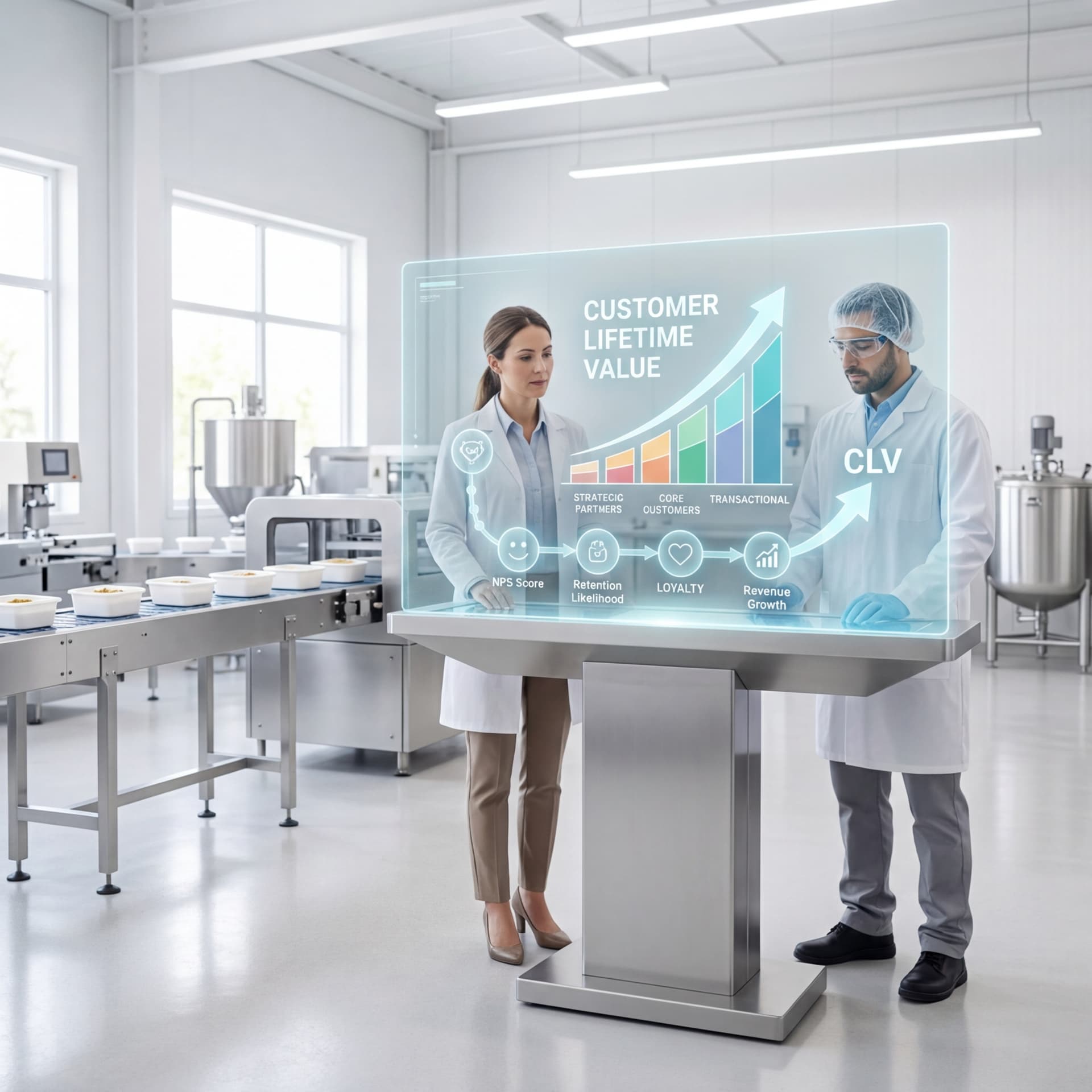
- Satisfaction level (NPS score, retention likelihood)
Example segmentation for $50M food manufacturer:
| Segment | Count | Revenue | Value | Strategy |
|---|---|---|---|---|
| Strategic Partners | 5 | $15M | High | Deep partnerships, innovation |
| Core Customers | 25 | $25M | Medium | Account management, growth |
| Transactional | 100 | $10M | Low | Efficient service |
Customer Lifetime Value (CLV) Model
Calculate value each customer segment generates over relationship:
Strategic Partner CLV:
- Annual revenue: $3M
- Relationship duration: 10 years
- Margin: 18%
- Lifetime profit: $3M x 10 years x 18% = $5.4M
- Investment justified: $500K account management = 9x ROI
Core Customer CLV:
- Annual revenue: $1M
- Relationship duration: 8 years
- Margin: 15%
- Lifetime profit: $1M x 8 years x 15% = $1.2M
- Investment justified: $150K per customer = 8x ROI
Transactional Customer CLV:
- Annual revenue: $100K
- Relationship duration: 3 years
- Margin: 12%
- Lifetime profit: $100K x 3 years x 12% = $36K
- Investment: $5K (efficient service) = 7x ROI
Building Customer Loyalty
Tier 1: Product Quality and Reliability (Table Stakes)
- Consistent, quality products
- On-time, accurate delivery
- Responsive customer service
- Compliance and safety
Tier 2: Partnership and Collaboration
- Account manager assigned
- Regular business reviews
- Joint planning and forecasting
- Early communication on changes
Tier 3: Innovation and Solutions
- Co-develop new products aligned to customer needs
- Technical support and problem-solving
- Data sharing enabling customer optimization
- Thought leadership on trends
Tier 4: Exclusive Relationship
- Long-term contracts providing security
- Preferred pricing rewarding loyalty
- Exclusive products/services unavailable to competitors
- Executive-level relationships
Loyalty Program Framework
Recognition Program:
- Tiered recognition (Silver, Gold, Platinum)
- Tied to volume, growth, partnership contributions
- Annual awards and celebrations
- Executive visibility and involvement
Financial Incentives:
- Volume discounts (higher volume = lower price)
- Growth bonuses (if customer grows 15%+, additional 2% discount)
- Payment term improvements (Net 60 vs. Net 30)
- Exclusive product access
Relationship Deepening:
- Account manager assigned (Gold tier)
- Quarterly business reviews
- Monthly contact and updates
- Executive visits
Measuring and Improving Loyalty
Key Metrics:
- Customer Retention Rate (target: 95%+)
- Net Promoter Score (NPS, target: 50+)
- Customer Lifetime Value
- Share of wallet (% of customer spend with us vs. competitors)
- Time between repeat purchases
- Average order value growth
Improvement Actions:
- Quarterly satisfaction surveys
- Annual strategy updates
- Proactive problem-solving
- Innovation in products/services
- Competitive response to threats
Financial Impact
Improving customer loyalty and CLV:
- Average CLV increase: 20-30%
- Retention improvement: 10%
- Customer acquisition cost reduction: 15% (referrals)
- Revenue per customer growth: 25%
For $50M food manufacturer with 100 core customers:
- Current CLV: $1M average = $100M total
- Improved CLV: $1.25M average = $125M total
- 5-year additional profit: $25M x 15% margin = $3.75M
For food manufacturing companies, customer-centric operations building loyalty and lifetime value generate sustainable revenue growth and competitive advantage.