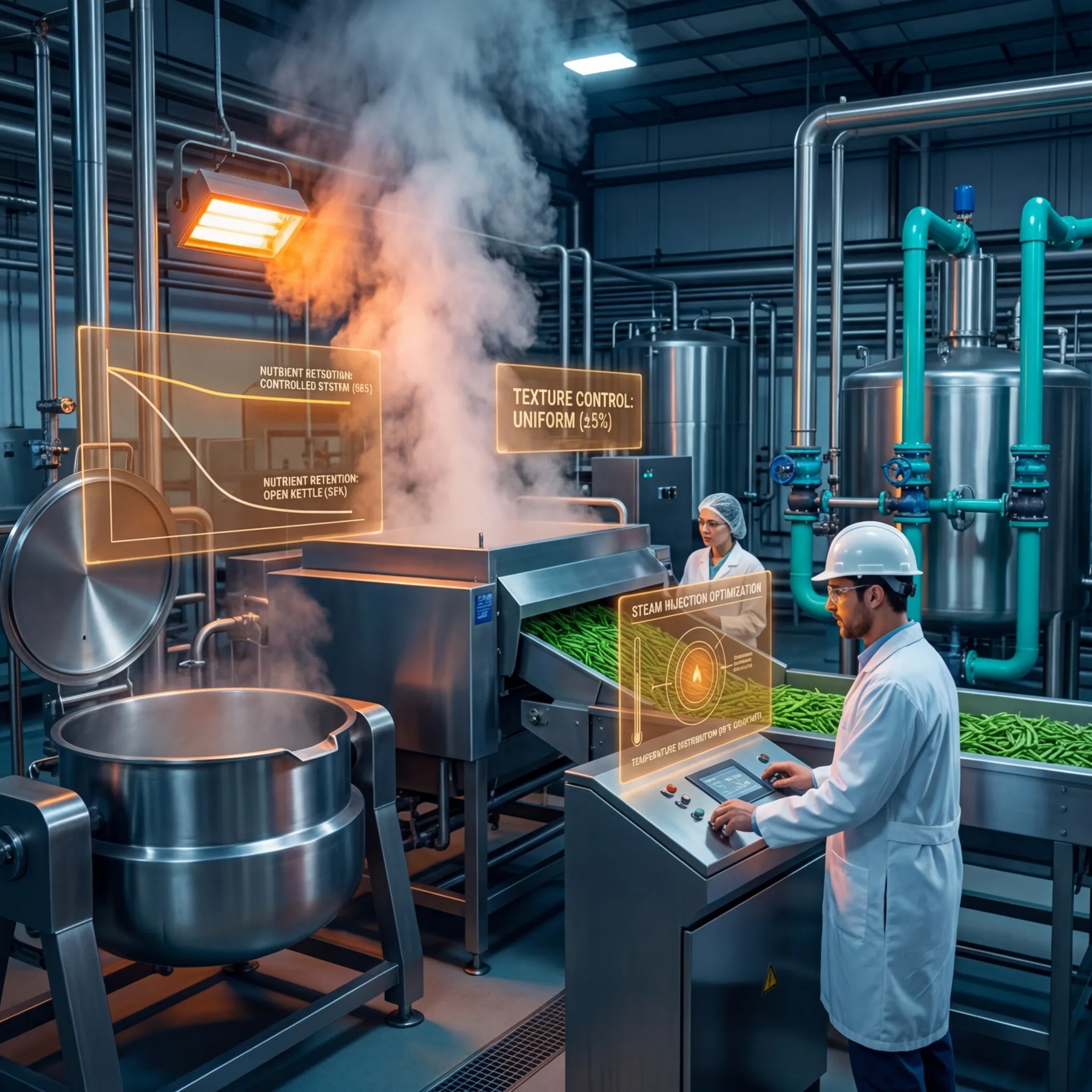
A vegetable processor uses open kettle cooking. Result: Uneven heating, excessive overcooking on surface, undercooking inside. Nutrient loss excessive. Texture variable.
A compliant processor installs steam-jacketed kettle with stirring system. Heat distribution uniform. Cooking time reduced 30%. Nutrient retention improved. Texture consistent.
Cooking and blanching equipment selection directly impacts product quality and nutrient preservation.
The Cooking Framework
Core Processes:
-
Blanching: Brief thermal treatment (inactivate enzymes, soften)
- Temperature: 70-100 degrees C
- Time: 1-5 minutes
- Purpose: Preserve color, flavor, texture; reduce microbial load
-
Cooking: Thorough thermal treatment (product consumption)
- Temperature: 80-100 degrees C (or higher for pressure cooking)
- Time: 10-60 minutes
- Purpose: Develop flavor, improve digestibility, preserve
Heat Transfer Mechanisms
Conduction: Direct contact (metal kettle bottom)
- Slowest, non-uniform
- Risk: Burning at contact surface
Convection: Stirring distributes heat
- Better uniformity
- Prevents localized overheating
Steam Injection: Direct steam into product
- Fastest, most uniform
- No burns, rapid heating
Equipment Types
Open Kettle (Steam-Jacketed):
Design: Metal vessel with steam-filled jacket for heating
Applications: Vegetable cooking, sauce preparation
- Capacity: 50-1,000 L typical
- Heating time: 20-40 minutes (depends on jacket area)
- Temperature control: Manual thermostat or PLC
- Stirring: Manual or mechanical paddle
Advantages:
- Simple, reliable
- Easy product changeover
- Good for batch processing
Disadvantages:
- Slower heating (conduction through jacket)
- Non-uniform if not stirred adequately
- Manual monitoring required
Continuous Steamer (Belt or Screw Conveyor):
Design: Enclosed conveyor belt through steam chamber
Applications: Vegetable blanching, pasta cooking
- Throughput: 100-1,000 kg/hour
- Temperature: 70-100 degrees C (adjustable)
- Residence time: 30 seconds to 5 minutes (adjustable)
- Capacity utilization: Continuous (high productivity)
Advantages:
- High throughput
- Consistent residence time
- Reduced nutrient loss (shorter time)
Disadvantages:
- High capital cost ($50K-200K)
- Complex operation
- Limited product flexibility
Direct Steam Injection Cooker:
Design: Steam injected directly into product, rapid heating
Applications: Soup, sauce, liquid products
- Heating time: 2-5 minutes (very fast)
- Temperature rise: Can heat to 100 degrees C in seconds
- Advantage: Minimal nutrient loss (brief exposure)
Energy Efficiency: 20-30x more efficient than steam jacket (direct transfer)
Temperature Control Strategies
Manual Control (Batch):
- Operator monitors temperature
- Adjusts steam valve as needed
- Cost: Low, labor: High
- Consistency: Variable
Thermostat Control (Batch):
- Sensor triggers steam valve on/off
- Maintains setpoint temperature
- Cost: Moderate, labor: Low
- Consistency: Good (+/-2 degrees C)
PLC with Feedback (Continuous):
- Continuous temperature monitoring
- Proportional valve adjustment
- Maintains setpoint precisely
- Cost: Higher, labor: Minimal
- Consistency: Excellent (+/-0.5 degrees C)
Nutrient Preservation
Heat Sensitivity (Ranked by Loss):
| Nutrient | Loss Rate | Target Limit |
|---|---|---|
| Vitamin C | Very high (50%+ per min at 100 degrees C) | Under 10 min exposure |
| B Vitamins | High (30-40% per 20 min) | Under 30 min |
| Carotenoids | Moderate (20% per 30 min) | Under 30 min |
| Proteins | Low (denaturation, not loss) | Under 60 min |
| Minerals | Low (not degraded by heat) | No limit |
Optimization:
- Minimize cooking time
- Use highest temperature practical (faster = shorter exposure)
- Steam injection is better than steam jacket, which is better than water immersion (in terms of speed)
Process Parameters Example (Broccoli Blanching)
| Parameter | Value | Reason |
|---|---|---|
| Temperature | 95 degrees C | High temp = short time |
| Time | 3 minutes | Quick inactivation of enzymes |
| Method | Steam injection | Fastest heating |
| Cooling | Immediate ice bath | Stop cooking, preserve quality |
| Nutrient retention | 85-90% vitamin C | Vs. 50% with slow kettle method |
Equipment Selection Decision Tree
For small batch (50-200 L, variable products): Use steam-jacketed kettle with stirring
For high volume (over 500 kg/hour, consistent product): Use continuous steamer with PLC control
For rapid heating (soup, sauces): Use direct steam injection system
For food manufacturers, proper cooking equipment selection optimizes product quality, nutrient retention, and operational efficiency.