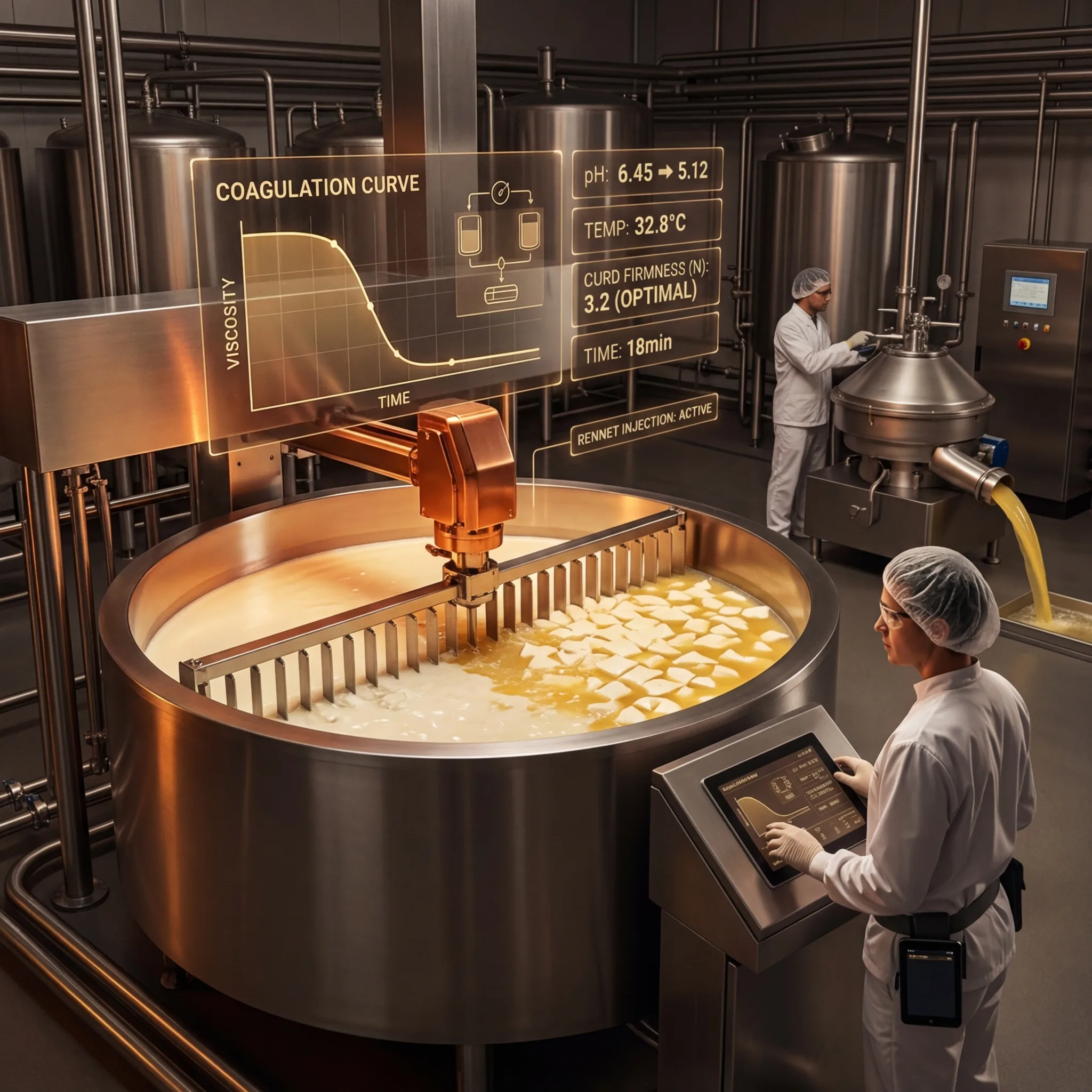
A small cheese maker uses traditional methods: Add rennet, wait for coagulation, cut curds by eye estimate. Result: Inconsistent curd formation. Variable whey separation. Yield 8-10%. Product quality inconsistent.
A modern facility uses precise coagulation control: Measure pH, temperature, enzyme activity. Cut curds at exact firmness (validated texture). Separate whey mechanically. Yield 12-15%. Product consistency excellent. Premium cheese reputation built.
Coagulation and whey separation directly impact cheese yield and quality.
The Cheese Coagulation Framework
Principle:
Milk proteins (casein) coagulate (solidify) through two mechanisms:
Mechanism 1: Acid Coagulation
- Add acid (lactic acid from bacteria or citric acid)
- Lowers pH (target: 4.6-5.0)
- Casein precipitates (becomes solid)
- Time: 30 minutes - 2 hours
Mechanism 2: Enzyme Coagulation
- Add rennet (contains chymosin enzyme)
- Enzyme cuts casein protein (K-casein)
- Clots form (soft gel, 15-40 minutes)
- Temperature critical (optimal: 30-40 degrees C)
Typical Process (Hard Cheese - Cheddar Example):
- Heat milk to 30 degrees C (enzyme works best)
- Add cultures (Lactococcus lactis): Start acid production
- Add rennet: Start protein coagulation
- Wait 30-40 minutes: Curd forms (soft jelly texture)
- Test curd firmness: Cut when ready
- Cook curds: Stir while heating to 38-40 degrees C
- Drain whey: Separate curds from liquid
- Salt and mold: Shape into blocks
- Age: 3-24 months (develop flavor)
Coagulation Monitoring
Firmness Assessment:
Traditional: "Clean break" test
- Insert knife into curd mass
- Break curd by hand (should break cleanly)
- Indicates proper firmness for cutting
Modern: Texture analysis (rheological testing)
- Measure gel firmness (exact force needed to break)
- Precise timing for optimal cutting
- Consistency batch-to-batch
Timing Variation:
Coagulation time affected by:
- Temperature: Warmer = faster (+/-5 degrees C can change time 50%)
- Rennet concentration: More enzyme = faster
- Milk pH: Affects enzyme speed
- Milk composition: Variable fat/protein
Whey Separation Process
Cutting and Cooking:
-
Cut curds: 1-2 cm cubes (size affects moisture)
- Larger cubes: Wetter curds (higher moisture cheese)
- Smaller cubes: Drier curds (lower moisture cheese)
-
Cook curds: Heat while stirring (38-40 degrees C typical)
- Heat gradually (1 degree C per minute)
- Stirring prevents matting/clumping
- Time: 30-60 minutes
-
Drain whey: Remove liquid through cloth
- Drain immediately after cooking
- Drain temperature: Still hot (over 35 degrees C)
- Efficiency: 90-95% whey removal
Whey Composition
What's in Whey:
| Component | Amount | Value |
|---|---|---|
| Lactose | 5% | Feed/biofuel production |
| Whey proteins | 0.6-0.8% | Isolate for products |
| Minerals | 0.5% | Nutrient value |
| Water | 93% | Bulk |
Whey Byproduct Value:
- Whey protein: Premium ingredient ($3-8/lb isolate)
- Lactose: Animal feed, fermentation ($0.20-0.50/lb)
- Whey powder: Infant formula, supplements ($1-3/lb)
- Total value: $0.15-0.40 per lb cheese (significant)
Yield Calculation
Example: Cheddar Cheese from Milk
Raw milk input: 100 kg (3.6% fat, 3.2% protein)
- Fat content: 3.6 kg (all goes to cheese)
- Protein: 3.2 kg (most goes to cheese)
- Water: Approximately 50-60% of finished cheese
Traditional yield: 8-10% (8-10 kg cheese per 100 kg milk) Modern optimized: 12-15% (12-15 kg cheese per 100 kg milk) Premium: 15-20% (with optimized process)
Improvement: +50% yield increase = +50% margin improvement
Cost-Benefit
| Factor | Impact |
|---|---|
| Coagulation monitoring equipment | $50-150K |
| Whey processing system | $100-300K |
| Total capital | $150-450K |
| Yield improvement | 8% to 15% (+87.5%) |
| Byproduct revenue | Whey proteins (+$0.20/lb cheese) |
| Quality improvement | Consistency, premium positioning |
| Payback | 2-4 years |
For cheese makers, precise coagulation and whey separation optimization dramatically increases yield and enables premium quality positioning.