A dairy manufacturer uses gravity settling to separate cream from milk. Result: Process takes 12 hours. Space requirement enormous. Microbial growth risk during long holding times.
A compliant manufacturer installs disc stack separator. Separation completes in minutes. Space reduced 90%. Microbial safety improved. Throughput increases 50%.
Centrifugation equipment selection directly impacts separation efficiency, product quality, and facility footprint.
The Centrifugation Framework
Core Principle: Force Multiplication
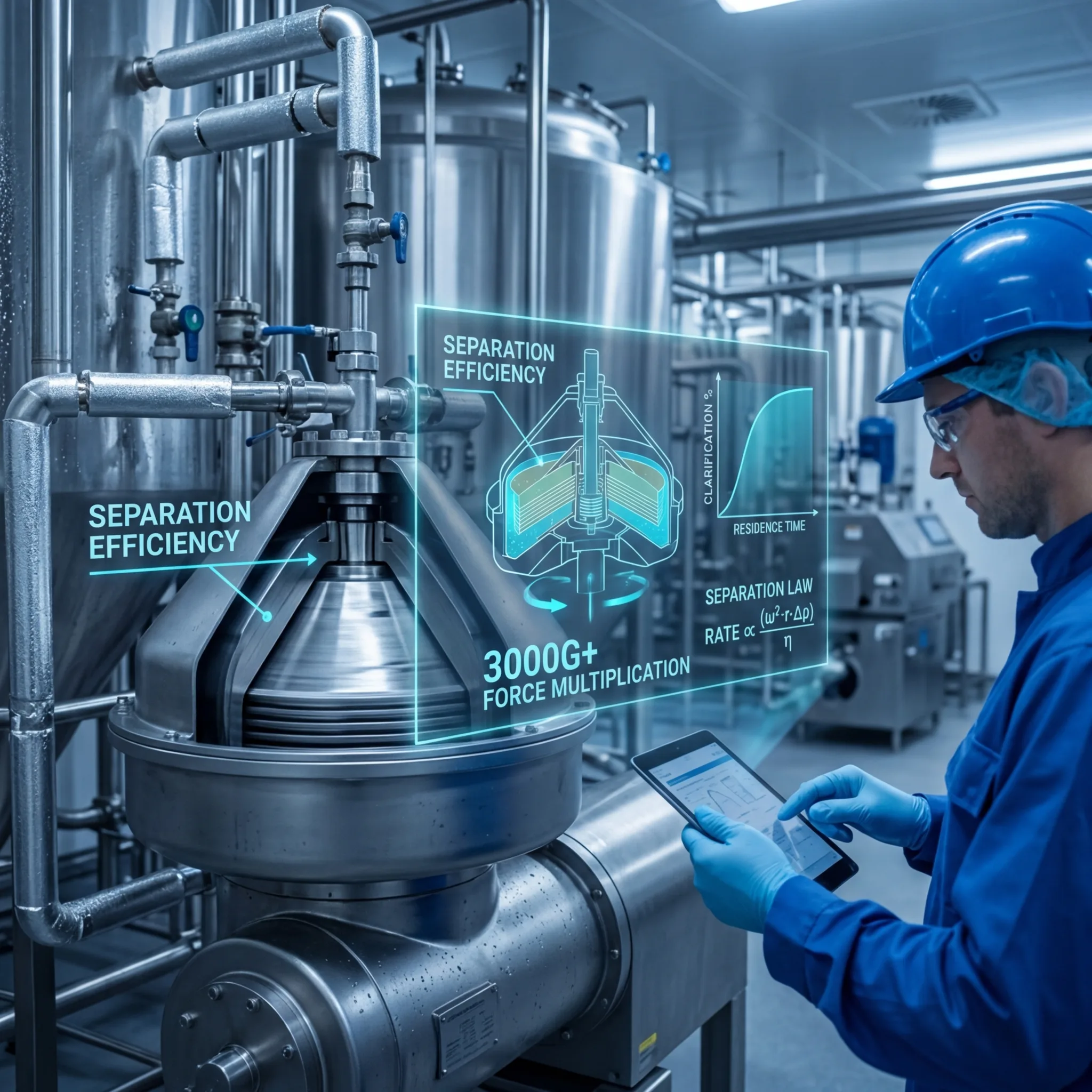
Gravity alone (1x G-force) separates slowly. Centrifugation multiplies this force 1,000-3,000x, enabling rapid separation.
Separation Law: Separation rate is proportional to (w2 x r x density difference) / viscosity
Where:
- w = rotational speed (rpm)
- r = radius to particle
- Density difference = density difference between phases
- Viscosity = fluid viscosity
Practical Application: Increase centrifugal force = faster separation = shorter residence time
Centrifugation Equipment Types
Disc Stack Separator (Liquid-Liquid Separation):
Design: Rotating bowl containing stacked conical discs (clarifier design)
- G-force: 3,000-10,000 G typical
- Throughput: 100-10,000 L/hour (depending on model)
- Application: Cream/milk separation, oil/water clarification, de-sludging
- Separation principle: Discs create many thin separation layers, enabling compact design
Separation Efficiency:
- Milk to cream: Remove fat globules (95%+ separation)
- Clarity: Reduce particles to under 1% original level
- Microbes: ~50% removal (not sterile, requires downstream treatment)
Decanter Centrifuge (Solid-Liquid Separation):
Design: Long horizontal bowl with internal scroll conveyor
- G-force: 1,000-3,000 G
- Throughput: 1-100 tons/hour (high capacity)
- Application: Sludge dewatering, yeast recovery, fiber separation
- Principle: Solids settle on bowl wall, scroll conveys to discharge
Basket Centrifuge (Batch Separation):
Design: Vertical rotating basket with fixed housing
- Application: Batch processing, filtration
- Throughput: 50-500 kg per batch
- Time: 3-10 minutes per batch
- Use case: Small-scale or specialty products
Separation Parameters and Design
Clarification Target:
For milk separation:
- Input: Whole milk (3.5-4% fat, turbid)
- Output (cream): 35-40% fat, creamy
- Output (skimmed milk): under 0.05% fat, clear
Settling Rate Calculation:
Stokes Law: v = (2 x r2 x g x density difference) / (9 x viscosity)
Example - cream separation:
- Fat globule size: 4 um diameter
- Density difference: 0.1 g/mL (cream vs. milk)
- Viscosity: 1.2 cP (milk)
- Gravity settling: ~0.001 mm/second (extremely slow)
- Centrifugation (5,000 G): ~5 mm/second (5,000x faster)
Residence Time Impact:
| Separation Method | Residence Time | Throughput | Space | Microbes |
|---|---|---|---|---|
| Gravity (12 hrs) | 12 hours | 10 L/hr | Large | Growth risk |
| Centrifuge (1 min) | 1 minute | 500 L/hr | Compact | Reduced |
Critical Design Considerations
1. Material Selection:
- Bowl: Stainless steel (316L preferred)
- Scroll: Specialized alloy (wear resistance)
- Seals: EPDM or specialty materials
2. Temperature Control:
- Centrifugation generates heat (friction)
- Temperature rise: 5-20 degrees C possible during separation
- Risk: Thermosensitive products (proteins, vitamins)
- Solution: Heat-jacketed bowl, cooling via baffle system
3. Back Pressure:
- Product pressure increases with separation force
- Back pressure management: Differential bowl speed, weight balance
- Improper balance leads to product leakage
4. Washing and CIP:
- Residual product in discs: Contamination risk
- CIP procedure: Spray wash, chemical cleaning, cold rinse
- Validation: ATP testing post-clean (under 100 RLU)
Operation and Maintenance
Startup Procedure:
- Load product feed rate gradually (5-10 min ramp)
- Monitor G-force development (gradual acceleration)
- Reach target speed and G-force
- Monitor discharge quality
- Stop rate: Gradual deceleration (prevent product splashing)
Vibration and Balance:
- Imbalanced load leads to vibration
- Excessive vibration leads to bearing wear, seal failure
- Prevention: Load balance check, dynamic balancing before operation
Seal Maintenance:
- Seals prevent product leakage during rotation
- Failure mode: Product leak leading to contamination, loss of product
- Maintenance: Replace seals every 500-1,000 operating hours
- Cost: $1,000-3,000 per replacement
Equipment Selection Criteria
| Parameter | Milk | Juice | Oil | Consideration |
|---|---|---|---|---|
| G-force | 5,000-10,000 | 2,000-5,000 | 1,000-3,000 | Density difference |
| Throughput | 500-2,000 L/h | 100-500 L/h | 1-50 T/h | Particle size |
| Residence Time | 1-2 min | 2-5 min | 5-15 min | Efficiency target |
| Temp Control | Essential | Important | Moderate | Product sensitivity |
Troubleshooting Common Issues
-
Poor Separation Clarity: Discs blocked or G-force insufficient
- Solution: Clean discs, increase bowl speed
-
Product Leakage: Worn seals or overpressure
- Solution: Replace seals, adjust back pressure
-
Vibration/Noise: Imbalanced feed or bearing wear
- Solution: Check load distribution, service bearings
For food manufacturing companies, proper centrifugation equipment selection enables rapid separation, improves product quality, and optimizes facility utilization.